What it is
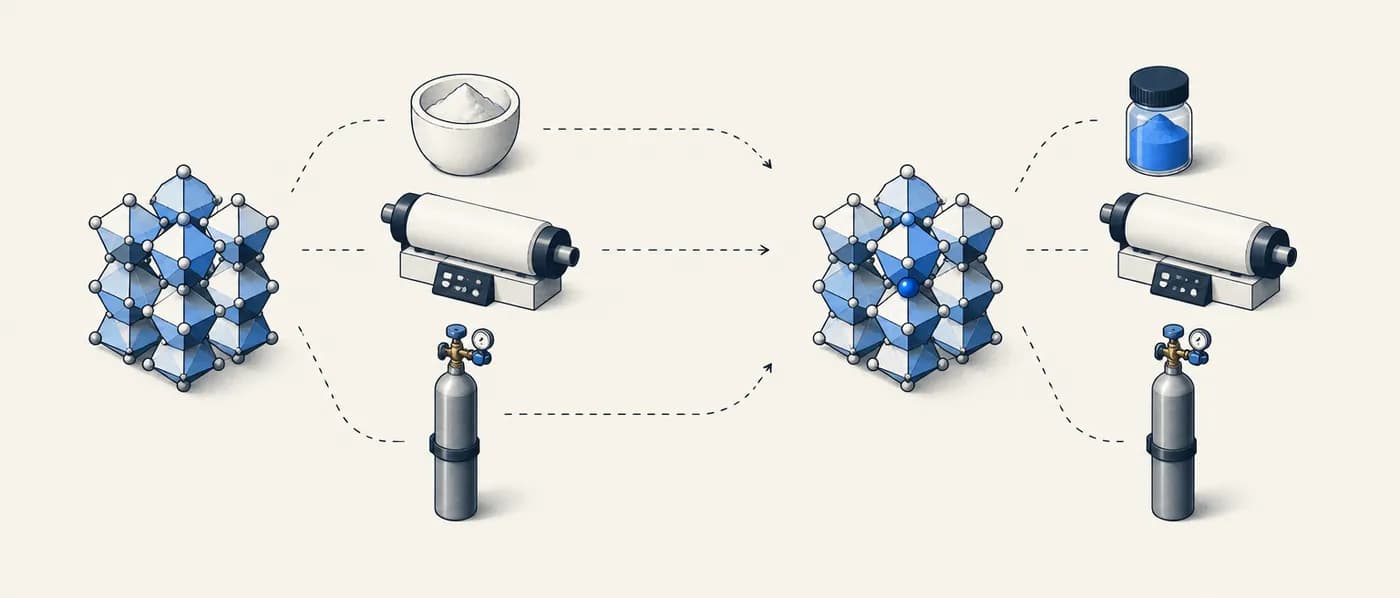
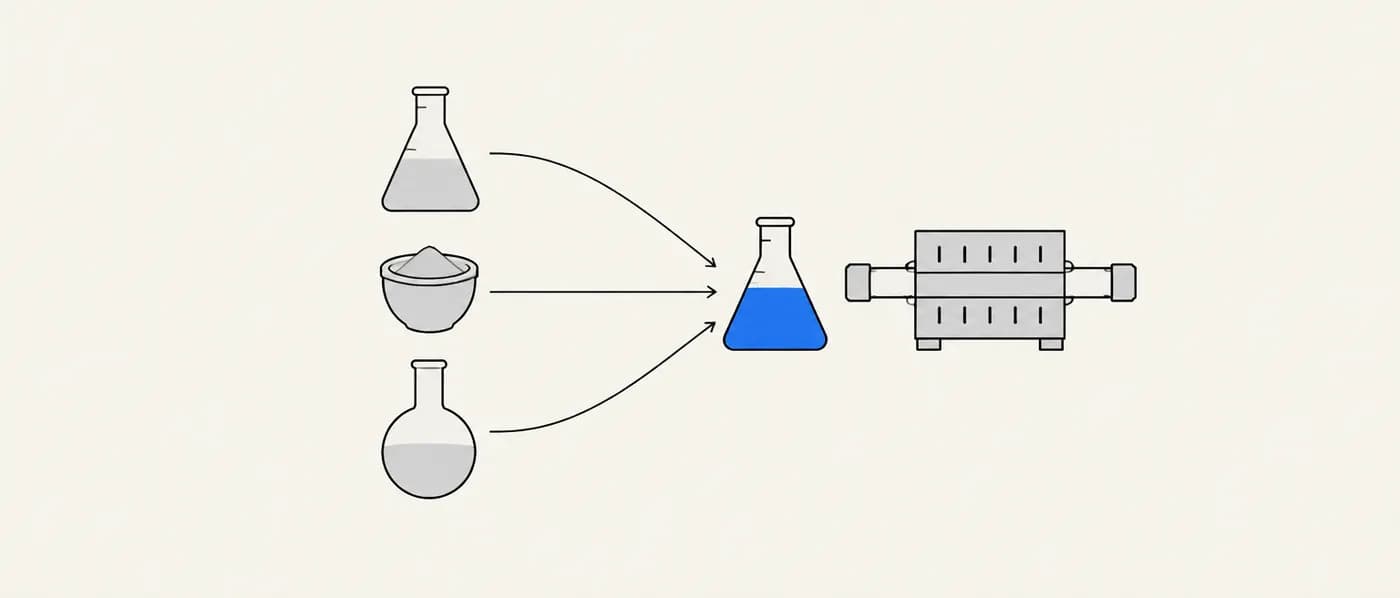
Synthesis by analogy is the way experienced solid-state chemists actually plan a first attempt at a new material. Instead of deriving conditions from first principles — which is rarely possible for inorganic solids — they find materials that are similar in structure and chemistry, look at how those were made, and adapt the recipe: swap one precursor, keep the atmosphere that protects the oxidation state, start the temperature scan where the analogues worked.
Large text-mined recipe datasets have made this systematic. Kononova and co-workers extracted nearly 20,000 solid-state synthesis recipes from the literature, and later work showed that recommending precursors based on similarity to known targets can reproduce many of the precursor choices chemists actually made. Autonomous labs such as the A-Lab reported by Szymanski and co-workers in 2023 used literature-trained models of this kind to propose first recipes for their target compounds.
Analogy gives a starting point, not a guaranteed route. Each analogue was optimised for its own chemistry, and the target may need different conditions because of differing volatility, melting points, reaction pathways or competing phases.
Why it matters for R&D decisions
Synthesis is usually the bottleneck between a computed candidate and real data. A first attempt chosen by analogy is far more likely to produce the target phase than one chosen arbitrarily, and the set of analogues gives a defensible temperature and atmosphere window. That turns ‘can we make it?’ from an open question into a small, planned set of experiments.
How to apply it, step by step
- 1Define what must be preserved
List the structure type, the oxidation states of each element and any sensitive species (for example Fe²⁺, volatile Li or Na, air-sensitive sulfides). These constraints decide which analogues are relevant and which atmosphere you need.
- 2Find the nearest analogues
Search for materials with the same structure family and similar chemistry: substitute one element at a time (Fe → Mn, Zr → Hf, O → S) and look for reported syntheses. Prefer analogues that share the same structure and the same oxidation-state chemistry over ones that only share elements.
- 3Extract a recipe envelope, not a single recipe
Pull three to five recipes and tabulate precursors, mixing method, calcination and sintering temperatures, times and atmospheres. The range across analogues is your starting window; a single paper’s value is just one point.
- 4Adapt for the target’s differences
Adjust for known differences: a precursor that decomposes at a different temperature, a more volatile element that needs excess, a more easily oxidised cation that needs a more reducing atmosphere. Write down each adaptation and why.
- 5Plan a small scan and characterise
Run a short temperature (and if needed atmosphere) scan inside the window, check phase purity by X-ray diffraction after each step, and use what you learn to narrow conditions. Design of experiments helps once the right phase forms.
Worked examples
LiMnPO₄ by analogy with LiFePO₄
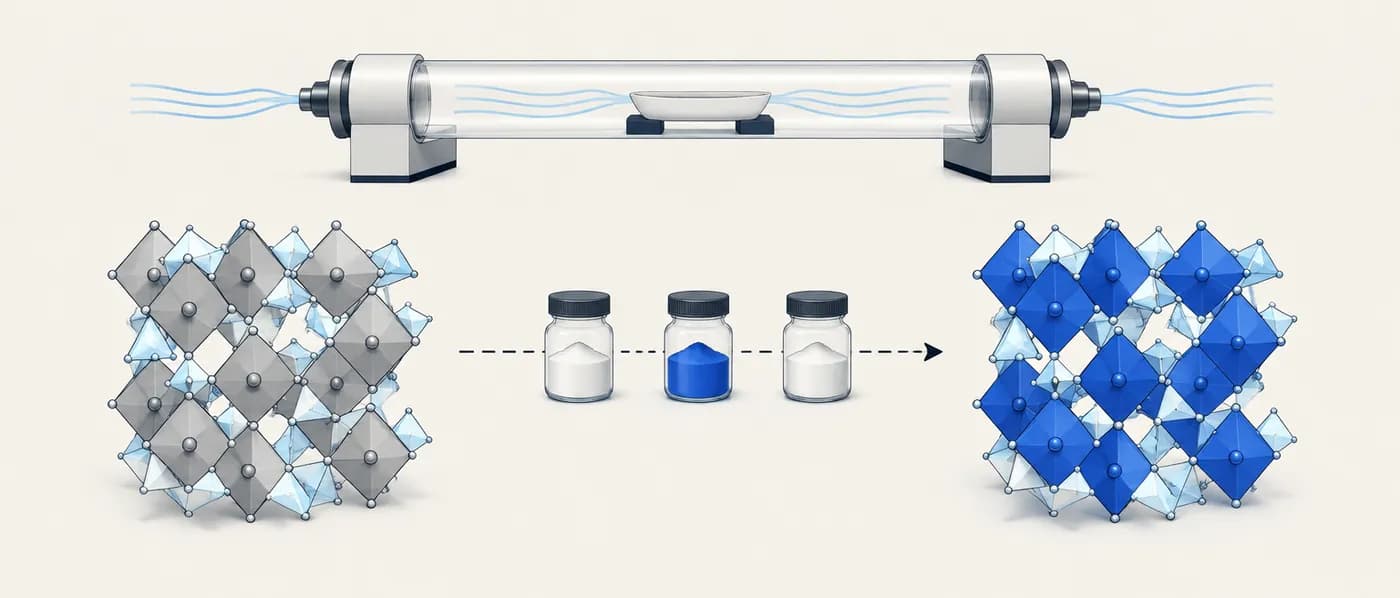
Target: olivine LiMnPO₄. Closest well-documented analogue: olivine LiFePO₄, commonly made by solid-state reaction of Li₂CO₃, iron(II) oxalate dihydrate and NH₄H₂PO₄ under inert gas.
- 01Keep the structure family (olivine) and the 2+ transition-metal oxidation state; swap FeC₂O₄·2H₂O for MnC₂O₄·2H₂O.
- 02Stoichiometry for 10.0 g LiMnPO₄ (M = 6.94 + 54.94 + 30.97 + 4 × 16.00 = 156.85 g/mol): n = 10.0 / 156.85 = 0.0638 mol.
- 03Li₂CO₃ (73.89 g/mol), 0.5 mol per mol product: 0.0319 × 73.89 = 2.36 g.
- 04MnC₂O₄·2H₂O (178.99 g/mol), 1:1: 0.0638 × 178.99 = 11.41 g. NH₄H₂PO₄ (115.03 g/mol), 1:1: 0.0638 × 115.03 = 7.33 g.
- 05Atmosphere: keep inert gas as for LiFePO₄ to protect Mn²⁺ during precursor decomposition. Temperature: start from the LiFePO₄ window (commonly reported around 600–800 °C) and scan, checking XRD for Mn₂P₂O₇ or Li₃PO₄ impurities.
- 06Anticipate a known difference: LiMnPO₄ has lower electronic conductivity than LiFePO₄, so plan carbon coating and small particle size from the start.
Swap one thing at a time and keep the conditions that protect the oxidation state you need.
Doped garnet electrolyte: compensating for lithium loss
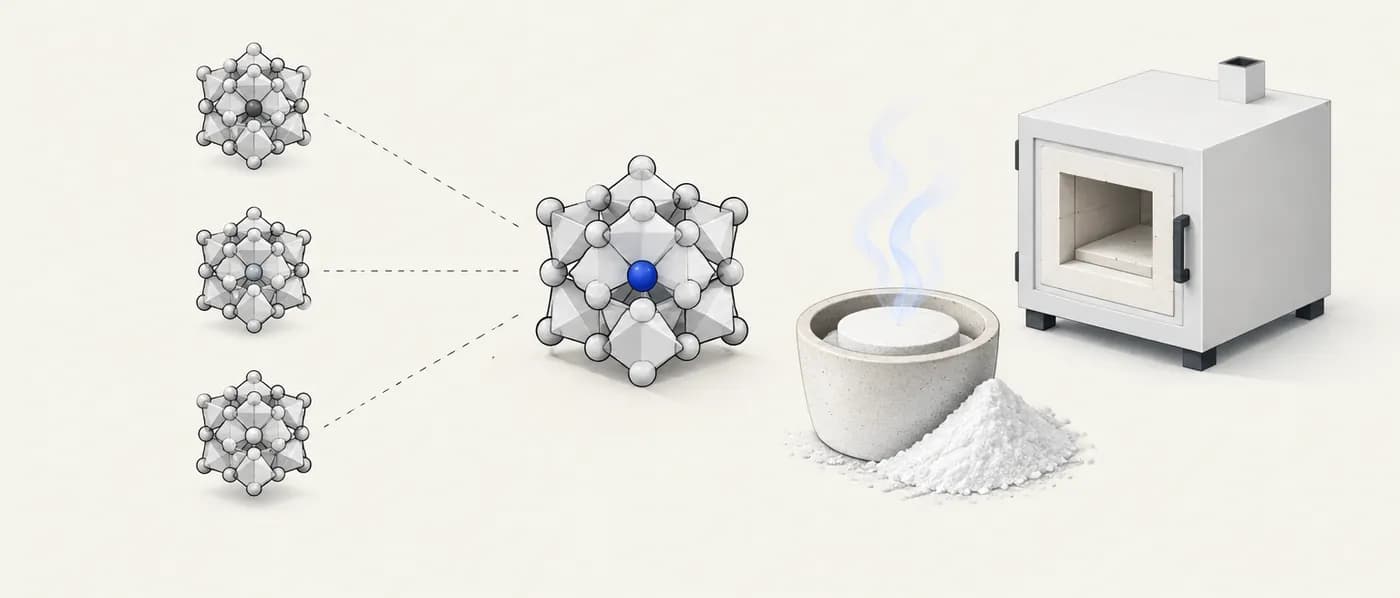
Target: a new dopant variant of the garnet Li₇La₃Zr₂O₁₂ (LLZO), a solid electrolyte first reported as a fast lithium conductor by Murugan, Thangadurai and Weppner (2007).
- 01Analogue set: published Al-, Ga- and Ta-doped LLZO syntheses (same garnet structure, same Li-rich chemistry).
- 02Common feature across analogues: lithium is volatile at the high sintering temperatures used, so recipes add excess lithium precursor.
- 03Common feature: dopants such as Al or Ga are used to stabilise the more conductive cubic phase rather than the tetragonal one.
- 04Adaptation: keep a lithium excess and a sintering window taken from the analogue range; choose the new dopant level by charge balance with the dopant’s oxidation state.
- 05Check: XRD for cubic versus tetragonal garnet and for La₂Zr₂O₇ (a sign of lithium loss).
Analogues carry tacit knowledge (volatility, impurity phases) that is not visible from the target’s formula.
Choosing between two analogues (hypothetical)
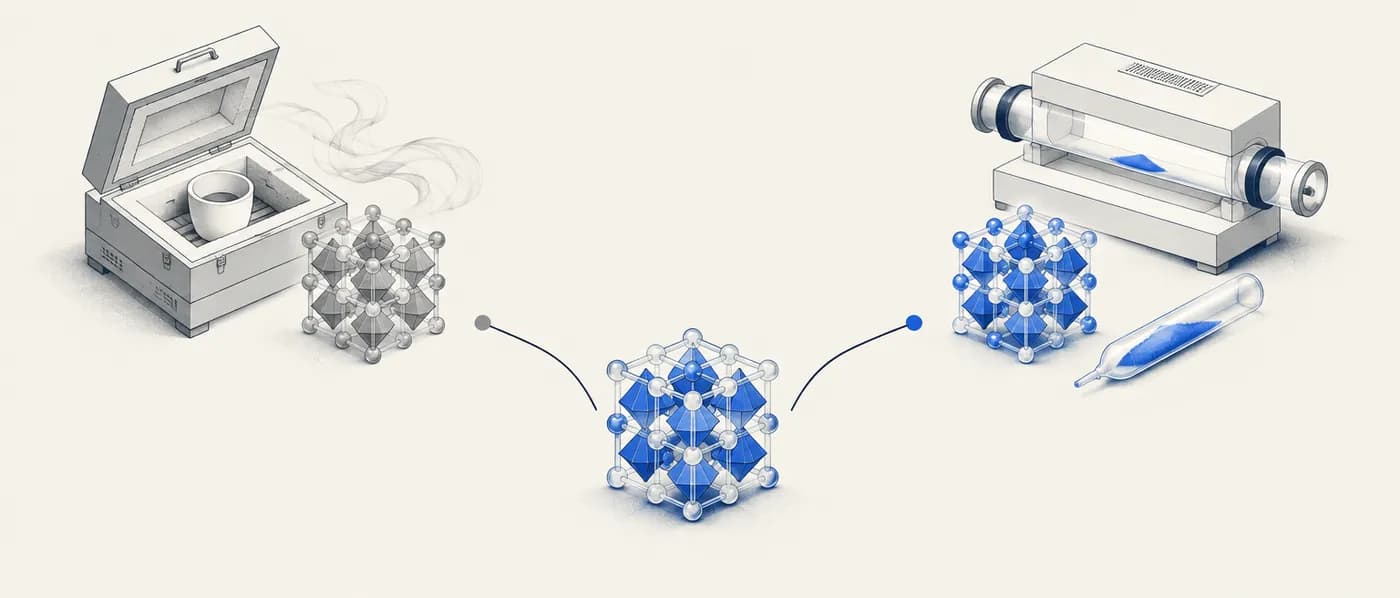
A target sulfide could be compared with (a) an oxide containing the same metals or (b) a sulfide with the same structure but a different metal.
- 01Analogue (a) shares elements but is made in air at high temperature — conditions that would oxidise a sulfide.
- 02Analogue (b) shares the structure and the anion chemistry and is made in sealed ampoules or under inert gas.
- 03The relevant constraint is anion chemistry and air sensitivity, so analogue (b) is the better template.
- 04Adapt (b) by swapping the metal precursor and checking whether the new metal sulfide melts or decomposes in the planned window.
Similarity should be judged on what controls the reaction — structure, anion, oxidation state — not on how many elements are shared.
When to use it — and when not to
- Planning the first synthesis of a computationally predicted material.
- Choosing precursors and atmosphere for a substituted or doped version of a known compound.
- Setting the temperature window for a design-of-experiments study.
- Estimating whether a candidate is likely to be makeable at all.
- Truly new structure types with no close analogues — expect a broader exploratory search.
- Metastable targets that require non-equilibrium routes (thin-film deposition, high pressure) unlike the analogues’ solid-state routes.
- Final process conditions for production — analogy gives a start, not an optimised process.
Common mistakes
Applying it in Lattice Graph
Use LatticeGraph’s graph neighbours and synthesis recipe records to find the closest made analogues of a candidate and compare their reported conditions side by side.
- 01Open the candidate and look at structurally and chemically similar materials in the graph, especially those with experimental records.
- 02Pull reported recipes for the closest analogues and tabulate precursors, temperatures and atmospheres.
- 03Use the range across analogues as the starting window; open source papers for any value that drives the plan.
- 04Record the chosen analogues and adaptations in your evidence pack so the synthesis plan is traceable.
Frequently asked questions
How close does an analogue need to be?
Ideally the same structure type with one element substituted. The further the analogue, the wider the temperature scan you should plan.
Can machine learning choose precursors for me?
Published models trained on literature recipes can suggest precursors and temperatures, and have been used in autonomous labs. Treat their output as a ranked list of analogue-based suggestions and still check the chemistry.
What if no analogue has been made?
Look at the binary and ternary phases in the same chemical system to understand which competing phases form and at what temperatures, then plan a broader exploratory scan.
References & further reading
- [1]Kononova, O. et al. (2019). Text-mined dataset of inorganic materials synthesis recipes. Scientific Data 6, 203.Large literature-extracted solid-state recipe dataset.
- [2]Kim, E. et al. (2017). Materials synthesis insights from scientific literature via text extraction and machine learning. Chemistry of Materials 29, 9436–9444.Early text-mining of synthesis parameters.
- [3]He, T. et al. (2023). Precursor recommendation for inorganic synthesis by machine learning materials similarity from scientific literature. Science Advances 9, eadg8180.Similarity-based precursor recommendation.
- [4]Szymanski, N. J. et al. (2023). An autonomous laboratory for the accelerated synthesis of novel materials. Nature 624, 86–91.A-Lab: literature-informed first recipes in an autonomous loop.
- [5]Murugan, R., Thangadurai, V. & Weppner, W. (2007). Fast lithium ion conduction in garnet-type Li₇La₃Zr₂O₁₂. Angewandte Chemie International Edition 46, 7778–7781.Original LLZO fast-conductor report.