What it is
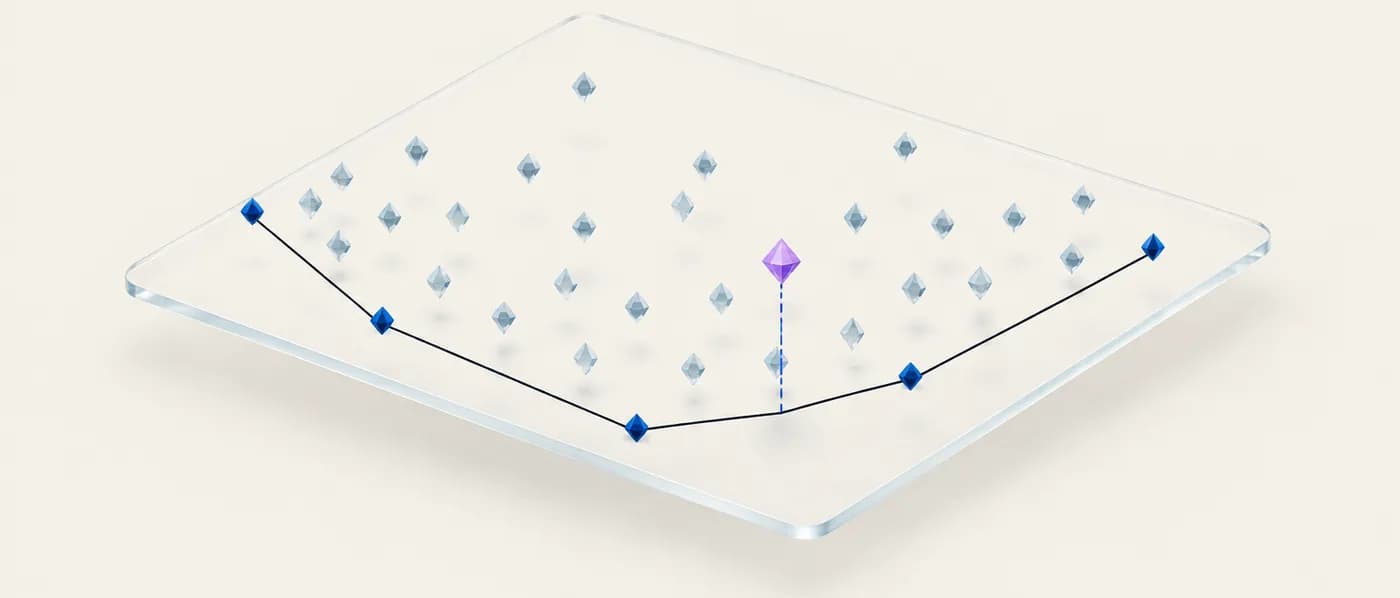
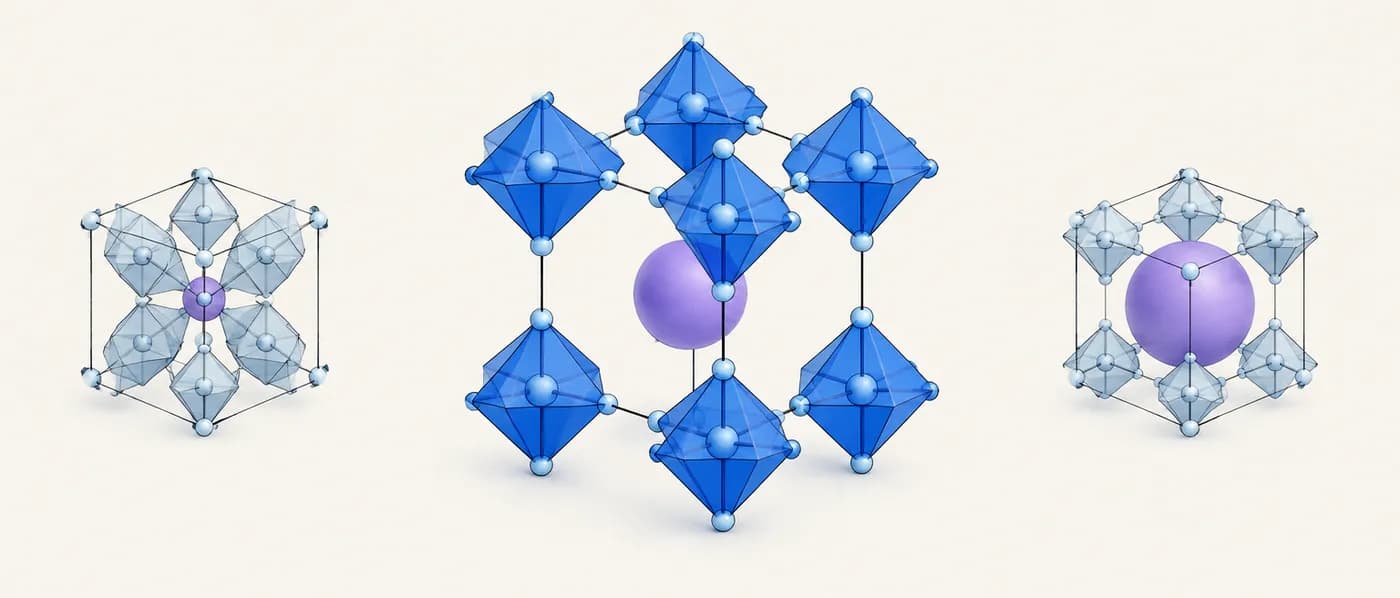
In 1929 Linus Pauling proposed five principles that govern the structures of complex ionic crystals. He treated the crystal as cations surrounded by coordination polyhedra of anions, and asked which arrangements of these polyhedra minimise electrostatic energy.
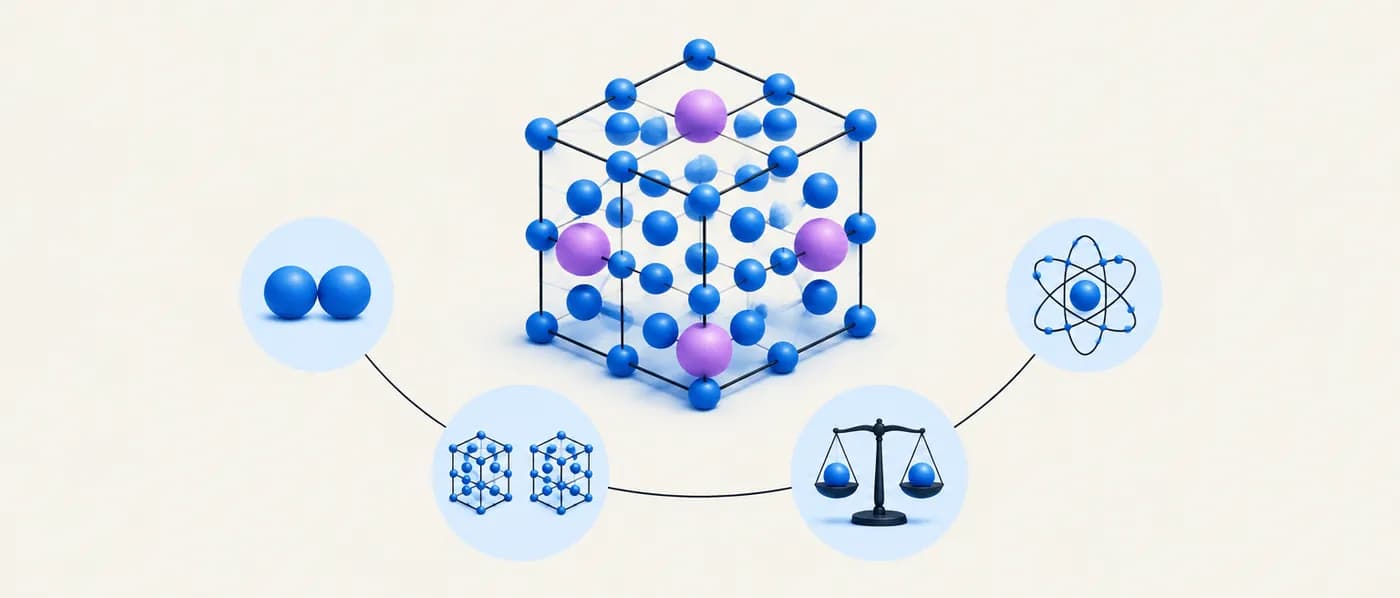
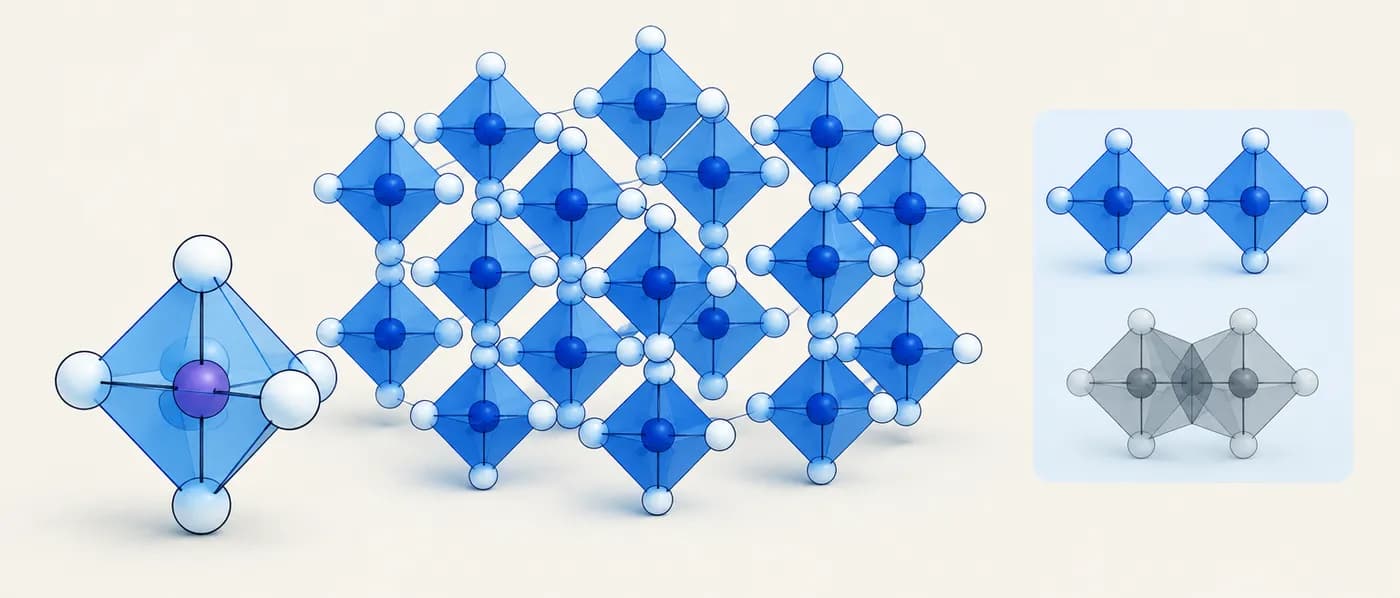
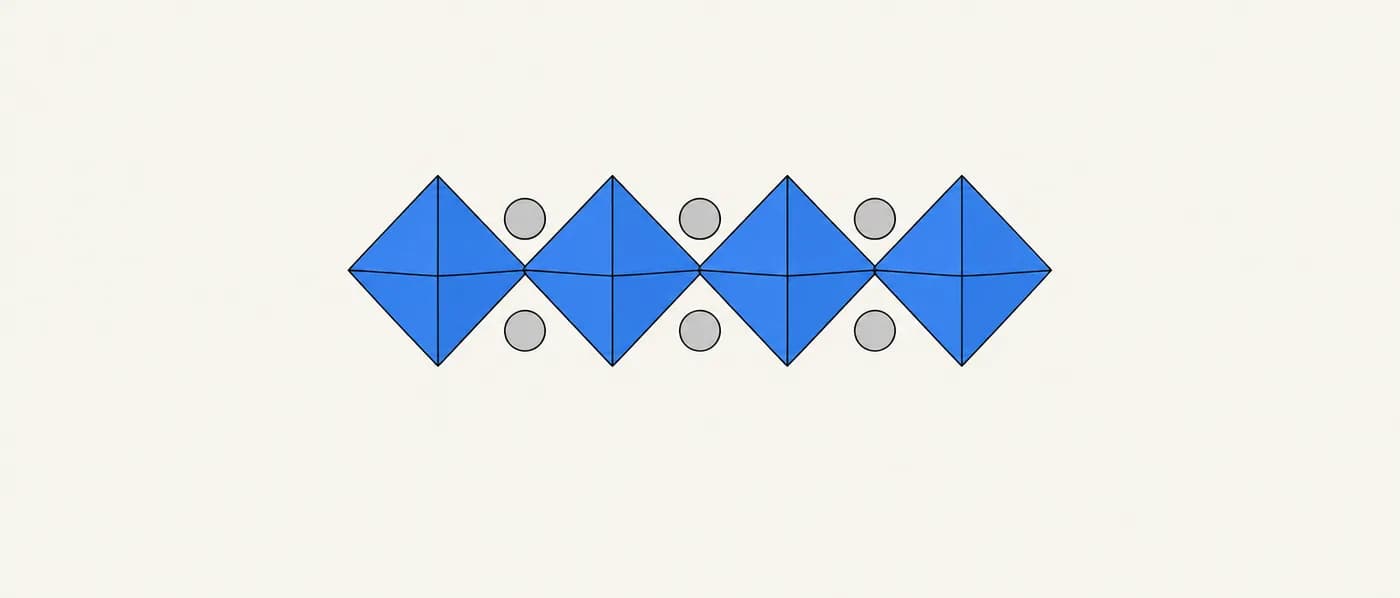
The five rules are: (1) a coordination polyhedron of anions forms about each cation, with the cation–anion distance set by the sum of radii and the coordination number set by the radius ratio; (2) the electrostatic valence principle — the charge of each anion is balanced by the sum of electrostatic bond strengths from neighbouring cations, where each bond strength equals cation charge divided by coordination number; (3) sharing edges, and especially faces, between polyhedra decreases stability, most strongly for cations with high charge and low coordination number; (4) in crystals with different cations, those with high charge and low coordination number tend not to share polyhedron elements with each other; (5) the rule of parsimony — the number of essentially different kinds of constituents (coordination environments) in a crystal tends to be small.
The rules work best for strongly ionic compounds such as oxides, fluorides and silicates. Covalency, metallic bonding, lone pairs and large polarisable ions weaken them.
Why it matters for R&D decisions
When a database, ML model or structure generator proposes a new ionic compound, Pauling’s rules let you check it in minutes with a pencil: do the coordination numbers make sense for the ion sizes, are the anions charge-balanced, and are high-charge cations sharing faces? Structures that fail badly deserve scrutiny before you invest in further calculations.
The formula
s = z / CN ; Σ s_i ≈ |z_anion|
- s
- Electrostatic bond strength contributed by a cation to each neighbouring anion
- z
- Formal charge of the cation
- CN
- Coordination number of the cation (number of anion neighbours)
- Σ s_i
- Sum of bond strengths reaching one anion from all its cation neighbours
- |z_anion|
- Magnitude of the anion’s formal charge (2 for O²⁻, 1 for F⁻)
Rule 1 uses the radius ratio r_cation / r_anion with radii for the appropriate coordination number (Shannon, 1976). Modern bond-valence methods refine rule 2 using bond lengths.
How to apply it, step by step
- 1Assign formal charges and coordination
List each cation and anion with its formal oxidation state, and read each cation’s coordination number from the structure (or the one you expect).
- 2Check radius ratios (rule 1)
Divide the cation radius by the anion radius, using Shannon radii for the stated coordination numbers, and compare with the ideal ranges in the table below.
- 3Sum bond strengths at each anion (rule 2)
For every distinct anion site, add z/CN for each cation neighbour. A sum close to the anion charge (within ~10–20%) is consistent; large deviations suggest a strained or unlikely structure.
- 4Inspect how polyhedra connect (rules 3 and 4)
Note whether polyhedra share corners, edges or faces. Face-sharing between high-charge, low-coordination cations is a warning sign.
- 5Count distinct environments (rule 5)
A proposed structure with many unusual coordination environments for one cation type is less likely than a simpler alternative.
Worked examples
Radius ratio: NaCl, CsCl and a famous exception
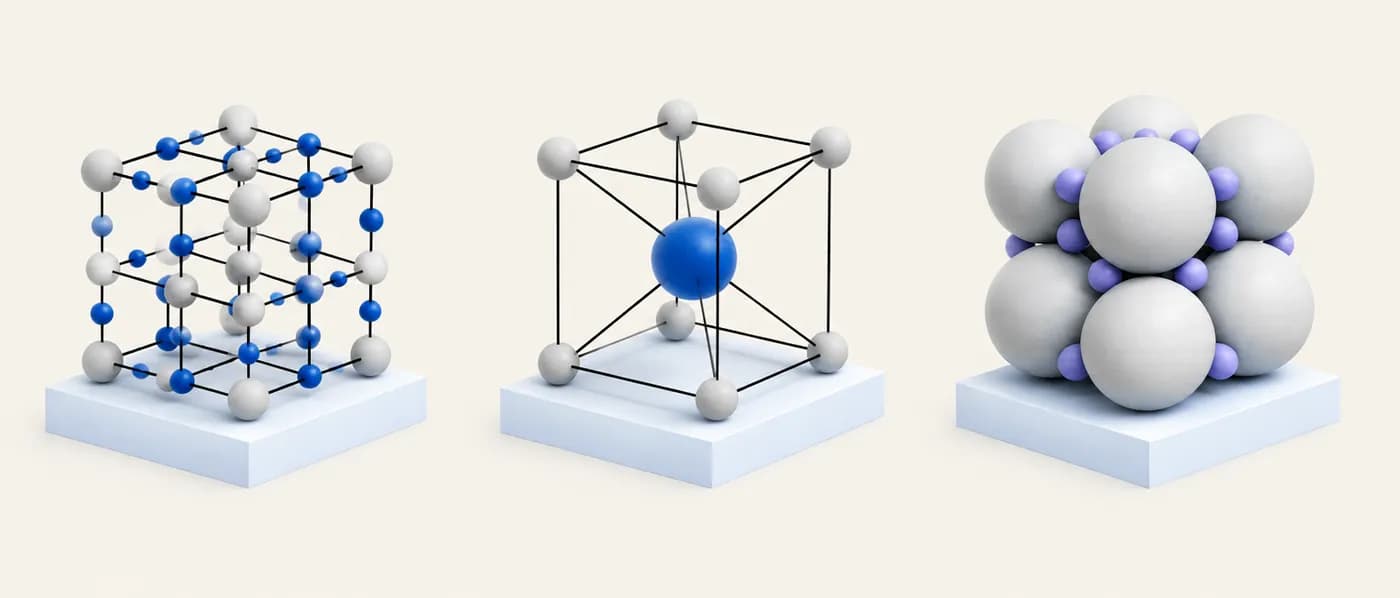
Use Shannon ionic radii for the stated coordination numbers to predict coordination in alkali halides.
- 01NaCl: r(Na⁺, CN 6) = 1.02 Å, r(Cl⁻, CN 6) = 1.81 Å → 1.02 / 1.81 ≈ 0.56 → octahedral range (0.414–0.732). Observed: rock salt, CN 6. ✓
- 02CsCl: r(Cs⁺, CN 8) = 1.74 Å, r(Cl⁻) = 1.81 Å → 1.74 / 1.81 ≈ 0.96 → cubic range (0.732–1.0). Observed: CsCl structure, CN 8. ✓
- 03LiI: r(Li⁺, CN 6) = 0.76 Å, r(I⁻, CN 6) = 2.20 Å → 0.76 / 2.20 ≈ 0.35 → predicts tetrahedral (CN 4). Observed: rock salt, CN 6. ✗
- 04The large, polarisable iodide ion and the limits of the hard-sphere picture explain the failure.
Radius ratios are a guide to likely coordination, not a law. Expect exceptions with large, polarisable anions.
Electrostatic valence in SrTiO₃
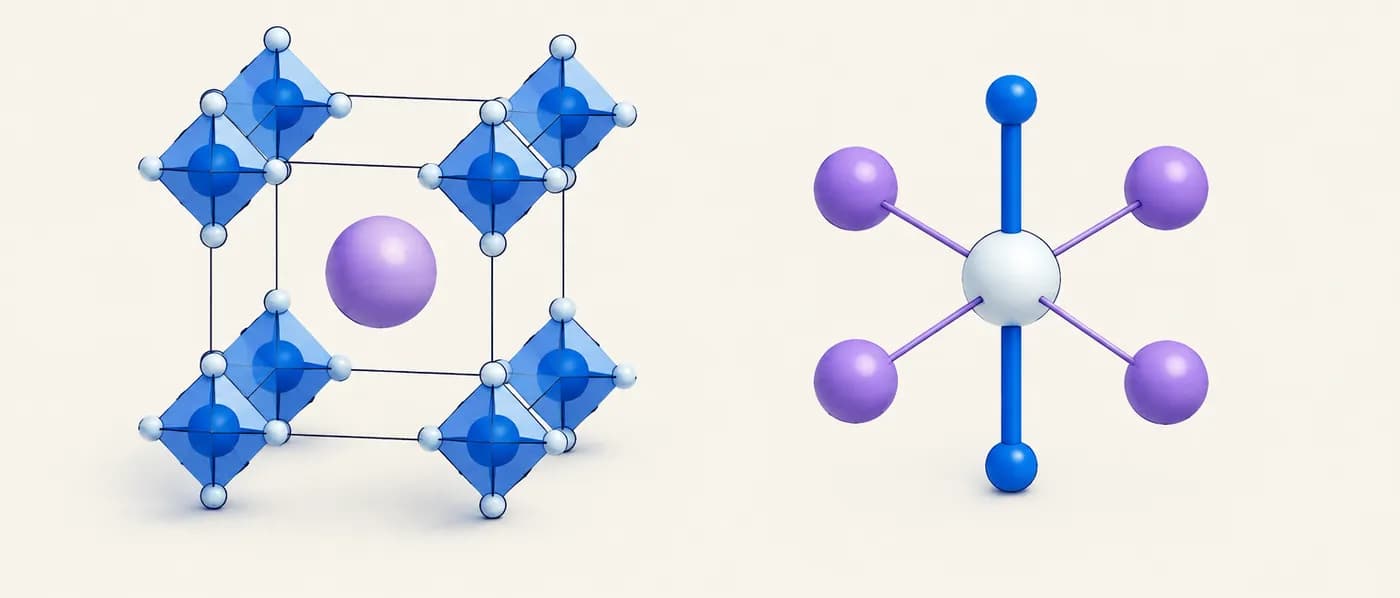
In cubic perovskite SrTiO₃, Ti⁴⁺ is 6-coordinated by oxygen and Sr²⁺ is 12-coordinated. Each oxygen has 2 Ti and 4 Sr neighbours.
- 01Bond strength from Ti⁴⁺: s = 4 / 6 ≈ 0.667.
- 02Bond strength from Sr²⁺: s = 2 / 12 ≈ 0.167.
- 03Sum at each oxygen: 2 × 0.667 + 4 × 0.167 = 1.333 + 0.667 = 2.00.
- 04This equals the charge of O²⁻ exactly.
Bond-strength sums are quick to compute and immediately show whether a proposed connectivity can balance anion charges.
Why silicates share corners
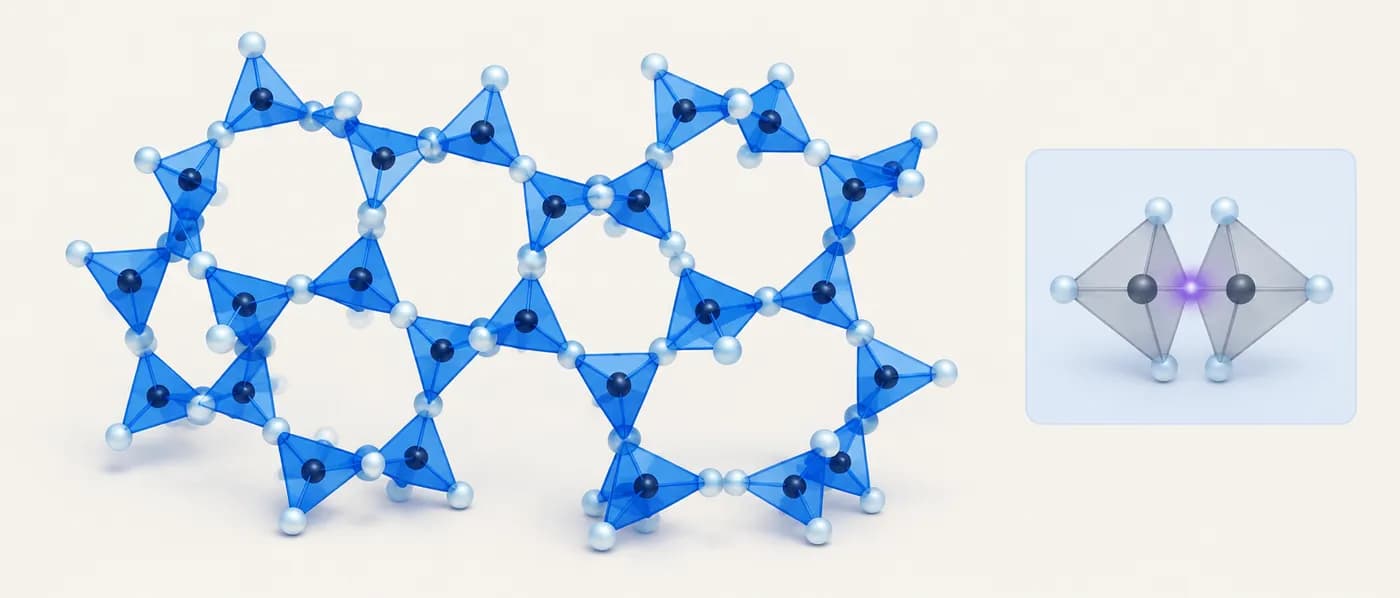
In silicates, Si⁴⁺ sits in SiO₄ tetrahedra (CN 4), giving bond strength s = 4/4 = 1.0 per Si–O bond.
- 01An oxygen bonded to two Si atoms receives 1.0 + 1.0 = 2.0 — exactly its charge, as in quartz (SiO₂), where every oxygen bridges two tetrahedra.
- 02A third Si neighbour would over-bond the oxygen (3.0), so oxygens are shared by at most two tetrahedra.
- 03Sharing an edge would bring two highly charged Si⁴⁺ ions much closer than corner sharing does, raising cation–cation repulsion (rule 3).
- 04Silicate frameworks therefore connect SiO₄ tetrahedra almost exclusively through corners.
When a predicted structure shows edge- or face-sharing between high-charge, low-CN polyhedra, check whether a corner-sharing alternative is lower in energy.
Ideal radius-ratio ranges for coordination (hard-sphere model)
| r_cation / r_anion | Coordination number | Polyhedron |
|---|---|---|
| 0.155–0.225 | 3 | Triangle |
| 0.225–0.414 | 4 | Tetrahedron |
| 0.414–0.732 | 6 | Octahedron |
| 0.732–1.000 | 8 | Cube |
| ≥ 1.000 | 12 | Cuboctahedron |
When to use it — and when not to
- Sanity-checking computed or ML-generated structures of oxides, fluorides, silicates and other strongly ionic compounds.
- Choosing plausible dopant sites by size and charge.
- Explaining to non-specialists why a structure adopts a particular arrangement.
- Teaching and quick back-of-envelope reasoning during screening.
- Metals and intermetallics — use Hume-Rothery-type reasoning instead.
- Strongly covalent compounds (many nitrides, carbides, chalcogenides) and compounds with stereochemically active lone pairs.
- As a hard filter in automated screens: many stable oxides violate at least one rule.
Common mistakes
Applying it in Lattice Graph
LatticeGraph gives you the structures and compositions to test against Pauling’s rules, and lets you compare a candidate with known experimental structures in the same family.
- 01Search the composition and open the structure records from the computed databases.
- 02Compare with experimental structures for the same or analogous compositions (for example in COD).
- 03Use hull distance and cross-source confidence alongside the rules to decide whether a candidate deserves further work.
Frequently asked questions
How often do real oxides obey all five rules?
Less often than textbooks suggest. A large-scale analysis of oxide structures by George et al. (2020) found that only 13% of about 5,000 oxides satisfy rules 2–5 simultaneously. Individual rules fare unevenly: the radius-ratio prediction matched about two-thirds of coordination environments, but rule 2 held almost exactly for only about 20% of oxygen sites. Treat them as tendencies.
What is the difference between Pauling’s rule 2 and the bond-valence method?
Rule 2 uses an idealised bond strength (charge ÷ coordination number) for every bond. The bond-valence method assigns each bond a valence that depends on its actual length, which handles distorted environments much better.
Which radii should I use?
Shannon’s 1976 effective ionic radii are the standard. Pick the value for the correct oxidation state, coordination number and (where relevant) spin state.
References & further reading
- [1]Pauling, L. (1929). The principles determining the structure of complex ionic crystals. Journal of the American Chemical Society 51, 1010–1026.The original five rules.
- [2]Shannon, R. D. (1976). Revised effective ionic radii and systematic studies of interatomic distances in halides and chalcogenides. Acta Crystallographica A32, 751–767.Standard table of ionic radii by coordination number.
- [3]George, J., Waroquiers, D., Di Stefano, D., Petretto, G., Rignanese, G.-M. & Hautier, G. (2020). The limited predictive power of the Pauling rules. Angewandte Chemie International Edition 59, 7569–7575.Large-scale test of the rules on oxide structures.
- [4]Brown, I. D. (2002). The Chemical Bond in Inorganic Chemistry: The Bond Valence Model. Oxford University Press.Modern extension of the electrostatic valence principle.