What it is
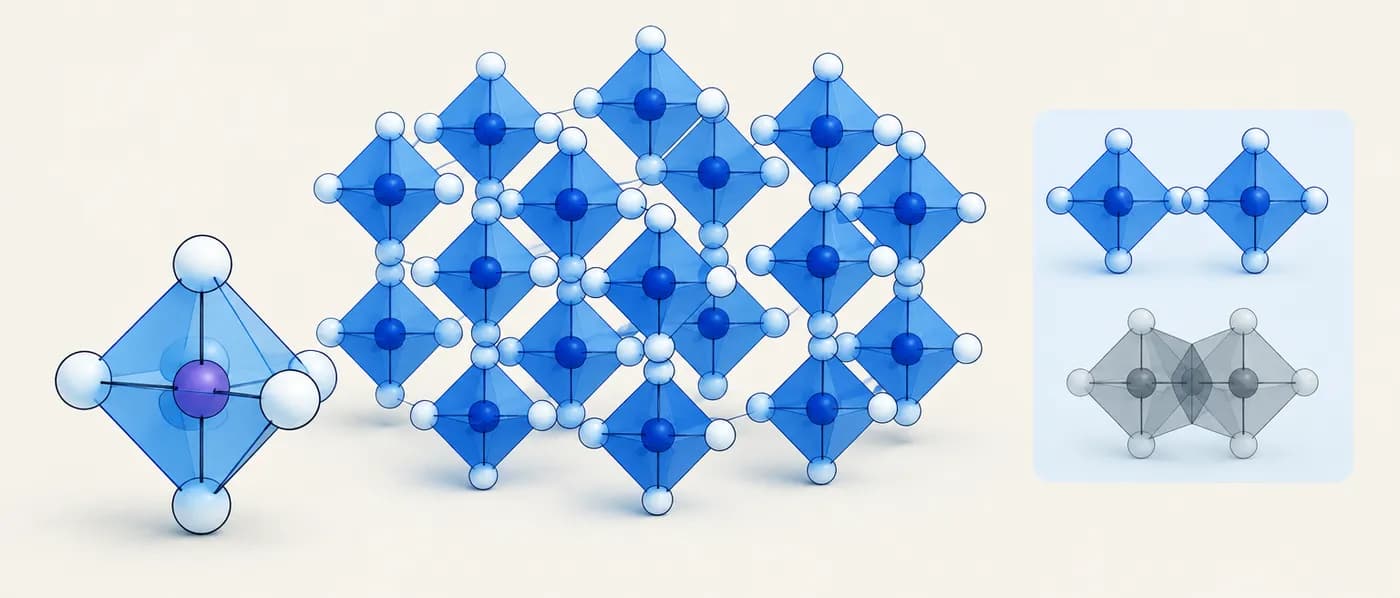
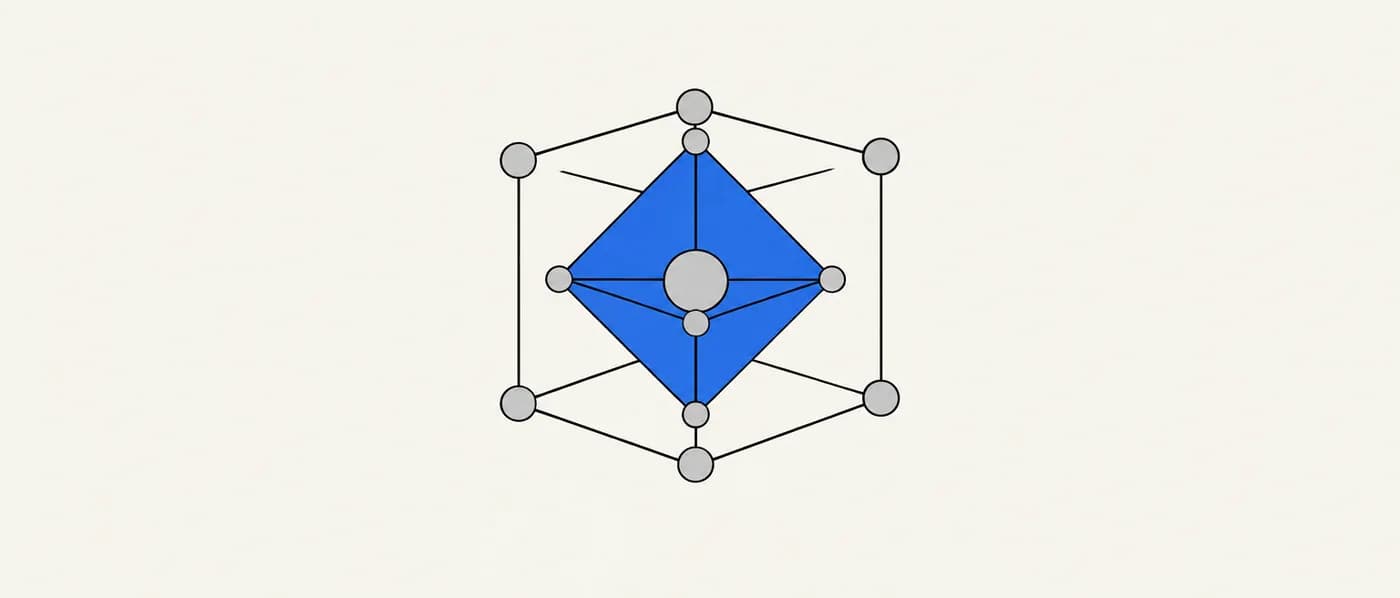
Perovskites have the formula ABX₃: a small B cation sits at the centre of an octahedron of X anions, and a large A cation sits in the cavity between eight corner-sharing octahedra. In the ideal cubic structure the geometry fixes a relationship between the A–X and B–X distances: the A–X distance should equal √2 times the B–X distance.
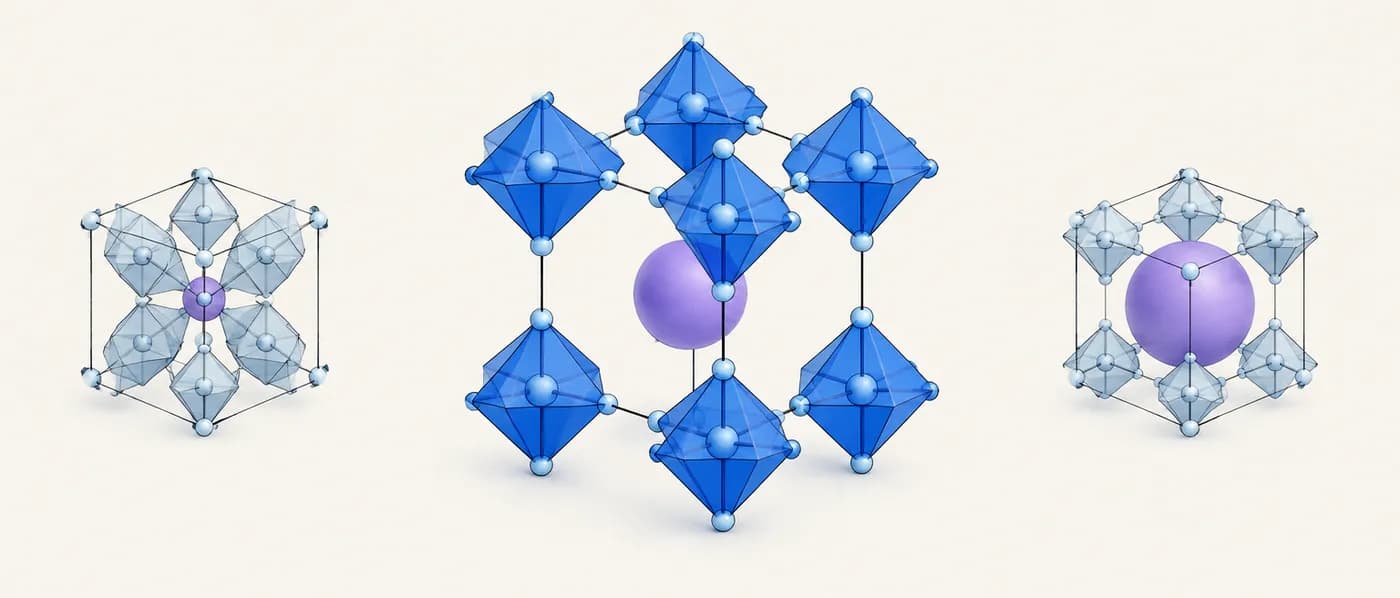
In 1926 Victor Moritz Goldschmidt expressed how far real ions depart from that ideal as the tolerance factor t. When t ≈ 1 the ions fit the cubic cell. When the A cation is too small (t < 1) the octahedra tilt to shrink the cavity, giving orthorhombic or rhombohedral perovskites. When the A cation is too large (t > 1) the structure often switches to hexagonal stacking with face-sharing octahedra, or the B cation shifts off-centre.
Because it needs only three radii, the tolerance factor is one of the cheapest structure-prediction tools in materials science and is widely used to pre-screen perovskite oxides and halides for photovoltaics, solid oxide fuel cells, ferroelectrics and catalysis.
Why it matters for R&D decisions
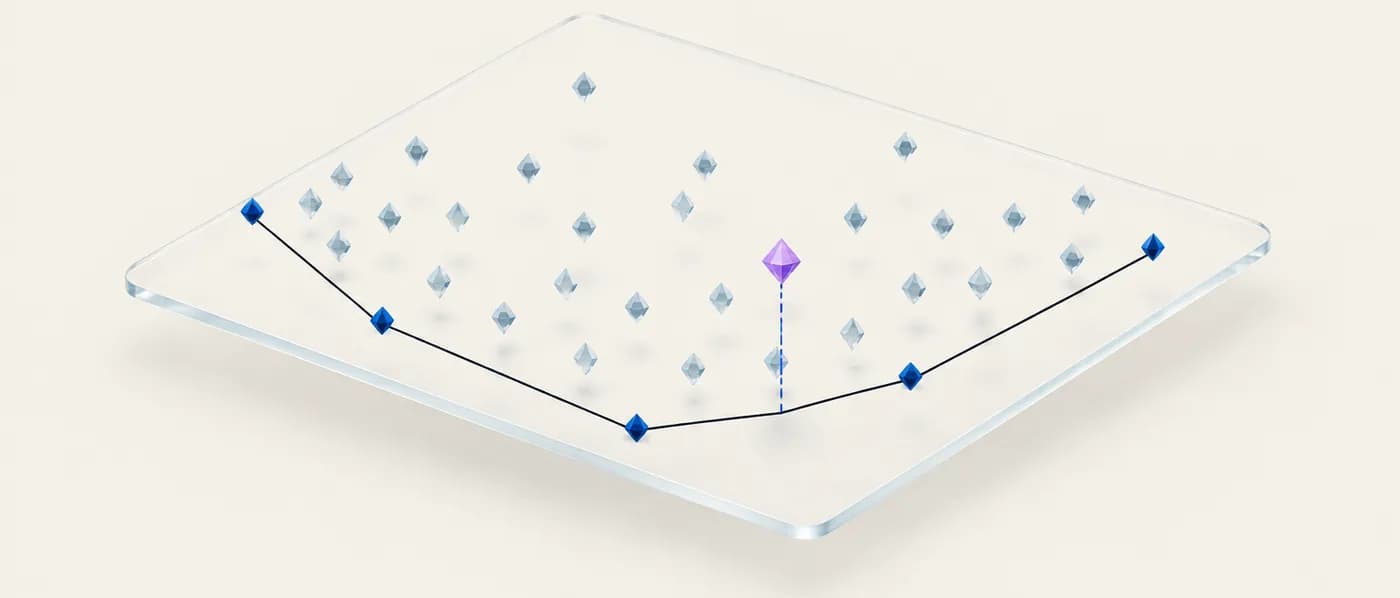
Perovskite chemistry spans thousands of possible A/B/X combinations. A tolerance-factor screen removes combinations that cannot form a perovskite before you compute or synthesise them, and predicts the distortions (tilts, off-centring) that control band gaps, ionic conductivity and ferroelectricity.
The formula
t = (r_A + r_X) / (√2 · (r_B + r_X))
- r_A
- Ionic radius of the A-site cation (usually 12-coordinate)
- r_B
- Ionic radius of the B-site cation (6-coordinate)
- r_X
- Ionic radius of the anion (6-coordinate in Shannon’s table)
- μ = r_B / r_X
- Octahedral factor; below the geometric limit of ~0.41 (√2 − 1) the B cation is too small for a stable BX₆ octahedron. Empirical cut-offs are slightly higher: ~0.43 in Bartel et al. (2019), ~0.44 for halides in Li et al. (2008)
Bartel et al. (2019) proposed τ = r_X/r_B − n_A (n_A − (r_A/r_B) / ln(r_A/r_B)), where n_A is the oxidation state of A; τ < 4.18 predicts perovskite and classified known compounds more accurately than t.
How to apply it, step by step
- 1Fix oxidation states
Choose charges that balance the formula (for example A²⁺B⁴⁺O₃ or A³⁺B³⁺O₃, or A⁺B²⁺X₃ for halides). The radii depend on them.
- 2Look up radii for the right coordination
Use Shannon radii: A in 12-fold coordination, B in 6-fold, X in 6-fold. If a 12-coordinate value is not tabulated, note the substitute you used.
- 3Compute t and the octahedral factor
Calculate both. A promising candidate typically has t between ~0.8 and ~1.0 and μ above ~0.41–0.44.
- 4Interpret the range
Use the table below to anticipate cubic, tilted or hexagonal structures — and therefore which properties to expect.
- 5Confirm with a better classifier or calculation
For borderline cases, compute Bartel’s τ and check hull distance in computed databases before committing to synthesis.
Worked examples
SrTiO₃ — the ideal cubic perovskite
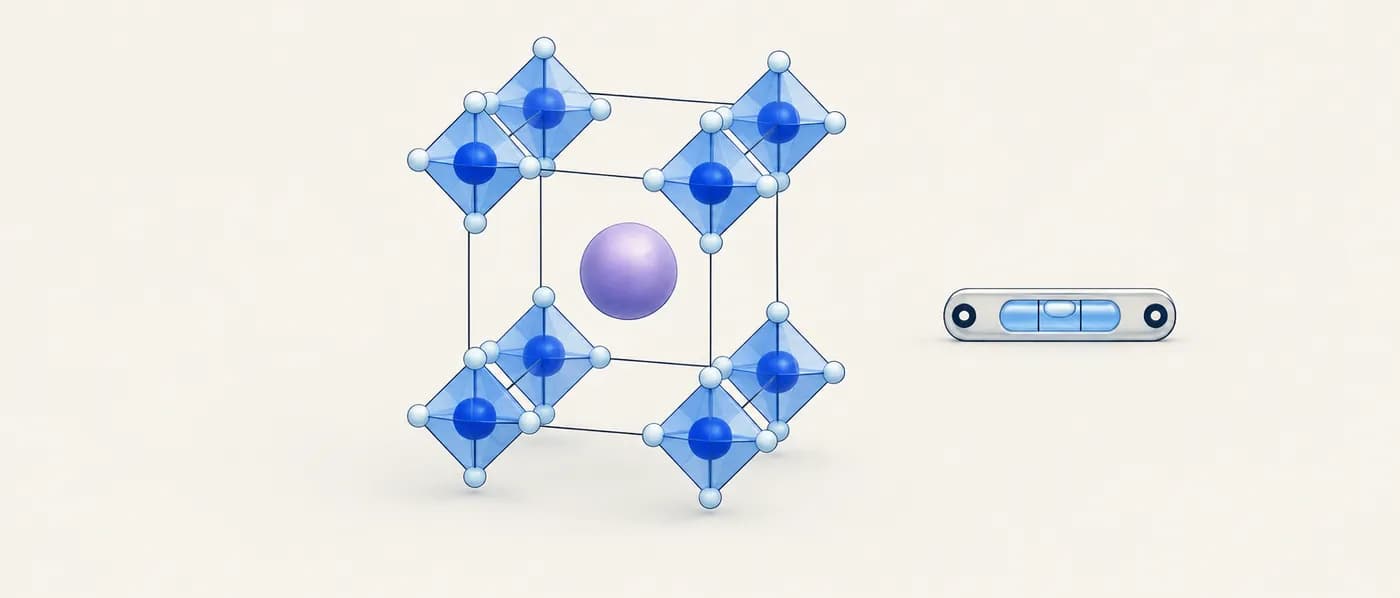
Shannon radii: Sr²⁺ (CN 12) = 1.44 Å, Ti⁴⁺ (CN 6) = 0.605 Å, O²⁻ (CN 6) = 1.40 Å.
- 01Numerator: r_A + r_X = 1.44 + 1.40 = 2.84 Å.
- 02Denominator: √2 × (0.605 + 1.40) = 1.414 × 2.005 = 2.835 Å.
- 03t = 2.84 / 2.835 ≈ 1.00.
- 04Octahedral factor μ = 0.605 / 1.40 ≈ 0.43 — above the ~0.41 geometric limit, though close to the empirical cut-offs.
A perfect fit gives the undistorted cubic structure.
CaTiO₃ and BaTiO₃ — too small and too big
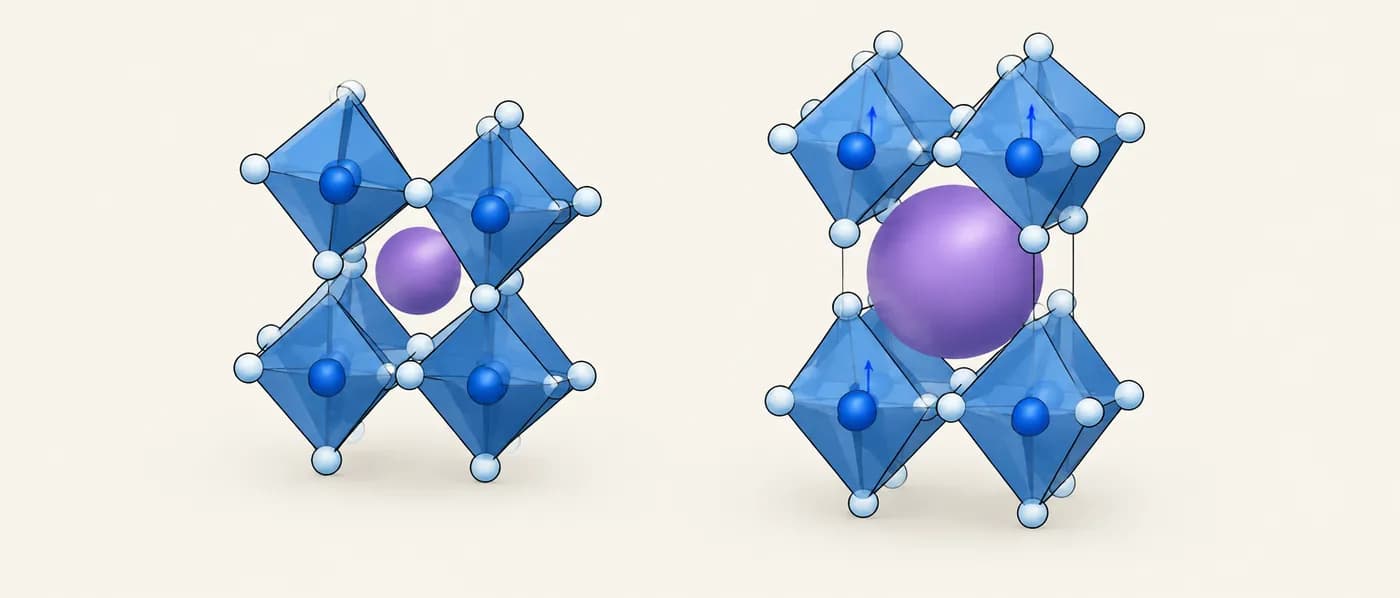
Swap the A cation while keeping Ti⁴⁺ and O²⁻: Ca²⁺ (CN 12) = 1.34 Å, Ba²⁺ (CN 12) = 1.61 Å.
- 01CaTiO₃: t = (1.34 + 1.40) / 2.835 = 2.74 / 2.835 ≈ 0.97.
- 02Ca²⁺ is slightly small for the cavity, so the TiO₆ octahedra tilt; CaTiO₃ is orthorhombic at room temperature.
- 03BaTiO₃: t = (1.61 + 1.40) / 2.835 = 3.01 / 2.835 ≈ 1.06.
- 04Ba²⁺ is slightly large, stretching the cell so that Ti⁴⁺ can shift off-centre; BaTiO₃ is tetragonal and ferroelectric at room temperature.
The tolerance factor predicts not only whether a perovskite forms but which distortion — and therefore which properties — to expect.
CsPbI₃ — a pass that is not the whole story
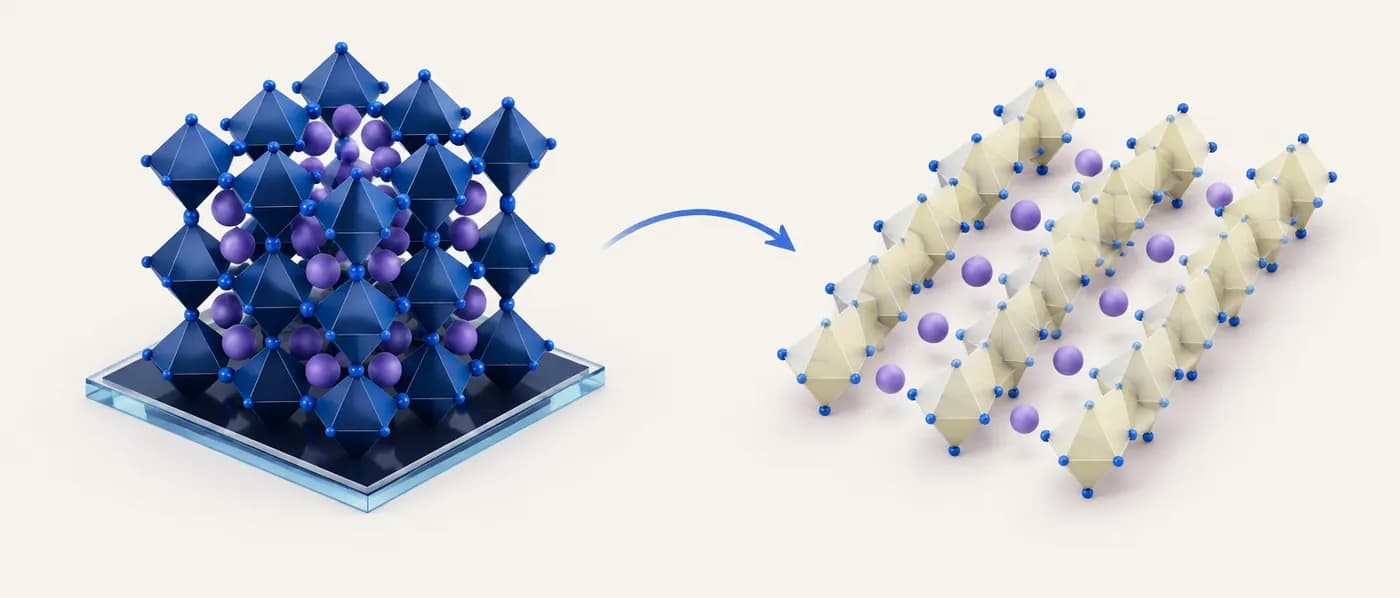
A halide perovskite candidate for solar cells. Shannon radii: Cs⁺ (CN 12) = 1.88 Å, Pb²⁺ (CN 6) = 1.19 Å, I⁻ (CN 6) = 2.20 Å.
- 01Numerator: 1.88 + 2.20 = 4.08 Å.
- 02Denominator: 1.414 × (1.19 + 2.20) = 1.414 × 3.39 = 4.79 Å.
- 03t = 4.08 / 4.79 ≈ 0.85 — inside the usual perovskite window.
- 04Yet the black perovskite phase of CsPbI₃ is metastable at room temperature and tends to convert to a yellow non-perovskite (δ) phase.
Halide perovskites are especially sensitive to the limits of t. Use τ, hull distance and experimental evidence before relying on a pass.
Typical interpretation of the tolerance factor
| t | Typical structure | Example |
|---|---|---|
| > 1.0 | A cation too large: hexagonal perovskite polytypes or B-site off-centring | BaTiO₃ (≈ 1.06, tetragonal) |
| ≈ 0.9–1.0 | Cubic or nearly cubic perovskite (mild tilting is common below ~1) | SrTiO₃ (≈ 1.00); CaTiO₃ (≈ 0.97, orthorhombic) |
| ≈ 0.71–0.9 | Tilted perovskite (orthorhombic or rhombohedral) | GdFeO₃-type structures |
| < ~0.71 | Perovskite unlikely; ilmenite or other structures | — |
When to use it — and when not to
- Pre-screening A/B/X combinations for perovskite oxides, fluorides and halides.
- Predicting whether a substitution will cause tilting or off-centring.
- Choosing A-site or B-site dopants that keep the structure stable.
- Explaining structural trends across a perovskite family.
- Non-ABX₃ structures (use Pauling-type reasoning or hull distance instead).
- Molecular A-site cations without a well-defined effective radius — results depend heavily on the chosen radius.
- As the only screen for halide perovskites, where t has well-known false positives.
Common mistakes
Applying it in Lattice Graph
LatticeGraph lets you take perovskite candidates that pass a tolerance-factor screen and check them against computed stability and experimental structures in one place.
- 01Search the ABX₃ composition (or a family of compositions) across computed databases.
- 02Check hull distance and cross-source confidence for the perovskite structure.
- 03Look for an experimental structure in COD to see which polymorph has actually been made.
Frequently asked questions
Why √2?
In the ideal cubic perovskite the A–X distance is half the face diagonal of the cubic cell and the B–X distance is half the cell edge, so A–X = √2 × B–X. The tolerance factor measures departure from that ratio.
What is Bartel’s τ and is it better?
τ is a tolerance factor found by data-driven search (Bartel et al., 2019) that also uses the A-site oxidation state. On their set of 576 ABX₃ compounds it classified perovskite versus non-perovskite correctly about 92% of the time, compared with 74% for t.
Does it work for double perovskites?
Approximately: use the average radius of the B-site cations (and A-site cations if mixed). Ordering and size mismatch add effects the single number cannot capture.
References & further reading
- [1]Goldschmidt, V. M. (1926). Die Gesetze der Krystallochemie. Die Naturwissenschaften 14, 477–485.Original statement of the tolerance factor.
- [2]Shannon, R. D. (1976). Revised effective ionic radii and systematic studies of interatomic distances in halides and chalcogenides. Acta Crystallographica A32, 751–767.Source of the radii used in the examples.
- [3]Bartel, C. J. et al. (2019). New tolerance factor to predict the stability of perovskite oxides and halides. Science Advances 5, eaav0693.The τ descriptor and its comparison with t.
- [4]Li, C., Lu, X., Ding, W., Feng, L., Gao, Y. & Guo, Z. (2008). Formability of ABX₃ (X = F, Cl, Br, I) halide perovskites. Acta Crystallographica B64, 702–707.Tolerance and octahedral factors for halide perovskites.