Fe3O4
Magnetite · iron(II,III) oxide, ferrous-ferric oxide, triiron tetraoxide
Fe3O4 is magnetite, a mixed-valence iron oxide that contains both divalent and trivalent iron in an inverse spinel structure. It is ferrimagnetic, and electrons hop between iron ions, which makes it unusually conductive for an oxide. It is widely studied as a conversion-type anode for lithium-ion batteries and is valued for its magnetic and electrical properties.
About Magnetite
What is Fe3O4 and what structure does it adopt?
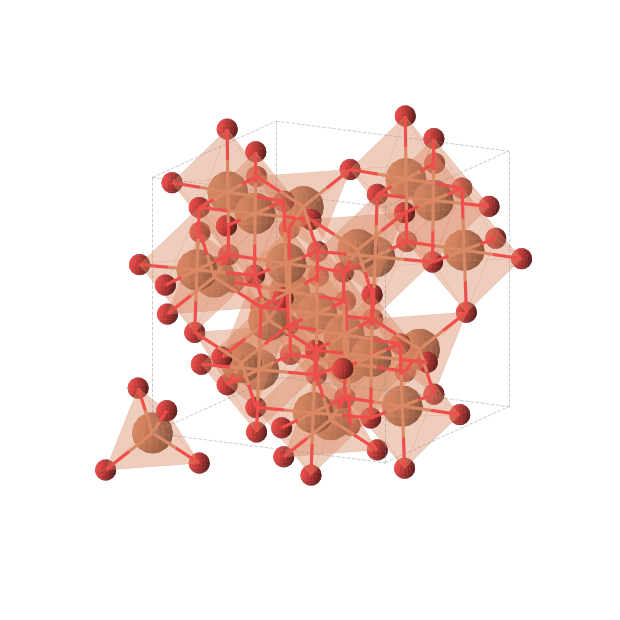
Fe3O4, commonly called magnetite, is an iron oxide that contains iron in two oxidation states, Fe2+ and Fe3+. It crystallizes in an inverse spinel structure, in which the oxygen anions form a face-centered cubic (cubic close-packed) lattice. Ferric iron (Fe3+) fills the tetrahedral sites, while the octahedral sites hold equal numbers of ferrous (Fe2+) and ferric (Fe3+) cations. Its electrical conduction comes from fast electron hopping between these mixed-valence iron ions on the octahedral sites. Magnetite also occurs naturally as a mineral; naturally magnetized pieces have long been known as lodestone. In batteries, it works as a conversion oxide anode that reacts reversibly with several lithium ions per formula unit.
What is Fe3O4 used for?
Magnetite is a major iron ore mineral mined for iron and steel production, and finely ground magnetite is used in dense-medium separation to clean coal. A major research area for Fe3O4 is its use as a high-capacity conversion anode for lithium-ion batteries. During discharge it is reduced to metallic iron and lithium oxide. In these electrodes it is often combined with carbon, which cushions the volume changes during cycling and keeps the electrode electrically connected. Outside batteries, its ferrimagnetism makes it useful in magnetic recording media (magnetite particles were used in early magnetic recording), ferrofluids, magnetic separation, and as a black pigment. In biomedicine, magnetite nanoparticles are used as MRI contrast agents and for magnetic hyperthermia. Magnetite is also a catalyst and catalyst precursor, for example for the iron catalysts used in ammonia synthesis.
How stable and synthesizable is Fe3O4?
Magnetite is a thermodynamically stable phase of the iron–oxygen system and is common in nature, where it is an important iron ore. In air, however, hematite is the thermodynamically favored oxide. Near room temperature magnetite oxidizes only very slowly to maghemite, and at higher temperatures to hematite. Nanoparticles oxidize much faster than bulk crystals. In the laboratory, magnetite can be made by co-precipitating ferrous and ferric salts from aqueous solution under basic conditions, by hydrothermal or solvothermal methods, by microwave-assisted routes, and by controlled reduction of hematite. At low temperature it undergoes the well-known Verwey transition, in which the crystal structure distorts and the conductivity drops abruptly. In batteries, the multi-electron conversion reaction causes large volume changes and mechanical strain that have to be managed.
Is Fe3O4 a conductor, semiconductor, or insulator?
At room temperature Fe3O4 conducts electricity well for an oxide, through hopping of electrons (small polarons) between Fe2+ and Fe3+ ions on the octahedral sites. Its conductivity falls as it is cooled, which is typical of a semiconductor. On further cooling it passes through the Verwey transition, where a small band gap opens and it becomes insulating. In battery electrodes, its conductivity is usually boosted further by nanostructuring and by making composites with conductive carbon, so that charge moves efficiently during lithiation and delithiation.
How does Fe3O4 compare with CuO, Fe2O3, MnO2, Mn2O3, SnO2, Co3O4, CoO, and CoO2?
Among conversion oxide anodes, Fe3O4 combines high theoretical capacity with abundant raw materials, low toxicity, and low cost. Hematite (Fe2O3) contains only trivalent iron, so Fe3O4 has higher intrinsic electrical conductivity thanks to its mixed valence. Tin dioxide (SnO2) gives high capacity through conversion followed by alloying, but large volume swings cause severe mechanical degradation. Cobalt oxides (Co3O4, CoO) are electrochemically active but more expensive and more toxic. CoO2, by contrast, is best known as the delithiated framework of layered intercalation cathodes, not as an anode. Manganese oxides (MnO2, Mn2O3) are cheap and benign but tend to suffer from low conductivity and capacity fade. Copper oxide (CuO) also reacts by conversion, but it is antiferromagnetic and lacks magnetite's strong net magnetization.
Key Properties
Cross-validated computational properties for Magnetite, aggregated across 6 databases.
Band GapEnergy needed to move an electron from the valence band to the conduction band. Lower or zero values tend to behave more metallic; larger gaps are more insulating or semiconducting.
Energy Above HullThermodynamic distance from the most stable set of competing phases. 0 eV/atom is on the convex hull; small positive values may still be experimentally accessible.
StabilityA plain-language summary of the best reported energy-above-hull result. It reflects whether the lowest-energy structure is on, near, or far from the stability hull.
StructuresCount of reported calculated crystal structures for this formula, including alternate polymorphs, source databases, and observed space groups.
Cross-Source DFT Agreement
How well independent DFT databases agree on the thermodynamics of Fe3O4. Tight agreement means computed properties can be trusted without re-running calculations.
Agreement ScoreA normalized confidence score summarizing how closely independent DFT databases agree. Higher scores mean tighter cross-source agreement.
Hull SpreadDifference between the highest and lowest energy-above-hull values reported by comparable sources. Smaller spread means less thermodynamic disagreement.
Sources ComparedNumber and names of computational sources with comparable entries for this formula.
Space Group ConsensusWhether independent sources predict the same crystal symmetry for the lowest-energy structure.
Reported Structures
Lowest-energy structures reported for Fe3O4, ranked by energy above hull.
| Space GroupSymmetry classification of the crystal arrangement. The number is the international space-group index. | Crystal SystemBroad lattice family, such as cubic, tetragonal, monoclinic, or triclinic, derived from unit-cell symmetry. | Band Gap (eV)Electronic gap calculated for this specific reported structure, measured in electronvolts. | E above hull (eV/atom)Thermodynamic distance from the convex hull for this structure, normalized per atom. Lower is generally more stable. | E/atom (eV)Computed total energy normalized per atom. Use energy above hull, not this value alone, when comparing stability. | Density (g/cm³)Mass per relaxed crystal volume, reported in grams per cubic centimeter. |
|---|---|---|---|---|---|
| — | — | 0.71 | 0.0000 | -1.661 | — |
| Fd-3m (No. 227) | cubic | 0.00 | 0.0131 | -8.087 | 5.11 |
| Imma (No. 74) | orthorhombic | 0.00 | 0.0147 | -8.085 | 4.90 |
| — | — | 0.36 | 0.0167 | -1.644 | — |
| C2/c (No. 15) | monoclinic | 1.41 | 0.0217 | -8.078 | 4.90 |
| — | — | 0.36 | 0.0234 | -1.637 | — |
| Fd-3m (No. 227) | cubic | 0.00 | 0.0255 | -1.355 | — |
| P1 (No. 1) | triclinic | 1.21 | 0.0265 | -8.074 | 4.88 |
| — | — | 0.48 | 0.0306 | -1.630 | — |
| — | — | 0.24 | 0.0320 | -1.629 | — |
| Fd-3m (No. 227) | cubic | 0.00 | 0.0374 | -1.343 | — |
| Fd-3m (No. 227) | cubic | 0.00 | 0.0377 | -1.343 | — |
Synthesis Routes
Literature-extracted synthesis procedures targeting Fe3O4.
Applications
Where Magnetite is used.
Patent Landscape
4 patents reference Fe3O4 or close compositional variants.
| Patent | Title | Assignee | Granted |
|---|---|---|---|
| 11183688 | Porous Fe3O4/S composites for Li/S batteries | — | — |
| 9950311 | Process for the synthesis of magnetically recoverable, high surface area carbon-Fe3O4 nano-composite using met | — | — |
| 8673261 | Process for preparing magnetite (Fe3O4) and derivatives thereof | — | — |
| 11349117 | Magnetite (Fe3O4)—multiwalled carbon nanotube composite structures with performance as high rate electrode mat | — | — |
Frequently Asked Questions
Common questions about Magnetite, answered from cross-validated data and the published literature.
Is Fe3O4 magnetic?
Yes. Magnetite stays ferrimagnetically ordered up to temperatures well above room temperature. This comes from antiparallel magnetic coupling between the iron ions on tetrahedral sites and those on octahedral sites.
What is the difference between Fe3O4 and Fe2O3?
Why does Fe3O4 provide high capacity in lithium-ion batteries?
What is the Verwey transition in magnetite?
How is Fe3O4 synthesized in the laboratory?
What is Fe3O4?
What is Fe3O4 used for?
What is the band gap of Fe3O4?
Is Fe3O4 a metal, semiconductor, or insulator?
Is Fe3O4 thermodynamically stable?
What is the crystal structure of Fe3O4?
What is the density of Fe3O4?
How many polymorphs of Fe3O4 are known?
How is Fe3O4 synthesized?
What elements does Fe3O4 contain?
Where does the data for Fe3O4 come from?
Related Compounds
Other Conversion Oxide Anodes in the database.
Data sources & attribution
- oqmd — Data from the OQMD (oqmd.org). Cite: Saal et al., JOM 65, 1501 (2013); Kirklin et al., npj Comp. Mater. 1, 15010 (2015). (CC-BY-4.0)
- materials_project — Data from the Materials Project (materialsproject.org). Cite: Jain et al., APL Materials 1, 011002 (2013). (CC-BY-4.0)
- jarvis — Data from JARVIS (jarvis.nist.gov), NIST. Cite: Choudhary et al., npj Comp. Mater. 6, 173 (2020). (LicenseRef-US-Gov-PD)
Analyze Fe3O4 in the Lattice Graph platform
Polymorph comparison, confidence scoring, supply-chain risk, and patent monitoring — across 85 source databases.
Explore the Platform →