Fe2O3
Iron(III) oxide · ferric oxide, iron sesquioxide, red iron oxide
Fe2O3 is iron(III) oxide (ferric oxide), with iron in the +3 oxidation state. Its thermodynamically stable form at ambient conditions is alpha-Fe2O3, found in nature as the mineral hematite. It is the main mineral of hematite iron ore and a widely used red pigment, and it is also studied as a conversion-type battery anode.
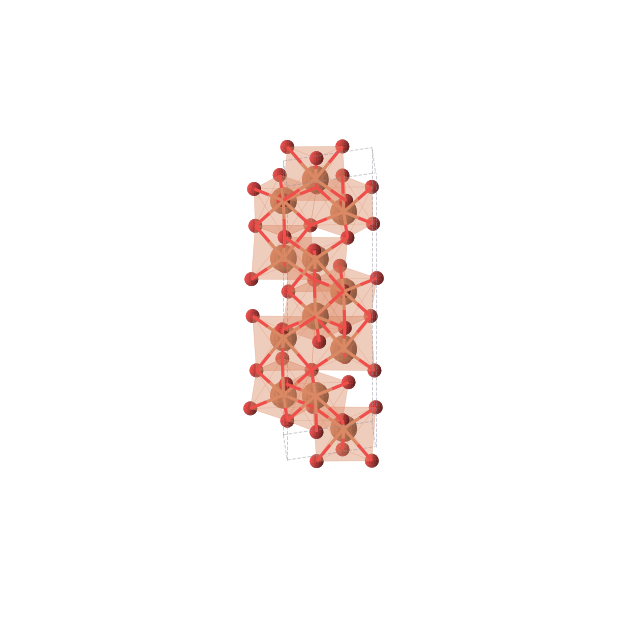
About Iron(III) oxide
What is Fe2O3 and what structure family does it belong to?
Fe2O3 is iron(III) oxide, the oxide of iron in the +3 state. It has several polymorphs: alpha (hematite), beta, gamma (maghemite) and epsilon. Hematite, the stable form, has the corundum structure. Its oxygen ions are hexagonally close-packed, and iron fills two-thirds of the octahedral sites. Maghemite is a cation-deficient spinel, so some of its iron sits on tetrahedral sites. In battery research Fe2O3 is grouped with conversion oxide anodes such as Fe3O4, Co3O4, MnO2 and CuO. It reacts with lithium to form metallic iron and lithium oxide, rather than simply taking lithium into its lattice. Iron is abundant and Fe2O3 has low toxicity, which is one reason it is so widely studied.
What is Fe2O3 used for?
In battery research, Fe2O3 is studied as a conversion-reaction anode for lithium-ion and sodium-ion batteries. Its high theoretical capacity and low cost make it attractive, even though the conversion reaction causes large volume changes. Outside energy storage, iron(III) oxide is an established industrial material. As the mineral hematite it is a main iron ore for steelmaking. It is also a red pigment in paints, ceramics and coatings, and a component of iron-based catalysts. Hematite is also researched for gas sensors and as a photoanode for splitting water with light. Practical battery electrodes usually rely on nanostructuring, conductive carbon coatings or composite designs to limit mechanical damage during cycling.
How stable and synthesizable is Fe2O3?
Alpha-Fe2O3 (hematite) is the thermodynamically stable iron(III) oxide at ambient conditions. Maghemite and the beta and epsilon polymorphs are metastable and tend to turn into hematite when heated. Fe2O3 is easy to make on a large scale. Routes include oxidising metallic iron or iron(II) compounds, calcining precursors, hydrothermal synthesis and thermal decomposition. In battery electrodes the main challenge is structural, not synthetic. The conversion reaction causes large volume changes, so how well capacity holds up over cycling depends on nanostructuring and a conductive matrix. These help prevent particles from cracking apart and losing electrical contact.
What is the electronic character of Fe2O3 and what does it imply?
Hematite is a semiconductor. Electrons move by small-polaron hopping between iron centres, so its electronic conductivity at room temperature is low. In practice it is usually n-type because of oxygen vacancies and other defects. Bare Fe2O3 battery anodes therefore need conductive carbon or nanostructuring to carry current to the active material. Its band gap lets it absorb visible light, which is why hematite works as a photoanode for photoelectrochemical water splitting. However, low carrier mobility and short carrier lifetimes mean the material needs careful nanostructuring to perform well.
How does Fe2O3 compare with Fe3O4, Co3O4, MnO2, and other conversion oxide anodes?
Among conversion-oxide anodes, Fe2O3 stands out for its abundance and low toxicity. Unlike cobalt oxides such as Co3O4 and CoO, it contains no expensive, supply-limited elements. Magnetite (Fe3O4) conducts electricity better because electrons hop quickly between its mixed-valence Fe2+ and Fe3+ ions. Fe2O3, however, has a somewhat higher theoretical lithium storage capacity per unit mass. Manganese oxides (MnO2, Mn2O3) and copper oxide (CuO) are also low-cost conversion anodes. Fe2O3 competes with them mainly on raw-material availability and environmental friendliness.
Key Properties
Cross-validated computational properties for Iron(III) oxide, aggregated across 6 databases.
Band GapEnergy needed to move an electron from the valence band to the conduction band. Lower or zero values tend to behave more metallic; larger gaps are more insulating or semiconducting.
Energy Above HullThermodynamic distance from the most stable set of competing phases. 0 eV/atom is on the convex hull; small positive values may still be experimentally accessible.
StabilityA plain-language summary of the best reported energy-above-hull result. It reflects whether the lowest-energy structure is on, near, or far from the stability hull.
StructuresCount of reported calculated crystal structures for this formula, including alternate polymorphs, source databases, and observed space groups.
Cross-Source DFT Agreement
How well independent DFT databases agree on the thermodynamics of Fe2O3. Tight agreement means computed properties can be trusted without re-running calculations.
Agreement ScoreA normalized confidence score summarizing how closely independent DFT databases agree. Higher scores mean tighter cross-source agreement.
Hull SpreadDifference between the highest and lowest energy-above-hull values reported by comparable sources. Smaller spread means less thermodynamic disagreement.
Sources ComparedNumber and names of computational sources with comparable entries for this formula.
Space Group ConsensusWhether independent sources predict the same crystal symmetry for the lowest-energy structure.
Reported Structures
Lowest-energy structures reported for Fe2O3, ranked by energy above hull.
| Space GroupSymmetry classification of the crystal arrangement. The number is the international space-group index. | Crystal SystemBroad lattice family, such as cubic, tetragonal, monoclinic, or triclinic, derived from unit-cell symmetry. | Band Gap (eV)Electronic gap calculated for this specific reported structure, measured in electronvolts. | E above hull (eV/atom)Thermodynamic distance from the convex hull for this structure, normalized per atom. Lower is generally more stable. | E/atom (eV)Computed total energy normalized per atom. Use energy above hull, not this value alone, when comparing stability. | Density (g/cm³)Mass per relaxed crystal volume, reported in grams per cubic centimeter. |
|---|---|---|---|---|---|
| — | — | 1.09 | 0.0000 | -1.650 | — |
| R-3c (No. 167) | trigonal | 0.41 | 0.0000 | -1.450 | — |
| R-3c (No. 167) | trigonal | 0.00 | 0.0000 | -8.064 | 5.14 |
| — | — | 1.22 | 0.0129 | -1.637 | — |
| — | — | 1.22 | 0.0145 | -1.635 | — |
| — | — | — | 0.0148 | -1.635 | — |
| — | — | 1.21 | 0.0151 | -1.635 | — |
| — | — | 1.08 | 0.0369 | -1.613 | — |
| R-3c (No. 167) | trigonal | 0.00 | 0.0398 | -1.410 | — |
| — | — | 1.04 | 0.0568 | -1.593 | — |
| — | — | 1.11 | 0.0600 | -1.590 | — |
| Ia-3 (No. 206) | cubic | 1.39 | 0.0713 | -7.993 | 4.86 |
Synthesis Routes
Literature-extracted synthesis procedures targeting Fe2O3.
Applications
Where Iron(III) oxide is used.
Patent Landscape
5 patents reference Fe2O3 or close compositional variants.
| Patent | Title | Assignee | Granted |
|---|---|---|---|
| 6720284 | Au/Fe2O3 catalyst materials, method for the production thereof and their use | — | — |
| 6984337 | Mn—Zn ferrite containing less than 50 mol% Fe2O3 | — | — |
| 6984338 | Mn-Zn ferrite containing less than 50 mol % Fe2O3 | — | — |
| 11535911 | Method for reducing formation of CaSO4 and Fe2O3 containing deposits in a pressure oxidation autoclave and/or | — | — |
| 10513436 | Production of pure hydrogen and synthesis gas or carbon with CUO-Fe2O3 oxygen carriers using chemical looping | — | — |
Frequently Asked Questions
Common questions about Iron(III) oxide, answered from cross-validated data and the published literature.
Is Fe2O3 the same as rust?
Not exactly. Rust is mostly hydrated iron(III) oxide and iron oxyhydroxides, while Fe2O3 is the anhydrous compound. The natural mineral form of anhydrous alpha-Fe2O3 is hematite.
What is the difference between hematite and maghemite?
Is Fe2O3 magnetic?
Why is Fe2O3 considered a conversion anode rather than an intercalation anode?
Is Fe2O3 safe to handle?
What is Fe2O3?
What is Fe2O3 used for?
What is the band gap of Fe2O3?
Is Fe2O3 a metal, semiconductor, or insulator?
Is Fe2O3 thermodynamically stable?
What is the crystal structure of Fe2O3?
How many polymorphs of Fe2O3 are known?
How is Fe2O3 synthesized?
What elements does Fe2O3 contain?
Where does the data for Fe2O3 come from?
Related Research
Related Compounds
Other Conversion Oxide Anodes in the database.
Data sources & attribution
- oqmd — Data from the OQMD (oqmd.org). Cite: Saal et al., JOM 65, 1501 (2013); Kirklin et al., npj Comp. Mater. 1, 15010 (2015). (CC-BY-4.0)
- jarvis — Data from JARVIS (jarvis.nist.gov), NIST. Cite: Choudhary et al., npj Comp. Mater. 6, 173 (2020). (LicenseRef-US-Gov-PD)
- materials_project — Data from the Materials Project (materialsproject.org). Cite: Jain et al., APL Materials 1, 011002 (2013). (CC-BY-4.0)
Analyze Fe2O3 in the Lattice Graph platform
Polymorph comparison, confidence scoring, supply-chain risk, and patent monitoring — across 85 source databases.
Explore the Platform →