ZnO
Zinc oxide · Zincite, Calamine
Zinc oxide is a stable, semiconducting inorganic compound widely employed for its catalytic and electronic properties.
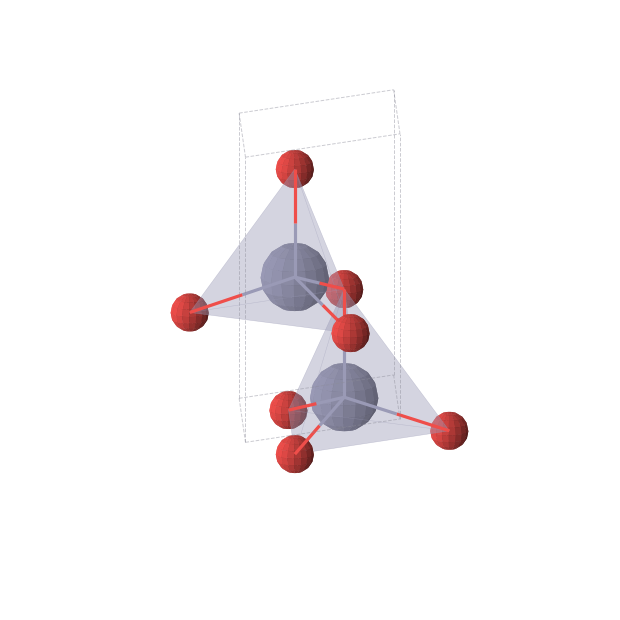
About Zinc oxide
Zinc oxide is a thermodynamically stable semiconducting material that serves as a cornerstone in modern materials science. Its robust electronic structure and high structural versatility make it a preferred candidate for various catalytic and optoelectronic applications.
Because it resides on the convex hull, this compound exhibits exceptional stability, ensuring reliable performance in demanding chemical environments. It is widely utilized in industrial processes where its surface reactivity and electronic properties can be precisely tuned.
Key Properties
Cross-validated computational properties for Zinc oxide, aggregated across 4 databases.
Band GapEnergy needed to move an electron from the valence band to the conduction band. Lower or zero values tend to behave more metallic; larger gaps are more insulating or semiconducting.
Energy Above HullThermodynamic distance from the most stable set of competing phases. 0 eV/atom is on the convex hull; small positive values may still be experimentally accessible.
StabilityA plain-language summary of the best reported energy-above-hull result. It reflects whether the lowest-energy structure is on, near, or far from the stability hull.
StructuresCount of reported calculated crystal structures for this formula, including alternate polymorphs, source databases, and observed space groups.
Synthesis Routes
Literature-extracted synthesis procedures targeting ZnO.
Applications
Where Zinc oxide is used.
Patent Landscape
70 patents reference ZnO or close compositional variants.
| Patent | Title | Assignee | Granted |
|---|---|---|---|
| 9464005 | Dielectric ceramic composition comprising Bi2O3, ZnO, Nb2O5 and V2O5, dielectric ceramic, electronic device, a | — | — |
| 5488019 | Dielectric ceramic composition containing ZnO-B.sub.2 O.sub.3 -SiO.sub.2 glass, method of preparing the same, | — | — |
| 8187976 | Stable P-type semiconducting behaviour in Li and Ni codoped ZnO | — | — |
| 10633609 | Process for in-situ synthesis of dispersion ZnO—TiO2 nanoparticles in oil | — | — |
| 8636927 | ZnO deposition material and ZnO film formed of the same | — | — |
| 6358378 | Method for fabricating ZnO thin film for ultraviolet detection and emission source operated at room temperatur | — | — |
| 4681717 | Process for the chemical preparation of high-field ZnO varistors | — | — |
| 7799291 | Apparatus for synthesis of ZnO nano-structured materials | — | — |
| 8642123 | Integration of ZnO nanowires with nanocrystalline diamond fibers | — | — |
| 5264403 | Dielectric ceramic composition containing ZnO-B.sub.2 O.sub.3 -SiO.sub.2 glass | — | — |
Frequently Asked Questions
Common questions about Zinc oxide, answered from cross-validated data.
What is ZnO?
Zinc oxide is a stable, semiconducting inorganic compound widely employed for its catalytic and electronic properties.
What is ZnO used for?
What is the band gap of ZnO?
Is ZnO a metal, semiconductor, or insulator?
Is ZnO thermodynamically stable?
How many polymorphs of ZnO are known?
How is ZnO synthesized?
What elements does ZnO contain?
Where does the data for ZnO come from?
How It Compares
Within the spinel oxide catalysts class.
Within the diverse family of spinel and related oxides, ZnO stands out as a highly accessible and extensively studied semiconductor compared to more complex perovskites like LaNiO3 or LaMnO3. While materials such as MgAl2O4 often serve as structural substrates, ZnO is frequently prioritized in catalytic research for its distinct electronic character and ease of synthesis.
Related Compounds
Other Spinel Oxide Catalysts in the database.
Data sources & attribution
- latticegraph — Lattice Graph Materials Intelligence Platform
Analyze ZnO in the Lattice Graph platform
Polymorph comparison, confidence scoring, supply-chain risk, and patent monitoring — across 53 integrated data sources.
Explore the Platform →