MgAl2O4
Magnesium aluminate spinel · magnesium aluminate, spinel, magnesium aluminium oxide, magnesia alumina spinel
MgAl2O4 is magnesium aluminate, a mixed magnesium-aluminum oxide that crystallizes in the archetypal spinel structure. It is a thermodynamically stable, wide-band-gap insulating oxide widely used as a refractory ceramic, catalyst support, and optical material.
About Magnesium aluminate spinel
What is MgAl2O4 and what structure does it adopt?
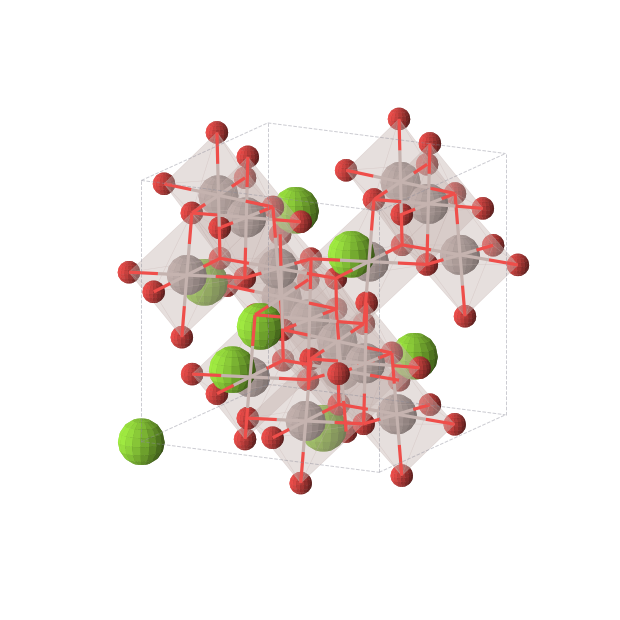
MgAl2O4 is magnesium aluminate, the archetypal member of the spinel crystal structure family. In the ideal normal cubic arrangement, magnesium cations occupy tetrahedral sites and aluminum cations occupy octahedral sites within a cubic close-packed oxygen framework. The compound is hard, chemically inert, and has a high melting point. Real samples often show partial cation inversion (some Mg and Al exchanging sites), and aluminum-rich non-stoichiometric variants are also known, making it a foundational reference compound for the spinel family.
What is MgAl2O4 used for?
Magnesium aluminate spinel is extensively used as a refractory material in high-temperature industrial linings and metallurgy, where its chemical stability and slag resistance are prized. In catalysis, it serves as a robust support material for active metal particles and oxide components. Fully dense polycrystalline ceramics of the compound are processed into transparent windows, infrared domes, and transparent armor because they transmit from the ultraviolet to the mid-infrared. Single crystals are also used as substrates for epitaxial thin-film growth, for example of GaN.
How stable and synthesizable is MgAl2O4?
MgAl2O4 is thermodynamically stable and does not decompose into competing phases under ambient conditions. It is readily synthesized by conventional solid-state reaction of magnesium and aluminum oxides at high temperatures. Wet-chemical methods such as combustion synthesis, sol-gel processing, and co-precipitation are also widely used to prepare homogeneous, fine powders at lower calcination temperatures.
What is the electronic character of MgAl2O4 and what does it imply?
MgAl2O4 is a wide-band-gap insulator with negligible electrical conductivity under normal conditions. This electronic character underlies its broad optical transparency and its use as an electrical insulator. In catalytic applications the oxide generally does not act as an electronically active semiconductor; instead, it provides a chemically resilient support that anchors and disperses metal or oxide catalysts.
How does MgAl2O4 compare to related oxides?
Unlike transition-metal oxides such as CuO and NiO, which feature correlated electronic states and antiferromagnetic order, MgAl2O4 is a non-magnetic, wide-band-gap insulator chosen for chemical and thermal inertness. Compared with ZnO, a semiconductor known for electronic transport and luminescence, MgAl2O4 is insulating. Relative to binary Al2O3, it shares high insulating strength and hardness but has the cubic spinel structure. Compared with perovskite oxides such as metallic LaNiO3, the manganite LaMnO3, dielectric LaAlO3, and multiferroic BiFeO3, MgAl2O4 lacks complex electronic and ferroic ordering and is valued mainly as a stable structural, refractory, and optical material.
Key Properties
Cross-validated computational properties for Magnesium aluminate spinel, aggregated across 3 databases.
Band GapEnergy needed to move an electron from the valence band to the conduction band. Lower or zero values tend to behave more metallic; larger gaps are more insulating or semiconducting.
Energy Above HullThermodynamic distance from the most stable set of competing phases. 0 eV/atom is on the convex hull; small positive values may still be experimentally accessible.
StabilityA plain-language summary of the best reported energy-above-hull result. It reflects whether the lowest-energy structure is on, near, or far from the stability hull.
StructuresCount of reported calculated crystal structures for this formula, including alternate polymorphs, source databases, and observed space groups.
Cross-Source DFT Agreement
How well independent DFT databases agree on the thermodynamics of MgAl2O4. Tight agreement means computed properties can be trusted without re-running calculations.
Agreement ScoreA normalized confidence score summarizing how closely independent DFT databases agree. Higher scores mean tighter cross-source agreement.
Hull SpreadDifference between the highest and lowest energy-above-hull values reported by comparable sources. Smaller spread means less thermodynamic disagreement.
Sources ComparedNumber and names of computational sources with comparable entries for this formula.
Space Group ConsensusWhether independent sources predict the same crystal symmetry for the lowest-energy structure.
Reported Structures
Lowest-energy structures reported for MgAl2O4, ranked by energy above hull.
| Space GroupSymmetry classification of the crystal arrangement. The number is the international space-group index. | Crystal SystemBroad lattice family, such as cubic, tetragonal, monoclinic, or triclinic, derived from unit-cell symmetry. | Band Gap (eV)Electronic gap calculated for this specific reported structure, measured in electronvolts. | E above hull (eV/atom)Thermodynamic distance from the convex hull for this structure, normalized per atom. Lower is generally more stable. | E/atom (eV)Computed total energy normalized per atom. Use energy above hull, not this value alone, when comparing stability. | Density (g/cm³)Mass per relaxed crystal volume, reported in grams per cubic centimeter. |
|---|---|---|---|---|---|
| Fd-3m (No. 227) | cubic | 5.63 | 0.0000 | -3.268 | — |
| Fd-3m (No. 227) | cubic | 5.11 | 0.0000 | -7.500 | 3.58 |
| — | — | 5.53 | 0.0012 | -3.230 | — |
| — | — | 5.54 | 0.0016 | -3.229 | — |
| R3m (No. 160) | trigonal | 4.56 | 0.0074 | -7.493 | 3.59 |
| C2/m (No. 12) | monoclinic | 4.34 | 0.0077 | -7.493 | 3.47 |
| Cm (No. 8) | monoclinic | 3.81 | 0.0091 | -7.491 | 3.59 |
| P3m1 (No. 156) | trigonal | 4.59 | 0.0100 | -7.491 | 3.47 |
| P3m1 (No. 156) | trigonal | 4.12 | 0.0132 | -7.487 | 3.59 |
| R3m (No. 160) | trigonal | 4.18 | 0.0165 | -7.484 | 3.47 |
| R3m (No. 160) | trigonal | 4.27 | 0.0206 | -7.480 | 3.47 |
| P3m1 (No. 156) | trigonal | 4.25 | 0.0270 | -7.473 | 3.47 |
Synthesis Routes
Literature-extracted synthesis procedures targeting MgAl2O4.
Applications
Where Magnesium aluminate spinel is used.
Patent Landscape
7 patents reference MgAl2O4 or close compositional variants.
| Patent | Title | Assignee | Granted |
|---|---|---|---|
| 7438004 | MgAl2O4 spinel refractory as containment liner for high-temperature alkali salt containing environments | — | — |
| 9938195 | Heat insulating material containing a porous sintered body formed of MgAl2O4 | — | — |
| 6673731 | MgAl2O4-system dielectric ceramic composition and method for fabricating dielectric ceramic using the same | — | — |
| 12281024 | Copper oxide-magnesium (CuO.MgAl2O4) spinel nanocomposite and method of synthesis thereof | — | — |
| 12420267 | g-C3N4@CoO/MgAl2O4 nanocomposite for hydrogen generation | — | — |
| 12365586 | Nanocomposite of graphitic C3N4, MnO2, and MgAl2O4 for hydrogen generation | — | — |
| 12370534 | g-C3N4@CuO/MgAl2O4 nanocomposite synthesis for hydrogen generation | — | — |
Frequently Asked Questions
Common questions about Magnesium aluminate spinel, answered from cross-validated data and the published literature.
Is MgAl2O4 the same as natural spinel?
Essentially, yes. The mineral spinel has the ideal formula MgAl2O4 and gives the whole spinel structure group its name. Natural crystals usually contain minor substitutions of other cations such as iron, zinc, or chromium, which also cause the colors of gem spinel.
Does MgAl2O4 conduct electricity?
Can MgAl2O4 be transparent?
Why is MgAl2O4 popular as a catalyst support?
Is MgAl2O4 well studied?
What is MgAl2O4?
What is MgAl2O4 used for?
What is the band gap of MgAl2O4?
Is MgAl2O4 a metal, semiconductor, or insulator?
Is MgAl2O4 thermodynamically stable?
What is the crystal structure of MgAl2O4?
How many polymorphs of MgAl2O4 are known?
How is MgAl2O4 synthesized?
What elements does MgAl2O4 contain?
Where does the data for MgAl2O4 come from?
Related Compounds
Other Spinel Oxide Catalysts in the database.
Data sources & attribution
- jarvis — Data from JARVIS (jarvis.nist.gov), NIST. Cite: Choudhary et al., npj Comp. Mater. 6, 173 (2020). (LicenseRef-US-Gov-PD)
- materials_project — Data from the Materials Project (materialsproject.org). Cite: Jain et al., APL Materials 1, 011002 (2013). (CC-BY-4.0)
- oqmd — Data from the OQMD (oqmd.org). Cite: Saal et al., JOM 65, 1501 (2013); Kirklin et al., npj Comp. Mater. 1, 15010 (2015). (CC-BY-4.0)
Analyze MgAl2O4 in the Lattice Graph platform
Polymorph comparison, confidence scoring, supply-chain risk, and patent monitoring — across 85 source databases.
Explore the Platform →