TiPO4
TiPO4 is a metastable, semimetallic transition-metal phosphate used primarily in fundamental materials research.
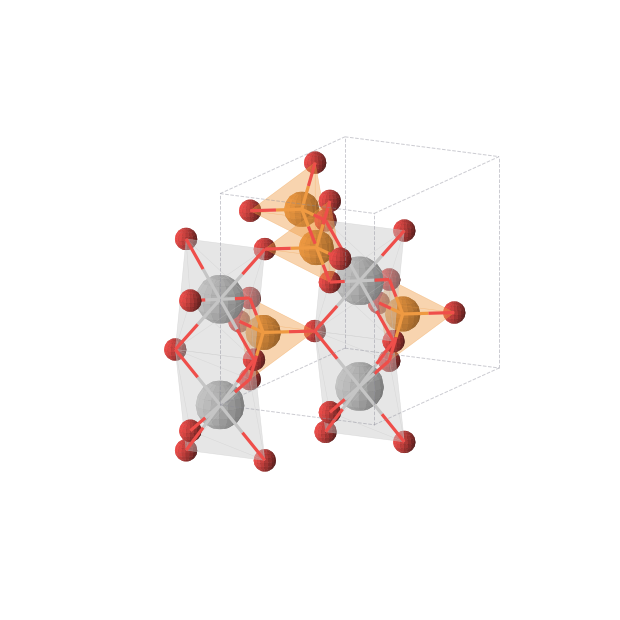
About TiPO4
TiPO4 is a transition-metal phosphate that exhibits semimetallic electronic behavior. As a metastable phase, it represents a complex structural arrangement within the phosphate family, drawing significant interest for its distinct electronic configuration compared to more conventional insulating phosphates. The material is characterized by its structural diversity, with numerous reported configurations across databases. Its status as a metastable compound makes it a subject of fundamental research into phase stability and potential applications in advanced electronic or electrochemical systems.
Key Properties
Cross-validated computational properties for TiPO4, aggregated across 3 databases.
Band GapEnergy needed to move an electron from the valence band to the conduction band. Lower or zero values tend to behave more metallic; larger gaps are more insulating or semiconducting.
Energy Above HullThermodynamic distance from the most stable set of competing phases. 0 eV/atom is on the convex hull; small positive values may still be experimentally accessible.
StabilityA plain-language summary of the best reported energy-above-hull result. It reflects whether the lowest-energy structure is on, near, or far from the stability hull.
StructuresCount of reported calculated crystal structures for this formula, including alternate polymorphs, source databases, and observed space groups.
Cross-Source DFT Agreement
How well independent DFT databases agree on the thermodynamics of TiPO4. Tight agreement means computed properties can be trusted without re-running calculations.
Agreement ScoreA normalized confidence score summarizing how closely independent DFT databases agree. Higher scores mean tighter cross-source agreement.
Hull SpreadDifference between the highest and lowest energy-above-hull values reported by comparable sources. Smaller spread means less thermodynamic disagreement.
Sources ComparedNumber and names of computational sources with comparable entries for this formula.
Space Group ConsensusWhether independent sources predict the same crystal symmetry for the lowest-energy structure.
Reported Structures
Lowest-energy structures reported for TiPO4, ranked by energy above hull.
| Space GroupSymmetry classification of the crystal arrangement. The number is the international space-group index. | Crystal SystemBroad lattice family, such as cubic, tetragonal, monoclinic, or triclinic, derived from unit-cell symmetry. | Band Gap (eV)Electronic gap calculated for this specific reported structure, measured in electronvolts. | E above hull (eV/atom)Thermodynamic distance from the convex hull for this structure, normalized per atom. Lower is generally more stable. | E/atom (eV)Computed total energy normalized per atom. Use energy above hull, not this value alone, when comparing stability. | Density (g/cm³)Mass per relaxed crystal volume, reported in grams per cubic centimeter. |
|---|---|---|---|---|---|
| Cmcm (No. 63) | orthorhombic | 0.00 | 0.0000 | -2.645 | — |
| — | — | 0.00 | 0.0384 | -2.791 | — |
| Cmcm (No. 63) | orthorhombic | 0.06 | 0.0718 | -8.474 | 3.39 |
| R-3c (No. 167) | trigonal | 0.00 | 0.0767 | -8.469 | 3.15 |
| Pnma (No. 62) | orthorhombic | 0.00 | 0.0866 | -8.459 | 3.17 |
| — | — | 0.00 | 0.1045 | -2.725 | — |
| Pnma (No. 62) | orthorhombic | — | — | — | 3.17 |
| Pnma (No. 62) | orthorhombic | — | — | — | 3.36 |
| Pnma (No. 62) | orthorhombic | — | — | — | 3.22 |
| Cmcm (No. 63) | orthorhombic | — | — | — | 3.60 |
| P21/m (No. 11) | monoclinic | — | — | — | 3.56 |
| Cmcm (No. 63) | orthorhombic | — | — | — | 3.39 |
Applications
Where TiPO4 is used.
Frequently Asked Questions
Common questions about TiPO4, answered from cross-validated data.
What is TiPO4?
TiPO4 is a metastable, semimetallic transition-metal phosphate used primarily in fundamental materials research.
What is TiPO4 used for?
What is the band gap of TiPO4?
Is TiPO4 a metal, semiconductor, or insulator?
Is TiPO4 thermodynamically stable?
What is the crystal structure of TiPO4?
What is the density of TiPO4?
How many polymorphs of TiPO4 are known?
What elements does TiPO4 contain?
Where does the data for TiPO4 come from?
How It Compares
Within the transition-metal phosphates class.
Unlike the widely utilized lithium-ion battery cathode materials such as LiFePO4 or LiCoPO4, which are typically stable insulators, TiPO4 stands out due to its semimetallic nature and metastable state. While compounds like TiP2O7 are frequently investigated for their framework stability in solid-state ionics, TiPO4 offers a different electronic profile that challenges standard design paradigms for transition-metal phosphate frameworks.
Related Compounds
Other Transition-Metal Phosphates in the database.
Data sources & attribution
- jarvis — Data from JARVIS (jarvis.nist.gov), NIST. Cite: Choudhary et al., npj Comp. Mater. 6, 173 (2020). (LicenseRef-US-Gov-PD)
- oqmd — Data from the OQMD (oqmd.org). Cite: Saal et al., JOM 65, 1501 (2013); Kirklin et al., npj Comp. Mater. 1, 15010 (2015). (CC-BY-4.0)
- materials_project — Data from the Materials Project (materialsproject.org). Cite: Jain et al., APL Materials 1, 011002 (2013). (CC-BY-4.0)
- mpaloe — Data from MP-ALOE. Cite: Kuner et al., npj Comput. Mater. (2025), doi:10.1038/s41524-025-01834-9.
- cod — Data from the Crystallography Open Database (crystallography.net/cod/). Cite: Grazulis et al., J. Appl. Cryst. 42, 726 (2009). (CC0-1.0)
Analyze TiPO4 in the Lattice Graph platform
Polymorph comparison, confidence scoring, supply-chain risk, and patent monitoring — across 85 source databases.
Explore the Platform →