LiFePO4
Lithium iron phosphate · LFP
Lithium iron phosphate is a stable, safe, and widely utilized cathode material for rechargeable lithium-ion batteries.
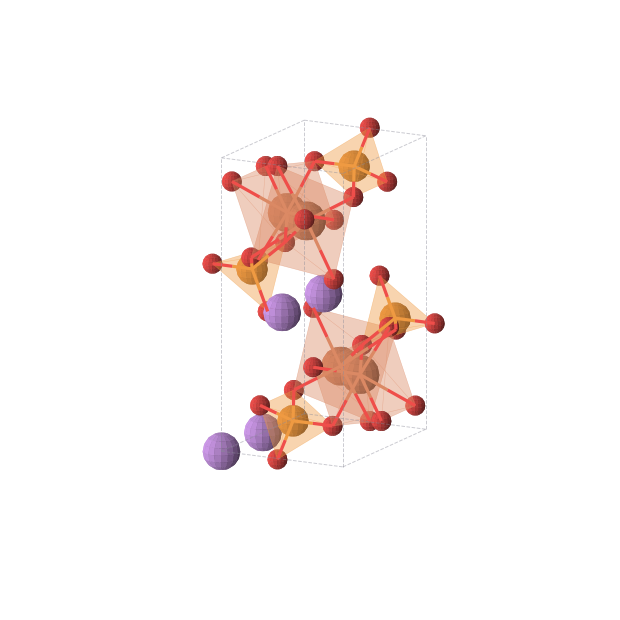
About Lithium iron phosphate
Lithium iron phosphate is a prominent olivine phosphate cathode material characterized by its exceptional thermodynamic stability. As a wide-band-gap insulator, it relies on structural design to facilitate efficient ion transport during electrochemical cycling, making it a cornerstone of modern energy storage technology. Its ability to maintain structural integrity over many charge-discharge cycles has solidified its position as a preferred choice for large-scale battery applications where safety and cycle life are paramount. The material is highly data-rich, with extensive structural studies documenting its behavior across various synthesis conditions.
Key Properties
Cross-validated computational properties for Lithium iron phosphate, aggregated across 3 databases.
Band GapEnergy needed to move an electron from the valence band to the conduction band. Lower or zero values tend to behave more metallic; larger gaps are more insulating or semiconducting.
Energy Above HullThermodynamic distance from the most stable set of competing phases. 0 eV/atom is on the convex hull; small positive values may still be experimentally accessible.
StabilityA plain-language summary of the best reported energy-above-hull result. It reflects whether the lowest-energy structure is on, near, or far from the stability hull.
StructuresCount of reported calculated crystal structures for this formula, including alternate polymorphs, source databases, and observed space groups.
Cross-Source DFT Agreement
How well independent DFT databases agree on the thermodynamics of LiFePO4. Tight agreement means computed properties can be trusted without re-running calculations.
Agreement ScoreA normalized confidence score summarizing how closely independent DFT databases agree. Higher scores mean tighter cross-source agreement.
Hull SpreadDifference between the highest and lowest energy-above-hull values reported by comparable sources. Smaller spread means less thermodynamic disagreement.
Sources ComparedNumber and names of computational sources with comparable entries for this formula.
Space Group ConsensusWhether independent sources predict the same crystal symmetry for the lowest-energy structure.
Reported Structures
Lowest-energy structures reported for LiFePO4, ranked by energy above hull.
| Space GroupSymmetry classification of the crystal arrangement. The number is the international space-group index. | Crystal SystemBroad lattice family, such as cubic, tetragonal, monoclinic, or triclinic, derived from unit-cell symmetry. | Band Gap (eV)Electronic gap calculated for this specific reported structure, measured in electronvolts. | E above hull (eV/atom)Thermodynamic distance from the convex hull for this structure, normalized per atom. Lower is generally more stable. | E/atom (eV)Computed total energy normalized per atom. Use energy above hull, not this value alone, when comparing stability. | Density (g/cm³)Mass per relaxed crystal volume, reported in grams per cubic centimeter. |
|---|---|---|---|---|---|
| — | — | 4.21 | 0.0000 | -2.410 | — |
| Pnma (No. 62) | orthorhombic | 3.92 | 0.0000 | -7.564 | 3.68 |
| Pc (No. 7) | monoclinic | 3.58 | 0.0082 | -7.555 | 2.84 |
| Pna21 (No. 33) | orthorhombic | 3.83 | 0.0105 | -7.553 | 2.91 |
| R3 (No. 146) | trigonal | 2.45 | 0.0107 | -7.553 | 2.98 |
| Pca21 (No. 29) | orthorhombic | 3.50 | 0.0114 | -7.552 | 2.93 |
| P21/c (No. 14) | monoclinic | 3.50 | 0.0117 | -7.552 | 2.90 |
| — | — | 3.21 | 0.0126 | -2.397 | — |
| P-1 (No. 2) | triclinic | 0.38 | 0.0138 | -2.062 | — |
| Pca21 (No. 29) | orthorhombic | 3.52 | 0.0139 | -7.550 | 2.92 |
| Cc (No. 9) | monoclinic | 3.48 | 0.0149 | -7.549 | 2.92 |
| Cmcm (No. 63) | orthorhombic | 3.51 | 0.0159 | -7.548 | 3.57 |
Synthesis Routes
Literature-extracted synthesis procedures targeting LiFePO4.
Applications
Where Lithium iron phosphate is used.
Patent Landscape
9 patents reference LiFePO4 or close compositional variants.
| Patent | Title | Assignee | Granted |
|---|---|---|---|
| 9368794 | LiFePO4 flakes for Li-ion battery and method for manufacturing the same | — | — |
| 11476462 | LiFePO4 precursor for manufacturing electrode material of Li-ion battery and method for manufacturing the same | — | — |
| 9484574 | Hydrothermal process for the production of LiFePO4 powder | — | — |
| 9954227 | Crystalline nanometric LiFePO4 | — | — |
| 9199850 | Method of fabricating LiFePO4 cathode electroactive material by recycling, and LiFePO4 cathode electroactive m | — | — |
| 11799084 | Method for making LiFePO4 by hydrothermal method | — | — |
| 9209461 | Process for the preparation of LiFePO4-carbon composites | — | — |
| 9139429 | High performance cathode material LiFePO4, its precursors and methods of making thereof | — | — |
| 9672951 | Method for preparing graphene-based LiFePO4/C composite material | — | — |
Frequently Asked Questions
Common questions about Lithium iron phosphate, answered from cross-validated data.
What is LiFePO4?
Lithium iron phosphate is a stable, safe, and widely utilized cathode material for rechargeable lithium-ion batteries.
What is LiFePO4 used for?
What is the band gap of LiFePO4?
Is LiFePO4 a metal, semiconductor, or insulator?
Is LiFePO4 thermodynamically stable?
What is the crystal structure of LiFePO4?
What is the density of LiFePO4?
How many polymorphs of LiFePO4 are known?
How is LiFePO4 synthesized?
What elements does LiFePO4 contain?
Where does the data for LiFePO4 come from?
Related Research
How the Materials Project, OQMD, AFLOW and JARVIS-DFT differ in size, DFT functional, license and access, why their values disagree, and when to use each.
Lithium iron phosphate battery vs NMC: how LFP and NMC 811 cathodes compare on energy density, cycle life, thermal safety, cost, and cobalt and nickel use.
What makes a mineral critical, the 17 rare earth elements and their uses, who mines and refines them, battery mineral concentration, and how recycling can help.
How lithium-ion battery recycling works: black mass, pyrometallurgy vs hydrometallurgy vs direct recycling, LFP economics, and EU recovery targets.
Lithium cobalt oxide dominated consumer electronics for decades, but scaling it to electric vehicles reveals fundamental structural, thermal, and economic failures. We analyzed 47 computational studies and 12 experimental datasets — nearly 15,000 structural relaxations and 1,200+ cells — to show why no amount of engineering can overcome LCO physics for automotive applications.
How It Compares
Within the olivine phosphate cathodes class.
Within the family of olivine phosphate cathodes, LiFePO4 stands out as the most commercially mature and reliable option compared to siblings like LiMnPO4 or LiCoPO4. While other members of the class often struggle with lower conductivity or structural instability during cycling, LiFePO4 offers a superior balance of safety and cost-effectiveness, making it the industry standard for stationary storage and electric vehicle power systems.
Related Compounds
Other Olivine Phosphate Cathodes in the database.
Data sources & attribution
- oqmd — Data from the OQMD (oqmd.org). Cite: Saal et al., JOM 65, 1501 (2013); Kirklin et al., npj Comp. Mater. 1, 15010 (2015). (CC-BY-4.0)
- materials_project — Data from the Materials Project (materialsproject.org). Cite: Jain et al., APL Materials 1, 011002 (2013). (CC-BY-4.0)
- jarvis — Data from JARVIS (jarvis.nist.gov), NIST. Cite: Choudhary et al., npj Comp. Mater. 6, 173 (2020). (LicenseRef-US-Gov-PD)
Analyze LiFePO4 in the Lattice Graph platform
Polymorph comparison, confidence scoring, supply-chain risk, and patent monitoring — across 85 source databases.
Explore the Platform →