CdS
Cadmium sulfide · cadmium(II) sulfide, greenockite, hawleyite, cadmium yellow
Cadmium sulfide (CdS) is a binary II-VI semiconductor made of cadmium and sulfur. It is thermodynamically stable. In nature it occurs as the minerals greenockite (hexagonal) and hawleyite (cubic). It is widely used as a bright yellow pigment, as a photoconductor, and as a window layer in thin-film solar cells.
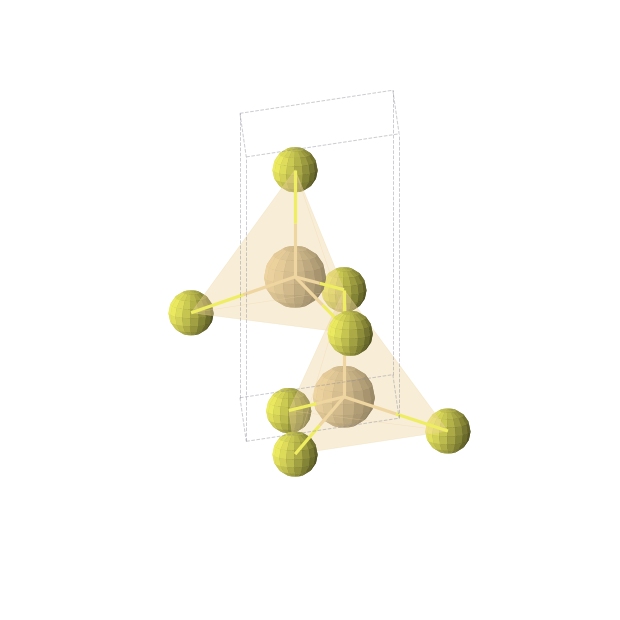
About Cadmium sulfide
What is CdS and what structure family does it belong to?
CdS is a binary chalcogenide in the II-VI semiconductor family. It has two forms (it is dimorphic). The thermodynamically stable form is the hexagonal wurtzite structure, found in nature as the mineral greenockite. The other form is the metastable cubic zinc blende structure, found as the rarer mineral hawleyite. Under high pressure, CdS changes to a rock-salt type structure. Its bonding is partly covalent and partly ionic. CdS can be made in many forms, from bulk single crystals to thin films and colloidal nanocrystals.
What is CdS used for?
CdS has long been used as a yellow-to-orange pigment known as cadmium yellow, valued for its color stability. In electronics it is a sensitive photoconductor: its conductivity rises sharply under light, so it is used in light-dependent resistors (photoresistors). In thin-film solar cells, such as cadmium telluride and copper indium gallium selenide cells, CdS films act as the n-type buffer and window layer. They let longer-wavelength sunlight pass through to the main absorber layer. CdS is also widely studied for solar-driven photocatalytic hydrogen production and for environmental cleanup.
How stable and synthesizable is CdS?
CdS is a thermodynamically stable compound of the cadmium-sulfur system, so it does not tend to break down into other phases. It can be made in many ways. Thin films are grown by chemical bath deposition, thermal evaporation, and sputtering. Large bulk single crystals are grown from the vapor phase. Colloidal nanoparticles are made by precipitation or solvothermal routes.
What is the electronic character of CdS and what does it imply?
CdS is a direct band gap semiconductor, and its gap lies in the visible range. It absorbs higher-energy (shorter-wavelength) visible light and transmits longer wavelengths, which is why it looks yellow. This visible absorption edge, its suitable band alignments, and its strong photoconductive response make it useful in photoresistors and in solar-powered photocatalytic reactions. Its main weakness as a photocatalyst is photocorrosion: photogenerated holes oxidize the sulfide. This is usually reduced with protective coatings or by pairing CdS with other materials (heterojunctions).
How does CdS compare to CdSe, CdTe, and ZnS?
Among these II-VI semiconductors, CdS has a wider band gap than cadmium selenide (CdSe) and cadmium telluride (CdTe), but a narrower one than zinc sulfide (ZnS). CdTe's absorption edge suits it to be the main light absorber in solar cells. CdS's wider gap lets it act as a window layer paired with CdTe without absorbing the lower-energy photons. ZnS has a much wider gap and transmits more ultraviolet light, while CdSe's narrower gap lets it absorb further into the red.
Key Properties
Cross-validated computational properties for Cadmium sulfide, aggregated across 5 databases.
Band GapEnergy needed to move an electron from the valence band to the conduction band. Lower or zero values tend to behave more metallic; larger gaps are more insulating or semiconducting.
Energy Above HullThermodynamic distance from the most stable set of competing phases. 0 eV/atom is on the convex hull; small positive values may still be experimentally accessible.
StabilityA plain-language summary of the best reported energy-above-hull result. It reflects whether the lowest-energy structure is on, near, or far from the stability hull.
StructuresCount of reported calculated crystal structures for this formula, including alternate polymorphs, source databases, and observed space groups.
Cross-Source DFT Agreement
How well independent DFT databases agree on the thermodynamics of CdS. Tight agreement means computed properties can be trusted without re-running calculations.
Agreement ScoreA normalized confidence score summarizing how closely independent DFT databases agree. Higher scores mean tighter cross-source agreement.
Hull SpreadDifference between the highest and lowest energy-above-hull values reported by comparable sources. Smaller spread means less thermodynamic disagreement.
Sources ComparedNumber and names of computational sources with comparable entries for this formula.
Space Group ConsensusWhether independent sources predict the same crystal symmetry for the lowest-energy structure.
Reported Structures
Lowest-energy structures reported for CdS, ranked by energy above hull.
| Space GroupSymmetry classification of the crystal arrangement. The number is the international space-group index. | Crystal SystemBroad lattice family, such as cubic, tetragonal, monoclinic, or triclinic, derived from unit-cell symmetry. | Band Gap (eV)Electronic gap calculated for this specific reported structure, measured in electronvolts. | E above hull (eV/atom)Thermodynamic distance from the convex hull for this structure, normalized per atom. Lower is generally more stable. | E/atom (eV)Computed total energy normalized per atom. Use energy above hull, not this value alone, when comparing stability. | Density (g/cm³)Mass per relaxed crystal volume, reported in grams per cubic centimeter. |
|---|---|---|---|---|---|
| — | — | 1.20 | 0.0000 | -0.790 | — |
| P63mc (No. 186) | hexagonal | 1.12 | 0.0000 | -14.846 | 4.70 |
| F-43m (No. 216) | cubic | 0.99 | 0.0000 | -0.670 | — |
| — | — | 1.31 | 0.0002 | -0.790 | — |
| P63mc (No. 186) | hexagonal | 1.06 | 0.0003 | -0.670 | — |
| — | — | 1.21 | 0.0006 | -0.790 | — |
| — | — | 1.34 | 0.0025 | -0.788 | — |
| F-43m (No. 216) | cubic | 1.05 | 0.0027 | -14.843 | 4.71 |
| Cmc21 (No. 36) | orthorhombic | 0.97 | 0.0074 | -0.663 | — |
| Fm-3m (No. 225) | cubic | 0.31 | 0.0737 | -0.597 | — |
| Fm-3m (No. 225) | cubic | 0.14 | 0.0816 | -0.589 | — |
| — | — | 0.71 | 0.1142 | -0.676 | — |
Synthesis Routes
Literature-extracted synthesis procedures targeting CdS.
Applications
Where Cadmium sulfide is used.
Patent Landscape
5 patents reference CdS or close compositional variants.
| Patent | Title | Assignee | Granted |
|---|---|---|---|
| 7211462 | Process for large-scale production of CdTe/CdS thin film solar cells | — | — |
| 6444043 | Apparatus for depositing CdS and CdTe layers on substrates by means of a CSS process | — | — |
| 9202867 | Nanocrystals containing CdTe core with CdS and ZnS coatings | — | — |
| 6300274 | CdS photocatalyst for hydrogen production, preparation therefor and method for producing hydrogen by use of th | — | — |
| 10934176 | Methods of degrading organic pollutants and preventing or treating microbe using Bi2S3-CdS particles | — | — |
Frequently Asked Questions
Common questions about Cadmium sulfide, answered from cross-validated data and the published literature.
Why is CdS yellow?
CdS has a band gap in the visible range. It absorbs short-wavelength light (violet, blue, and some green) and reflects or transmits longer wavelengths such as yellow and red, which gives it its color.
Is CdS toxic?
What crystal structure does CdS have?
Why is CdS used in solar cells?
Can CdS be used for photocatalysis?
What is CdS?
What is CdS used for?
What is the band gap of CdS?
Is CdS a metal, semiconductor, or insulator?
Is CdS thermodynamically stable?
What is the crystal structure of CdS?
How many polymorphs of CdS are known?
How is CdS synthesized?
What elements does CdS contain?
Where does the data for CdS come from?
Related Compounds
Other II-VI Semiconductors in the database.
Data sources & attribution
- oqmd — Data from the OQMD (oqmd.org). Cite: Saal et al., JOM 65, 1501 (2013); Kirklin et al., npj Comp. Mater. 1, 15010 (2015). (CC-BY-4.0)
- materials_project — Data from the Materials Project (materialsproject.org). Cite: Jain et al., APL Materials 1, 011002 (2013). (CC-BY-4.0)
- jarvis — Data from JARVIS (jarvis.nist.gov), NIST. Cite: Choudhary et al., npj Comp. Mater. 6, 173 (2020). (LicenseRef-US-Gov-PD)
Analyze CdS in the Lattice Graph platform
Polymorph comparison, confidence scoring, supply-chain risk, and patent monitoring — across 85 source databases.
Explore the Platform →