SrTiO3
Strontium titanate · ST, STO
Strontium titanate is a stable, semiconducting perovskite oxide widely used as a substrate in thin-film electronics and optical components.
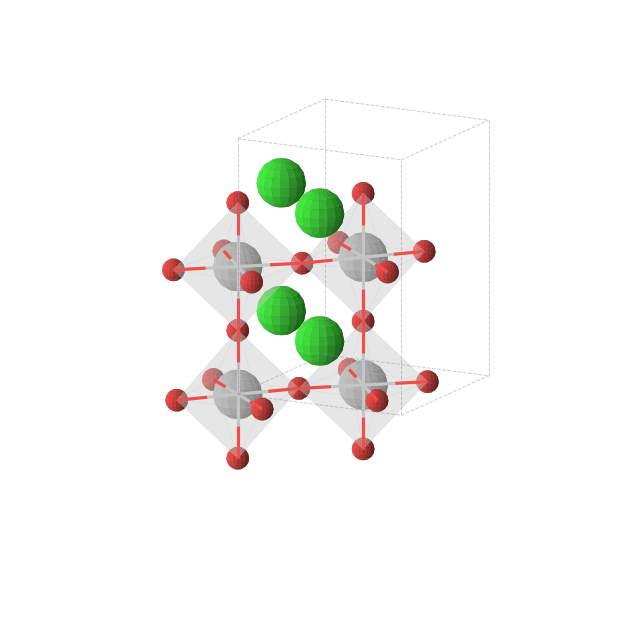
About Strontium titanate
Strontium titanate is a prominent member of the perovskite oxide family, characterized by its robust thermodynamic stability. As a semiconducting material, it serves as a foundational building block in condensed matter physics and materials science research due to its structural versatility and reliable performance. Its ability to host various dopants makes it highly adaptable for complex electronic systems. The compound is widely utilized in the development of high-k dielectrics, thin-film substrates, and optoelectronic devices. Its structural integrity under diverse conditions ensures its continued relevance in both academic studies and industrial technological applications.
Key Properties
Cross-validated computational properties for Strontium titanate, aggregated across 3 databases.
Band GapEnergy needed to move an electron from the valence band to the conduction band. Lower or zero values tend to behave more metallic; larger gaps are more insulating or semiconducting.
Energy Above HullThermodynamic distance from the most stable set of competing phases. 0 eV/atom is on the convex hull; small positive values may still be experimentally accessible.
StabilityA plain-language summary of the best reported energy-above-hull result. It reflects whether the lowest-energy structure is on, near, or far from the stability hull.
StructuresCount of reported calculated crystal structures for this formula, including alternate polymorphs, source databases, and observed space groups.
Synthesis Routes
Literature-extracted synthesis procedures targeting SrTiO3.
Applications
Where Strontium titanate is used.
Patent Landscape
8 patents reference SrTiO3 or close compositional variants.
| Patent | Title | Assignee | Granted |
|---|---|---|---|
| 7714695 | Method for manufacturing SrTiO3 series varistor using grain boundary segregation | — | — |
| 6292355 | SrTiO3-based grain boundary barrier layer capacitor | — | — |
| 6514476 | Anisotropically shaped SrTiO3 single crystal particles | — | — |
| 8361550 | Method for forming SrTiO3 film and storage medium | — | — |
| 6790278 | Method for preparing low-resistant p-type SrTiO3 | — | — |
| 4419310 | SrTiO.sub.3 barrier layer capacitor | — | — |
| 7604892 | Y and Nb-doped SrTiO3 as a mixed conducting anode for solid oxide fuel cells | — | — |
| 7816282 | Method for forming SrTiO3 film | — | — |
Frequently Asked Questions
Common questions about Strontium titanate, answered from cross-validated data.
What is SrTiO3?
Strontium titanate is a stable, semiconducting perovskite oxide widely used as a substrate in thin-film electronics and optical components.
What is SrTiO3 used for?
What is the band gap of SrTiO3?
Is SrTiO3 a metal, semiconductor, or insulator?
Is SrTiO3 thermodynamically stable?
How many polymorphs of SrTiO3 are known?
How is SrTiO3 synthesized?
What elements does SrTiO3 contain?
Where does the data for SrTiO3 come from?
How It Compares
Within the perovskite oxides class.
Within the diverse group of perovskite oxides, SrTiO3 stands out as a highly stable and well-characterized material compared to more complex or magnetic counterparts like LaMnO3 or BiFeO3. While materials such as BaTiO3 are frequently utilized for their strong ferroelectric responses, SrTiO3 is often preferred as a high-quality substrate for epitaxial growth due to its excellent lattice matching and consistent semiconducting behavior, making it a cornerstone of modern thin-film engineering.
Related Compounds
Other Perovskite Oxides in the database.
Data sources & attribution
- latticegraph — Lattice Graph Materials Intelligence Platform
Analyze SrTiO3 in the Lattice Graph platform
Polymorph comparison, confidence scoring, supply-chain risk, and patent monitoring — across 53 integrated data sources.
Explore the Platform →