NaHO
sodium hydroxide · caustic soda, lye, sodium hydrate, soda lye
NaHO is sodium hydroxide, usually written NaOH. It is an ionic compound made of sodium cations and hydroxide anions. Calculations place it on the convex hull, which makes it a thermodynamically stable phase, and it is an electronic insulator with a wide band gap.
About sodium hydroxide
What is NaHO and what structure family does it belong to?
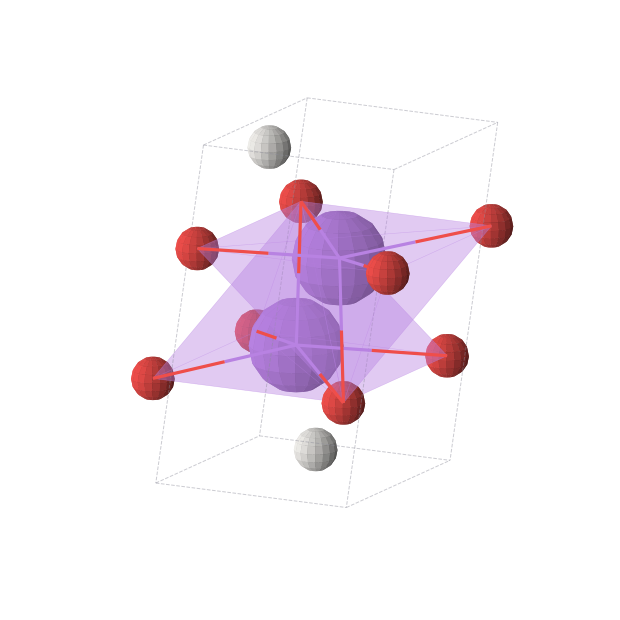
NaHO, usually written NaOH, is an inorganic ionic hydroxide made of sodium cations and hydroxide anions. At room temperature it has an orthorhombic, layered structure. When heated it changes to a monoclinic phase and then to a cubic phase before it melts, and further phases appear at high pressure. It belongs to the alkali-metal hydroxide family: ionic compounds of monovalent metal cations with hydroxide anions.
What is NaHO used for?
Sodium hydroxide is a major commodity chemical. Its main uses include pulp and paper production, soap and detergent manufacturing, water treatment, chemical synthesis and pH control. In the Bayer process it dissolves bauxite ore for aluminium production, and it is also used in industrial cleaning agents and drain cleaners. It is not used as an active electronic material.
How stable is NaHO and how easy is it to synthesize?
Calculations place NaHO on the convex hull, so it is a stable phase among sodium–hydrogen–oxygen compounds. Industry makes it in large amounts by the chlor-alkali process, which electrolyses aqueous sodium chloride to produce chlorine, hydrogen and sodium hydroxide. Solid sodium hydroxide is strongly hygroscopic and deliquescent. It quickly absorbs moisture and atmospheric carbon dioxide, which forms sodium carbonate, so it must be stored and handled dry and airtight.
What is the electronic character of NaHO and what does it imply?
Solid NaHO is an electronic insulator with a wide band gap, so it conducts almost no electronic current. That rules it out for electronic uses such as semiconductor channels or transparent conductors. Molten sodium hydroxide and its aqueous solutions do conduct electricity, but the current is carried by moving ions.
How does NaHO compare to other members of its class?
NaHO is a classic alkali-metal hydroxide. Potassium hydroxide, a heavier relative, is similar: strongly basic, ionically bonded and a wide-band-gap insulator. The two differ in cation size and in their phase-transition behaviour. NaHO has a closed-shell electronic structure and is non-magnetic.
Key Properties
Cross-validated computational properties for sodium hydroxide, aggregated across 3 databases.
Band GapEnergy needed to move an electron from the valence band to the conduction band. Lower or zero values tend to behave more metallic; larger gaps are more insulating or semiconducting.
Energy Above HullThermodynamic distance from the most stable set of competing phases. 0 eV/atom is on the convex hull; small positive values may still be experimentally accessible.
StabilityA plain-language summary of the best reported energy-above-hull result. It reflects whether the lowest-energy structure is on, near, or far from the stability hull.
StructuresCount of reported calculated crystal structures for this formula, including alternate polymorphs, source databases, and observed space groups.
Cross-Source DFT Agreement
How well independent DFT databases agree on the thermodynamics of NaHO. Tight agreement means computed properties can be trusted without re-running calculations.
Agreement ScoreA normalized confidence score summarizing how closely independent DFT databases agree. Higher scores mean tighter cross-source agreement.
Hull SpreadDifference between the highest and lowest energy-above-hull values reported by comparable sources. Smaller spread means less thermodynamic disagreement.
Sources ComparedNumber and names of computational sources with comparable entries for this formula.
Space Group ConsensusWhether independent sources predict the same crystal symmetry for the lowest-energy structure.
Reported Structures
Lowest-energy structures reported for NaHO, ranked by energy above hull.
| Space GroupSymmetry classification of the crystal arrangement. The number is the international space-group index. | Crystal SystemBroad lattice family, such as cubic, tetragonal, monoclinic, or triclinic, derived from unit-cell symmetry. | Band Gap (eV)Electronic gap calculated for this specific reported structure, measured in electronvolts. | E above hull (eV/atom)Thermodynamic distance from the convex hull for this structure, normalized per atom. Lower is generally more stable. | E/atom (eV)Computed total energy normalized per atom. Use energy above hull, not this value alone, when comparing stability. | Density (g/cm³)Mass per relaxed crystal volume, reported in grams per cubic centimeter. |
|---|---|---|---|---|---|
| — | — | 4.02 | 0.0000 | -1.504 | — |
| P21 (No. 4) | monoclinic | 3.80 | 0.0000 | -1.425 | — |
| P21 (No. 4) | monoclinic | 3.00 | 0.0000 | -4.773 | 2.29 |
| Pbcm (No. 57) | orthorhombic | 3.31 | 0.0014 | -4.772 | 2.37 |
| — | — | 3.96 | 0.0033 | -1.501 | — |
| Pbcm (No. 57) | orthorhombic | 3.73 | 0.0041 | -1.421 | — |
| — | — | 3.49 | 0.0067 | -1.498 | — |
| — | — | 3.28 | 0.0078 | -1.497 | — |
| — | — | 3.27 | 0.0084 | -1.496 | — |
| P21/m (No. 11) | monoclinic | 3.20 | 0.0091 | -1.416 | — |
| Cmcm (No. 63) | orthorhombic | 3.18 | 0.0091 | -1.416 | — |
| Cmcm (No. 63) | orthorhombic | 2.81 | 0.0092 | -4.764 | 2.16 |
Applications
Where sodium hydroxide is used.
Frequently Asked Questions
Common questions about sodium hydroxide, answered from cross-validated data and the published literature.
Is NaHO the same as NaOH?
Yes. NaHO is the formula as written in this database; the compound is sodium hydroxide, usually written NaOH.
Is sodium hydroxide an insulator or a conductor?
Is NaHO thermodynamically stable?
What polymorphs does solid sodium hydroxide form?
Why must sodium hydroxide be protected from air?
What is NaHO?
What is NaHO used for?
What is the band gap of NaHO?
Is NaHO a metal, semiconductor, or insulator?
What is the crystal structure of NaHO?
How many polymorphs of NaHO are known?
What elements does NaHO contain?
Where does the data for NaHO come from?
Data sources & attribution
- oqmd — Data from the OQMD (oqmd.org). Cite: Saal et al., JOM 65, 1501 (2013); Kirklin et al., npj Comp. Mater. 1, 15010 (2015). (CC-BY-4.0)
- jarvis — Data from JARVIS (jarvis.nist.gov), NIST. Cite: Choudhary et al., npj Comp. Mater. 6, 173 (2020). (LicenseRef-US-Gov-PD)
- materials_project — Data from the Materials Project (materialsproject.org). Cite: Jain et al., APL Materials 1, 011002 (2013). (CC-BY-4.0)
Analyze NaHO in the Lattice Graph platform
Polymorph comparison, confidence scoring, supply-chain risk, and patent monitoring — across 85 source databases.
Explore the Platform →