Na2SiO3
sodium metasilicate · disodium metasilicate, disodium trioxosilicate, disodium monosilicate
Na2SiO3, commonly called sodium metasilicate, is a thermodynamically stable, wide-band-gap insulating inorganic compound. It is built from chains of corner-sharing SiO4 tetrahedra held together by sodium cations. In industry it is used mainly as an alkaline ingredient in detergents and cleaners. It is also used in cements and binders, and as a stabilizer in peroxide bleaching of pulp.
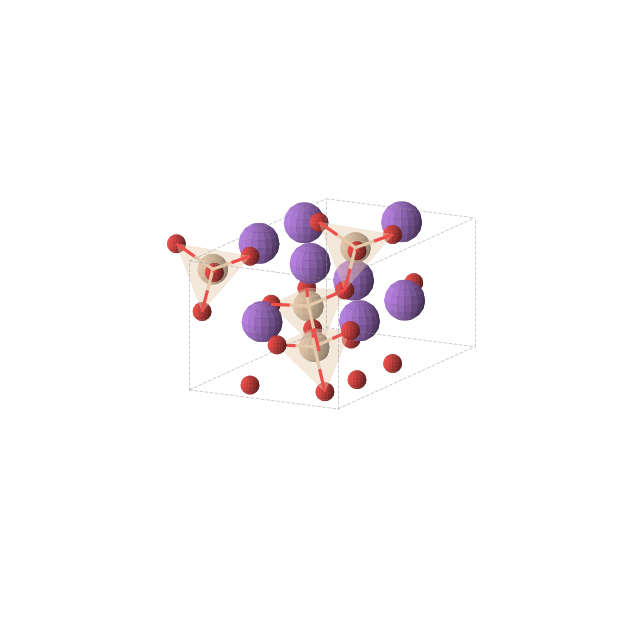
About sodium metasilicate
What is Na2SiO3 and what structure does it adopt?
Na2SiO3, sodium metasilicate, is an inosilicate (chain silicate). In the anhydrous solid the metasilicate anion is not a separate SiO3 unit. It is a polymer made of single (zweier) chains of corner-sharing SiO4 tetrahedra running along one axis of an orthorhombic unit cell (space group Cmc21). Sodium cations connect the chains, and each is surrounded by five oxygen atoms in a distorted trigonal-bipyramidal arrangement. Raman spectroscopy and X-ray diffraction studies have reported a transition to a lower-symmetry structure on heating well below the melting point, followed by premelting effects at higher temperatures.
What is Na2SiO3 used for?
Sodium metasilicate is a widely made industrial chemical. Its main use is in household and industrial cleaners, dishwasher and laundry detergents, and metal-cleaning formulations. There it provides alkalinity and pH buffering, helps emulsify fats and keep soil suspended, and helps protect metal, glass and glaze surfaces from alkaline attack. It is also used in cements and binders, including as a solid alkali activator for alkali-activated slag cements. In pulp and paper processing it acts as a buffer and stabilizer in hydrogen peroxide bleaching. Its other uses include egg preservation and automotive cooling-system and exhaust repair products.
How stable and synthesizable is Na2SiO3?
Na2SiO3 is a stable compound in the Na2O–SiO2 system and has been manufactured commercially for a long time. The anhydrous form is made at high temperature from sodium silicate glass, which is produced by melting high-purity sand with soda ash. The hydrated forms, such as the pentahydrate, are crystallized from sodium silicate solutions that have been adjusted with caustic soda. The solid is stable when dry, but it is hygroscopic and deliquescent: it absorbs moisture and dissolves in water to give strongly alkaline solutions.
Is Na2SiO3 an electrical conductor, semiconductor, or insulator?
Na2SiO3 is an electrical insulator with a wide band gap. Electrons are held in localized covalent Si–O bonds and ionic Na–O interactions, so there is no significant electronic conduction. The crystals are colorless, as expected for a material with such a large gap. At high temperatures, well below the melting point, sodium ions become mobile, so any charge transport comes from ion motion rather than electrons.
How does Na2SiO3 compare with other sodium silicates?
Sodium silicates differ in their ratio of Na2O to SiO2. At the metasilicate composition (a ratio of about one), the silicate anions form infinite single chains. More silica-rich compositions such as sodium disilicate (Na2Si2O5) have more connected, layered silicate anions and are less alkaline. Sodium orthosilicate (Na4SiO4) has isolated SiO4 tetrahedra and is more strongly alkaline.
Key Properties
Cross-validated computational properties for sodium metasilicate, aggregated across 3 databases.
Band GapEnergy needed to move an electron from the valence band to the conduction band. Lower or zero values tend to behave more metallic; larger gaps are more insulating or semiconducting.
Energy Above HullThermodynamic distance from the most stable set of competing phases. 0 eV/atom is on the convex hull; small positive values may still be experimentally accessible.
StabilityA plain-language summary of the best reported energy-above-hull result. It reflects whether the lowest-energy structure is on, near, or far from the stability hull.
StructuresCount of reported calculated crystal structures for this formula, including alternate polymorphs, source databases, and observed space groups.
Cross-Source DFT Agreement
How well independent DFT databases agree on the thermodynamics of Na2SiO3. Tight agreement means computed properties can be trusted without re-running calculations.
Agreement ScoreA normalized confidence score summarizing how closely independent DFT databases agree. Higher scores mean tighter cross-source agreement.
Hull SpreadDifference between the highest and lowest energy-above-hull values reported by comparable sources. Smaller spread means less thermodynamic disagreement.
Sources ComparedNumber and names of computational sources with comparable entries for this formula.
Space Group ConsensusWhether independent sources predict the same crystal symmetry for the lowest-energy structure.
Reported Structures
Lowest-energy structures reported for Na2SiO3, ranked by energy above hull.
| Space GroupSymmetry classification of the crystal arrangement. The number is the international space-group index. | Crystal SystemBroad lattice family, such as cubic, tetragonal, monoclinic, or triclinic, derived from unit-cell symmetry. | Band Gap (eV)Electronic gap calculated for this specific reported structure, measured in electronvolts. | E above hull (eV/atom)Thermodynamic distance from the convex hull for this structure, normalized per atom. Lower is generally more stable. | E/atom (eV)Computed total energy normalized per atom. Use energy above hull, not this value alone, when comparing stability. | Density (g/cm³)Mass per relaxed crystal volume, reported in grams per cubic centimeter. |
|---|---|---|---|---|---|
| Cmc21 (No. 36) | orthorhombic | 4.15 | 0.0000 | -2.511 | — |
| Cmc21 (No. 36) | orthorhombic | 3.86 | 0.0000 | -6.518 | 2.67 |
| — | — | 4.23 | 0.0005 | -2.601 | — |
| — | — | 4.23 | 0.0038 | -2.598 | — |
| — | — | 4.30 | 0.0927 | -2.509 | — |
| — | — | 4.88 | 0.2605 | -2.341 | — |
| — | — | 4.89 | 0.2609 | -2.341 | — |
| Cmc21 (No. 36) | orthorhombic | — | — | — | 2.68 |
| Cmc21 (No. 36) | orthorhombic | — | — | — | 2.61 |
| Cmc21 (No. 36) | orthorhombic | — | — | — | 2.54 |
| Cmc21 (No. 36) | orthorhombic | — | — | — | 2.68 |
Synthesis Routes
Literature-extracted synthesis procedures targeting Na2SiO3.
Applications
Where sodium metasilicate is used.
Frequently Asked Questions
Common questions about sodium metasilicate, answered from cross-validated data and the published literature.
Is Na2SiO3 the same as water glass?
Not exactly. Water glass is a general term for sodium silicate glasses and their water solutions, which can have a range of silica-to-sodium ratios. Na2SiO3 is a single crystalline compound with a fixed composition. Dissolving it gives an alkaline sodium silicate solution at the low-silica end of the water-glass composition range.
What hydrates does sodium metasilicate form?
Is sodium metasilicate hazardous?
Does Na2SiO3 dissolve in water?
Does Na2SiO3 occur as a natural mineral?
What is Na2SiO3?
What is Na2SiO3 used for?
What is the band gap of Na2SiO3?
Is Na2SiO3 a metal, semiconductor, or insulator?
Is Na2SiO3 thermodynamically stable?
What is the crystal structure of Na2SiO3?
How many polymorphs of Na2SiO3 are known?
How is Na2SiO3 synthesized?
What elements does Na2SiO3 contain?
Where does the data for Na2SiO3 come from?
Data sources & attribution
- jarvis — Data from JARVIS (jarvis.nist.gov), NIST. Cite: Choudhary et al., npj Comp. Mater. 6, 173 (2020). (LicenseRef-US-Gov-PD)
- materials_project — Data from the Materials Project (materialsproject.org). Cite: Jain et al., APL Materials 1, 011002 (2013). (CC-BY-4.0)
- oqmd — Data from the OQMD (oqmd.org). Cite: Saal et al., JOM 65, 1501 (2013); Kirklin et al., npj Comp. Mater. 1, 15010 (2015). (CC-BY-4.0)
- cod — Data from the Crystallography Open Database (crystallography.net/cod/). Cite: Grazulis et al., J. Appl. Cryst. 42, 726 (2009). (CC0-1.0)
- mpaloe — Data from MP-ALOE. Cite: Kuner et al., npj Comput. Mater. (2025), doi:10.1038/s41524-025-01834-9.
Analyze Na2SiO3 in the Lattice Graph platform
Polymorph comparison, confidence scoring, supply-chain risk, and patent monitoring — across 85 source databases.
Explore the Platform →