MgCl2
Magnesium chloride · magnesium dichloride, magnesium(II) chloride
Magnesium chloride (MgCl2) is a binary inorganic salt of magnesium and chlorine. It is thermodynamically stable, very soluble in water, and electrically a wide-band-gap insulator. It readily forms hydrates and is widely used in industry, in food, and in catalysis.
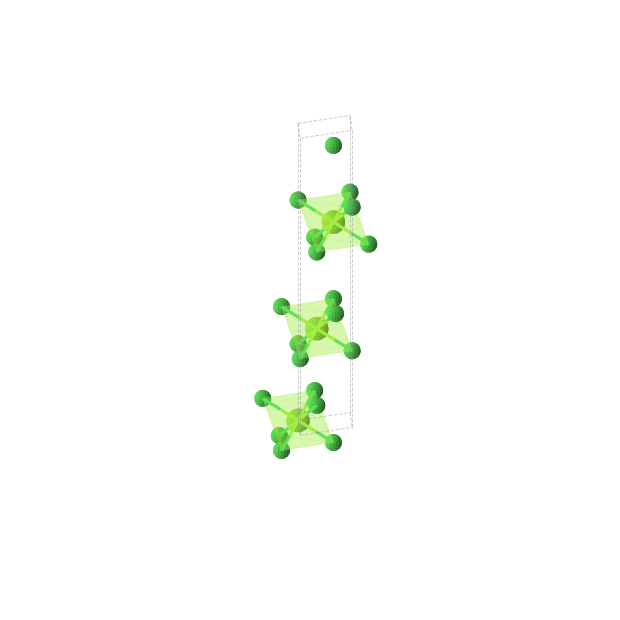
About Magnesium chloride
What is MgCl2 and what structure does it adopt?
MgCl2 is a binary ionic halide made of Mg2+ cations and Cl- anions. At ambient conditions, anhydrous MgCl2 (α-MgCl2) has the rhombohedral layered cadmium chloride-type structure. The chloride anions are cubic close-packed, and magnesium fills the octahedral holes in every other layer, giving stacked Cl–Mg–Cl sandwich layers. Diamond-anvil-cell experiments show that under modest pressure it changes to a hexagonal layered cadmium iodide-type structure (β-MgCl2), in which the chloride layers stack differently. In moist air it forms hydrates, most notably the hexahydrate, where six water molecules bind directly to each magnesium cation.
What is magnesium chloride used for?
Magnesium chloride is widely used to de-ice roads and to keep down dust on unpaved roads. Molten magnesium chloride is a main feedstock for making magnesium metal by electrolysis. Anhydrous MgCl2 is the standard solid support in heterogeneous Ziegler–Natta catalysts for olefin polymerization. In food, it is used as a coagulant for soy milk in traditional tofu-making and as a source of dietary magnesium.
How stable is MgCl2 and how easy is it to synthesize?
MgCl2 is a thermodynamically stable compound. It is obtained from natural brines and evaporite deposits, or made by reacting hydrochloric acid with magnesium oxide, hydroxide, or carbonate. It can also be made directly from the elements. Because the salt strongly attracts water, drying the hydrate needs carefully controlled conditions. Otherwise, heating causes hydrolysis and produces magnesium oxide or hydroxychlorides.
Is MgCl2 a conductor, semiconductor, or insulator?
Solid MgCl2 is an electrical insulator with a wide electronic band gap. The electrons are tightly bound in the ionic lattice, so there is essentially no electronic conduction. Molten or dissolved magnesium chloride, by contrast, conducts electricity well through mobile ions rather than electrons. This is what makes electrolytic production of magnesium possible.
How does MgCl2 compare to related magnesium halides?
Among the magnesium halides, MgCl2 sits between magnesium fluoride and the heavier bromide and iodide. Magnesium fluoride forms a three-dimensional rutile-type lattice, is poorly soluble in water, and has a high melting point. MgCl2 instead has a layered structure and dissolves readily. Its formation is more strongly exothermic than that of magnesium bromide or iodide, and it is less prone to decomposing in air than magnesium iodide.
Key Properties
Cross-validated computational properties for Magnesium chloride, aggregated across 3 databases.
Band GapEnergy needed to move an electron from the valence band to the conduction band. Lower or zero values tend to behave more metallic; larger gaps are more insulating or semiconducting.
Energy Above HullThermodynamic distance from the most stable set of competing phases. 0 eV/atom is on the convex hull; small positive values may still be experimentally accessible.
StabilityA plain-language summary of the best reported energy-above-hull result. It reflects whether the lowest-energy structure is on, near, or far from the stability hull.
StructuresCount of reported calculated crystal structures for this formula, including alternate polymorphs, source databases, and observed space groups.
Cross-Source DFT Agreement
How well independent DFT databases agree on the thermodynamics of MgCl2. Tight agreement means computed properties can be trusted without re-running calculations.
Agreement ScoreA normalized confidence score summarizing how closely independent DFT databases agree. Higher scores mean tighter cross-source agreement.
Hull SpreadDifference between the highest and lowest energy-above-hull values reported by comparable sources. Smaller spread means less thermodynamic disagreement.
Sources ComparedNumber and names of computational sources with comparable entries for this formula.
Space Group ConsensusWhether independent sources predict the same crystal symmetry for the lowest-energy structure.
Reported Structures
Lowest-energy structures reported for MgCl2, ranked by energy above hull.
| Space GroupSymmetry classification of the crystal arrangement. The number is the international space-group index. | Crystal SystemBroad lattice family, such as cubic, tetragonal, monoclinic, or triclinic, derived from unit-cell symmetry. | Band Gap (eV)Electronic gap calculated for this specific reported structure, measured in electronvolts. | E above hull (eV/atom)Thermodynamic distance from the convex hull for this structure, normalized per atom. Lower is generally more stable. | E/atom (eV)Computed total energy normalized per atom. Use energy above hull, not this value alone, when comparing stability. | Density (g/cm³)Mass per relaxed crystal volume, reported in grams per cubic centimeter. |
|---|---|---|---|---|---|
| — | — | 5.68 | 0.0000 | -2.106 | — |
| P-3m1 (No. 164) | trigonal | 5.63 | 0.0000 | -1.984 | — |
| R-3m (No. 166) | trigonal | 5.62 | 0.0000 | -4.031 | 2.28 |
| P-3m1 (No. 164) | trigonal | 5.57 | 0.0006 | -4.031 | 2.31 |
| — | — | 5.81 | 0.0007 | -2.105 | — |
| R-3m (No. 166) | trigonal | 5.64 | 0.0031 | -1.981 | — |
| — | — | 5.63 | 0.0035 | -2.102 | — |
| — | — | 5.61 | 0.0055 | -2.100 | — |
| — | — | 5.58 | 0.0126 | -2.093 | — |
| — | — | 0.00 | 0.0285 | -2.077 | — |
| — | — | 4.70 | 0.0423 | -2.064 | — |
| — | — | 4.90 | 0.0431 | -2.063 | — |
Synthesis Routes
Literature-extracted synthesis procedures targeting MgCl2.
Applications
Where Magnesium chloride is used.
Patent Landscape
13 patents reference MgCl2 or close compositional variants.
| Patent | Title | Assignee | Granted |
|---|---|---|---|
| 3953573 | Removal of boron from MgCl.sub.2 brines | — | — |
| 4195070 | Preparation of a MgCl.sub.2 solution for Nalco's MgCl.sub.2 process from MgSO.sub.4 and other MgSO.sub.4 salts | — | — |
| 4341752 | Method for purification and concentration of MgCl.sub.2 -brines | — | — |
| 3953572 | Removal of boron from MgCl.sub.2 brines | — | — |
| 4248838 | Preparation of useful MgCl.sub.2. solution with subsequent recovery of KCl from carnallite | — | — |
| 4099965 | Method of using MgCl.sub.2 -KCl flux for purification of an aluminum alloy preparation | — | — |
| 3952085 | Removal of boron from MgCl.sub.2 brines | — | — |
| 6042794 | Process for producing anhydrous MgCl.sub.2 | — | — |
| 4743347 | Production of pure MgCl.sub.2 solution suitable for the production of magnesium metal from an impure magnesite | — | — |
| 4364909 | Removal of Ca.sup.++ from MgCl.sub.2 | — | — |
Frequently Asked Questions
Common questions about Magnesium chloride, answered from cross-validated data and the published literature.
Is MgCl2 soluble in water?
Yes. MgCl2 is very soluble in water and deliquescent: it pulls moisture from the air and forms hydrates.
Does magnesium chloride occur naturally?
Is MgCl2 safe to handle?
Why is MgCl2 used for de-icing roads?
Why is MgCl2 used in Ziegler-Natta polymerization?
What is MgCl2?
What is MgCl2 used for?
What is the band gap of MgCl2?
Is MgCl2 a metal, semiconductor, or insulator?
Is MgCl2 thermodynamically stable?
What is the crystal structure of MgCl2?
What is the density of MgCl2?
How many polymorphs of MgCl2 are known?
How is MgCl2 synthesized?
What elements does MgCl2 contain?
Where does the data for MgCl2 come from?
Data sources & attribution
- oqmd — Data from the OQMD (oqmd.org). Cite: Saal et al., JOM 65, 1501 (2013); Kirklin et al., npj Comp. Mater. 1, 15010 (2015). (CC-BY-4.0)
- jarvis — Data from JARVIS (jarvis.nist.gov), NIST. Cite: Choudhary et al., npj Comp. Mater. 6, 173 (2020). (LicenseRef-US-Gov-PD)
- materials_project — Data from the Materials Project (materialsproject.org). Cite: Jain et al., APL Materials 1, 011002 (2013). (CC-BY-4.0)
Analyze MgCl2 in the Lattice Graph platform
Polymorph comparison, confidence scoring, supply-chain risk, and patent monitoring — across 85 source databases.
Explore the Platform →