KNO3
Potassium nitrate · Saltpeter, Saltpetre, Nitre, Nitrate of potash
KNO3 is potassium nitrate, commonly known as saltpeter. It is an ionic salt made of potassium cations and nitrate anions. It is a thermodynamically stable, wide-band-gap insulating solid, and its main uses are in fertilizers, meat curing, and pyrotechnics.
About Potassium nitrate
What is KNO3 and what structure does it adopt?
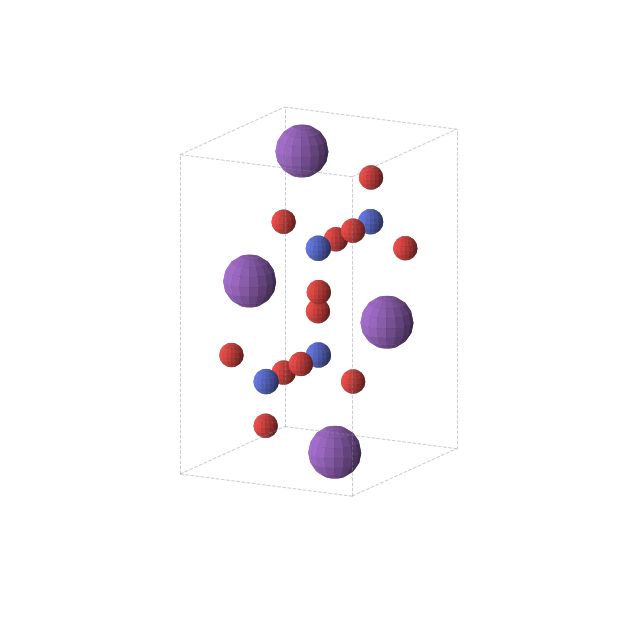
Potassium nitrate is an ionic salt containing potassium cations and planar nitrate anions. At ambient conditions it crystallizes in an orthorhombic, aragonite-type structure (phase II). On heating it transforms into a trigonal phase related to the calcite structure (phase I). On cooling it can pass through an intermediate trigonal ferroelectric phase (phase III) before returning to the ambient form. The solid is held together mainly by electrostatic attraction between potassium and nitrate ions, while covalent bonds hold each planar nitrate group together.
What is potassium nitrate used for?
Potassium nitrate has many historical and modern uses. In agriculture it is a water-soluble fertilizer that supplies both potassium and nitrate nitrogen. In the food industry it is a curing agent and preservative for meats. Bacteria reduce the nitrate to nitrite, which leads to nitric oxide binding to myoglobin and keeps the meat's characteristic red-pink colour. As an effective oxidizer it is a key ingredient of traditional black powder, fireworks, matches, and solid rocket propellants. It is also an active ingredient in desensitizing toothpastes, a component of molten nitrate salt mixtures for thermal energy storage, and is sold for removing tree stumps.
How stable and synthesizable is KNO3?
Potassium nitrate is thermodynamically stable at ambient conditions. It is easy to make by reacting potassium chloride with a nitrate source such as nitric acid, sodium nitrate, or ammonium nitrate, then separating the product by fractional crystallization. It is also recovered from natural deposits, where it forms through bacterial nitrification. Its temperature-driven phase transitions are reversible and well studied.
What is the electronic character of KNO3 and what does it imply?
Potassium nitrate is an electrical insulator with a wide band gap. Its electrons are tightly held in the closed-shell ionic lattice and in localized nitrate units, so there are no partially filled bands to carry electronic current. As a result, the pure solid is colourless and does not conduct electricity. It only conducts when molten or dissolved in water, where the potassium and nitrate ions are free to move.
How does KNO3 compare to related nitrate salts?
Potassium nitrate differs from sodium nitrate in crystal structure and solubility. At room temperature potassium nitrate has an orthorhombic aragonite-type structure, while sodium nitrate has a trigonal calcite-type lattice. Potassium nitrate is much less soluble than sodium nitrate in cold water, but its solubility rises much more steeply with temperature. This difference was historically used to separate the two salts, and other mineral salts, by fractional crystallization.
Key Properties
Cross-validated computational properties for Potassium nitrate, aggregated across 5 databases.
Band GapEnergy needed to move an electron from the valence band to the conduction band. Lower or zero values tend to behave more metallic; larger gaps are more insulating or semiconducting.
Energy Above HullThermodynamic distance from the most stable set of competing phases. 0 eV/atom is on the convex hull; small positive values may still be experimentally accessible.
StabilityA plain-language summary of the best reported energy-above-hull result. It reflects whether the lowest-energy structure is on, near, or far from the stability hull.
StructuresCount of reported calculated crystal structures for this formula, including alternate polymorphs, source databases, and observed space groups.
Cross-Source DFT Agreement
How well independent DFT databases agree on the thermodynamics of KNO3. Tight agreement means computed properties can be trusted without re-running calculations.
Agreement ScoreA normalized confidence score summarizing how closely independent DFT databases agree. Higher scores mean tighter cross-source agreement.
Hull SpreadDifference between the highest and lowest energy-above-hull values reported by comparable sources. Smaller spread means less thermodynamic disagreement.
Sources ComparedNumber and names of computational sources with comparable entries for this formula.
Space Group ConsensusWhether independent sources predict the same crystal symmetry for the lowest-energy structure.
Reported Structures
Lowest-energy structures reported for KNO3, ranked by energy above hull.
| Space GroupSymmetry classification of the crystal arrangement. The number is the international space-group index. | Crystal SystemBroad lattice family, such as cubic, tetragonal, monoclinic, or triclinic, derived from unit-cell symmetry. | Band Gap (eV)Electronic gap calculated for this specific reported structure, measured in electronvolts. | E above hull (eV/atom)Thermodynamic distance from the convex hull for this structure, normalized per atom. Lower is generally more stable. | E/atom (eV)Computed total energy normalized per atom. Use energy above hull, not this value alone, when comparing stability. | Density (g/cm³)Mass per relaxed crystal volume, reported in grams per cubic centimeter. |
|---|---|---|---|---|---|
| — | — | 3.02 | 0.0000 | -1.280 | — |
| Pnma (No. 62) | orthorhombic | 2.94 | 0.0000 | -6.285 | 2.19 |
| Pnma (No. 62) | orthorhombic | 2.82 | 0.0000 | -1.065 | — |
| — | — | 3.00 | 0.0007 | -1.279 | — |
| Pnma (No. 62) | orthorhombic | 3.31 | 0.0011 | -6.284 | 2.42 |
| R3m (No. 160) | trigonal | 2.98 | 0.0026 | -6.282 | 2.25 |
| Pm (No. 6) | monoclinic | 3.58 | 0.0029 | -6.282 | 2.26 |
| — | — | 3.06 | 0.0033 | -1.277 | — |
| P21/m (No. 11) | monoclinic | 3.55 | 0.0070 | -6.278 | 2.16 |
| P21/m (No. 11) | monoclinic | 2.98 | 0.0075 | -6.277 | 1.94 |
| R3m (No. 160) | trigonal | 3.02 | 0.0087 | -1.056 | — |
| P1 (No. 1) | triclinic | 3.06 | 0.0118 | -6.273 | 1.87 |
Applications
Where Potassium nitrate is used.
Patent Landscape
1 patent reference KNO3 or close compositional variants.
| Patent | Title | Assignee | Granted |
|---|---|---|---|
| 8871170 | Polyhalite IMI process for KNO3 production | — | — |
Frequently Asked Questions
Common questions about Potassium nitrate, answered from cross-validated data and the published literature.
Is potassium nitrate the same as saltpeter?
Yes. Saltpeter (or saltpetre) and nitre are traditional names for potassium nitrate. 'Chile saltpeter', by contrast, refers to sodium nitrate.
Is KNO3 soluble in water?
Why is potassium nitrate an effective oxidizer?
Why is potassium nitrate used in cured meats?
Does KNO3 conduct electricity?
What is KNO3?
What is KNO3 used for?
What is the band gap of KNO3?
Is KNO3 a metal, semiconductor, or insulator?
Is KNO3 thermodynamically stable?
What is the crystal structure of KNO3?
What is the density of KNO3?
How many polymorphs of KNO3 are known?
What elements does KNO3 contain?
Where does the data for KNO3 come from?
Data sources & attribution
- oqmd — Data from the OQMD (oqmd.org). Cite: Saal et al., JOM 65, 1501 (2013); Kirklin et al., npj Comp. Mater. 1, 15010 (2015). (CC-BY-4.0)
- materials_project — Data from the Materials Project (materialsproject.org). Cite: Jain et al., APL Materials 1, 011002 (2013). (CC-BY-4.0)
- jarvis — Data from JARVIS (jarvis.nist.gov), NIST. Cite: Choudhary et al., npj Comp. Mater. 6, 173 (2020). (LicenseRef-US-Gov-PD)
Analyze KNO3 in the Lattice Graph platform
Polymorph comparison, confidence scoring, supply-chain risk, and patent monitoring — across 85 source databases.
Explore the Platform →