Fe2I8Rb4
Fe2I8Rb4 is a semimetallic iron-iodide-rubidium compound that is considered a promising candidate for experimental synthesis.
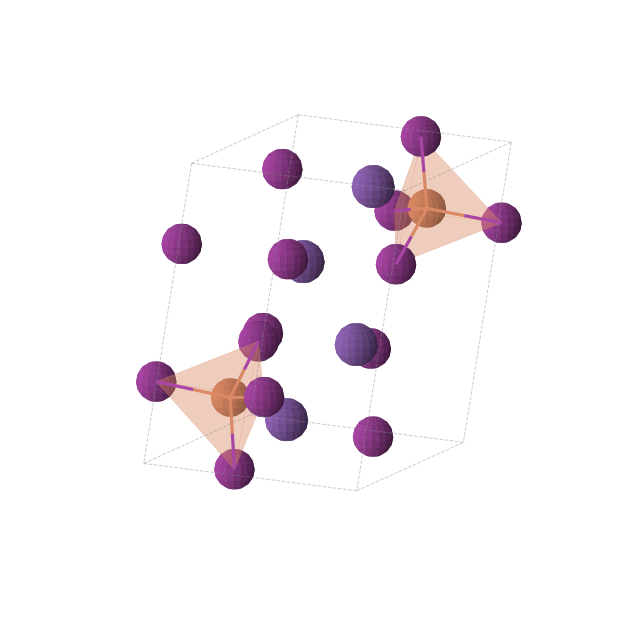
About Fe2I8Rb4
Fe2I8Rb4 is an inorganic compound featuring iron, iodine, and rubidium. Its electronic character is defined as a near-zero-gap semimetal, placing it in a unique position between traditional insulators and conductors.
As a near-hull material, it is considered likely to be synthesizable under laboratory conditions. Its structural data across multiple databases highlights its status as a notable subject for solid-state chemistry investigations.
Key Properties
Cross-validated computational properties for Fe2I8Rb4, aggregated across 1 database.
Band GapEnergy needed to move an electron from the valence band to the conduction band. Lower or zero values tend to behave more metallic; larger gaps are more insulating or semiconducting.
Energy Above HullThermodynamic distance from the most stable set of competing phases. 0 eV/atom is on the convex hull; small positive values may still be experimentally accessible.
StabilityA plain-language summary of the best reported energy-above-hull result. It reflects whether the lowest-energy structure is on, near, or far from the stability hull.
StructuresCount of reported calculated crystal structures for this formula, including alternate polymorphs, source databases, and observed space groups.
Cross-Source DFT Agreement
How well independent DFT databases agree on the thermodynamics of Fe2I8Rb4. Tight agreement means computed properties can be trusted without re-running calculations.
Only 1 independent DFT source (materials_project) reports a hull energy for Fe2I8Rb4, so cross-source agreement can't be assessed yet.
Reported Structures
Lowest-energy structures reported for Fe2I8Rb4, ranked by energy above hull.
| Space GroupSymmetry classification of the crystal arrangement. The number is the international space-group index. | Crystal SystemBroad lattice family, such as cubic, tetragonal, monoclinic, or triclinic, derived from unit-cell symmetry. | Band Gap (eV)Electronic gap calculated for this specific reported structure, measured in electronvolts. | E above hull (eV/atom)Thermodynamic distance from the convex hull for this structure, normalized per atom. Lower is generally more stable. | E/atom (eV)Computed total energy normalized per atom. Use energy above hull, not this value alone, when comparing stability. | Density (g/cm³)Mass per relaxed crystal volume, reported in grams per cubic centimeter. |
|---|---|---|---|---|---|
| P21 (No. 4) | monoclinic | 0.01 | 0.0179 | -3.504 | 3.89 |
| P21 (No. 4) | monoclinic | 2.59 | — | -3.040 | 3.67 |
Applications
Where Fe2I8Rb4 is used.
Frequently Asked Questions
Common questions about Fe2I8Rb4, answered from cross-validated data.
What is Fe2I8Rb4?
Fe2I8Rb4 is a semimetallic iron-iodide-rubidium compound that is considered a promising candidate for experimental synthesis.
What is Fe2I8Rb4 used for?
What is the band gap of Fe2I8Rb4?
Is Fe2I8Rb4 a metal, semiconductor, or insulator?
What is the crystal structure of Fe2I8Rb4?
What is the density of Fe2I8Rb4?
What elements does Fe2I8Rb4 contain?
Where does the data for Fe2I8Rb4 come from?
How It Compares
As a distinct inorganic compound, Fe2I8Rb4 occupies a specialized niche within its chemical family. While it currently stands as a unique entry without direct structural siblings in this context, its semimetallic nature suggests it may offer different transport properties compared to more conventional insulating or metallic halides.
Data sources & attribution
- materials_project — Data from the Materials Project (materialsproject.org). Cite: Jain et al., APL Materials 1, 011002 (2013). (CC-BY-4.0)
- aflow — Data from AFLOW (aflow.org). Cite: Curtarolo et al., Comp. Mater. Sci. 58, 218 (2012). (CC-BY-4.0)
Analyze Fe2I8Rb4 in the Lattice Graph platform
Polymorph comparison, confidence scoring, supply-chain risk, and patent monitoring — across 85 source databases.
Explore the Platform →