Cl2K2
Potassium chloride · KCl, Sylvite
Potassium chloride is a stable, insulating salt widely utilized as a source of potassium in industrial and medical applications.
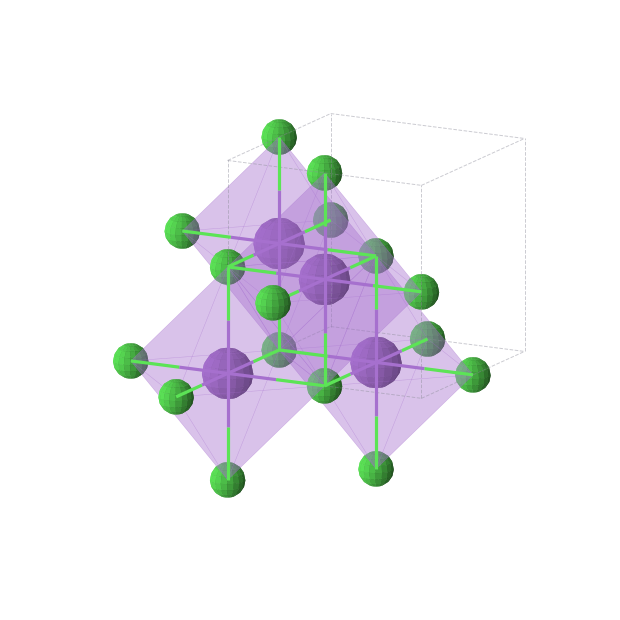
About Potassium chloride
Potassium chloride is a fundamental inorganic salt that exists as a thermodynamically stable crystalline solid. Characterized by a wide electronic band gap, it functions as a robust electrical insulator under standard conditions.
Its structural reliability is evidenced by extensive documentation across multiple scientific databases, reflecting its status as a highly consistent material. It serves as a critical component in various industrial, agricultural, and biological applications due to its predictable chemical behavior.
Key Properties
Cross-validated computational properties for Potassium chloride, aggregated across 2 databases.
Band GapEnergy needed to move an electron from the valence band to the conduction band. Lower or zero values tend to behave more metallic; larger gaps are more insulating or semiconducting.
Energy Above HullThermodynamic distance from the most stable set of competing phases. 0 eV/atom is on the convex hull; small positive values may still be experimentally accessible.
StabilityA plain-language summary of the best reported energy-above-hull result. It reflects whether the lowest-energy structure is on, near, or far from the stability hull.
StructuresCount of reported calculated crystal structures for this formula, including alternate polymorphs, source databases, and observed space groups.
Cross-Source DFT Agreement
How well independent DFT databases agree on the thermodynamics of Cl2K2. Tight agreement means computed properties can be trusted without re-running calculations.
Only 1 independent DFT source (materials_project) reports a hull energy for Cl2K2, so cross-source agreement can't be assessed yet.
Reported Structures
Lowest-energy structures reported for Cl2K2, ranked by energy above hull.
| Space GroupSymmetry classification of the crystal arrangement. The number is the international space-group index. | Crystal SystemBroad lattice family, such as cubic, tetragonal, monoclinic, or triclinic, derived from unit-cell symmetry. | Band Gap (eV)Electronic gap calculated for this specific reported structure, measured in electronvolts. | E above hull (eV/atom)Thermodynamic distance from the convex hull for this structure, normalized per atom. Lower is generally more stable. | E/atom (eV)Computed total energy normalized per atom. Use energy above hull, not this value alone, when comparing stability. | Density (g/cm³)Mass per relaxed crystal volume, reported in grams per cubic centimeter. |
|---|---|---|---|---|---|
| Fm-3m (No. 225) | cubic | 5.04 | 0.0000 | -3.738 | 2.00 |
| Pm-3m (No. 221) | cubic | 4.80 | 0.0776 | -3.660 | 2.19 |
| P21/m (No. 11) | monoclinic | — | — | -3.432 | 1.91 |
| C2/m (No. 12) | monoclinic | — | — | -3.374 | 1.99 |
| Pmmn (No. 59) | orthorhombic | — | — | -3.432 | 1.90 |
| Imma (No. 74) | orthorhombic | — | — | -3.290 | 1.72 |
| P4/nmm (No. 129) | tetragonal | — | — | -3.432 | 1.90 |
| P4/nmm (No. 129) | tetragonal | — | — | -3.432 | 1.91 |
| P4/nmm (No. 129) | tetragonal | — | — | -3.353 | 2.20 |
| I41/amd (No. 141) | tetragonal | — | — | — | — |
| I41/amd (No. 141) | tetragonal | — | — | — | — |
| I41/amd (No. 141) | tetragonal | — | — | — | — |
Applications
Where Potassium chloride is used.
Frequently Asked Questions
Common questions about Potassium chloride, answered from cross-validated data.
What is Cl2K2?
Potassium chloride is a stable, insulating salt widely utilized as a source of potassium in industrial and medical applications.
What is Cl2K2 used for?
What is the band gap of Cl2K2?
Is Cl2K2 a metal, semiconductor, or insulator?
What is the crystal structure of Cl2K2?
What is the density of Cl2K2?
How many polymorphs of Cl2K2 are known?
What elements does Cl2K2 contain?
Where does the data for Cl2K2 come from?
How It Compares
As a primary halide compound, potassium chloride serves as a benchmark for ionic stability and structural integrity within its class of alkali metal halides.
Data sources & attribution
- materials_project — Data from the Materials Project (materialsproject.org). Cite: Jain et al., APL Materials 1, 011002 (2013). (CC-BY-4.0)
- aflow — Data from AFLOW (aflow.org). Cite: Curtarolo et al., Comp. Mater. Sci. 58, 218 (2012). (CC-BY-4.0)
- nomad — Data from NOMAD (nomad-lab.eu). Cite: Draxl & Scheffler, J. Phys. Mater. 2, 036001 (2019). (CC-BY-4.0)
- cod — Data from the Crystallography Open Database (crystallography.net/cod/). Cite: Grazulis et al., J. Appl. Cryst. 42, 726 (2009). (CC0-1.0)
Analyze Cl2K2 in the Lattice Graph platform
Polymorph comparison, confidence scoring, supply-chain risk, and patent monitoring — across 85 source databases.
Explore the Platform →