AgNO3
Silver nitrate · Silver(I) nitrate, Lunar caustic, Nitric acid silver(1+) salt
AgNO3 (silver nitrate) is the nitrate salt of monovalent silver. It is made of silver cations and nitrate anions, and at room temperature its crystals are orthorhombic. It is a stable inorganic solid that dissolves very easily in water. It is used in synthesis, analytical chemistry and topical medicine.
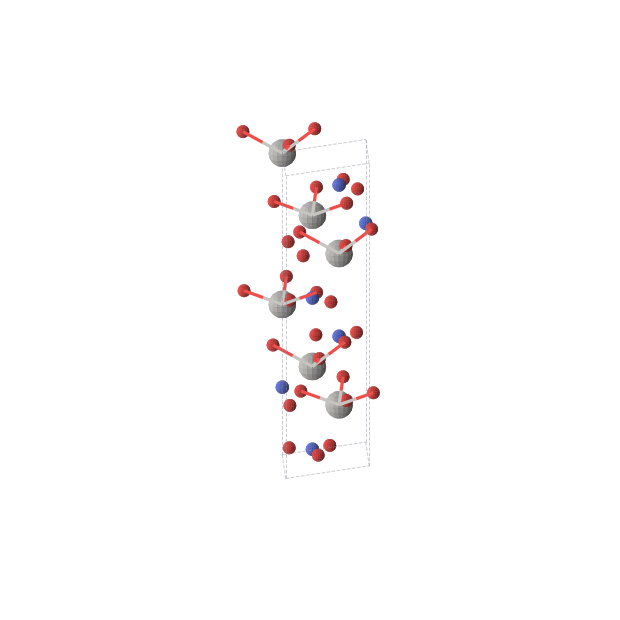
About Silver nitrate
What is AgNO3 and what structure does it adopt?
AgNO3 is an inorganic nitrate salt made of silver cations and planar nitrate anions. At ambient temperature and pressure, solid silver nitrate forms orthorhombic crystals. Different X-ray studies have assigned it to space group Pbca or P212121. The silver atoms lie in layers, and nitrate groups link these layers by bonding to silver through their oxygen atoms. The result is an extended three-dimensional coordination network. Heating converts it to a different polymorph above room temperature.
What is silver nitrate used for?
Silver nitrate is the most common and versatile starting material in silver chemistry. It is used to make other silver salts and silver nanoparticles, because monovalent silver is easily reduced to the metal. In analytical chemistry it is the main titrant and test reagent in argentometric methods, which detect and measure halides such as chloride, bromide and iodide by precipitation. It has also been used for silvering mirrors, for making the silver halides in photographic emulsions, and in medicine as a topical antiseptic and cauterizing agent.
How stable is AgNO3 and how is it synthesized?
Silver nitrate is a thermodynamically stable compound under ambient conditions. Unlike some other silver salts, it does not absorb moisture from the air (it is non-hygroscopic). It keeps well when protected from light and organic contaminants, but light or reducing impurities slowly turn the surface dark as metallic silver forms. It is easily made by dissolving silver metal in nitric acid, which gives silver nitrate, nitrogen oxides and water. The salt is then crystallized from the concentrated solution.
What is the electronic character of AgNO3 and what does it imply?
Silver nitrate has a sizeable band gap, which separates the filled valence states (mainly oxygen and silver levels) from the empty conduction states. Because of this, solid AgNO3 conducts electricity very poorly through electrons, and any conduction in the solid comes from moving ions. When it is melted or dissolved in polar solvents such as water, it splits into mobile silver and nitrate ions, and these carry current efficiently.
How does AgNO3 compare to other metal nitrates?
Unlike the alkali and alkaline-earth nitrates, silver nitrate contains a noble-metal cation. This makes AgNO3 much easier to reduce to the metal, by chemicals or by light. That property is the basis of its use in photography, mirror making and nanoparticle production. When heated, most alkali metal nitrates break down into nitrites and oxygen, while silver nitrate breaks down to silver metal, nitrogen dioxide and oxygen.
Key Properties
Cross-validated computational properties for Silver nitrate, aggregated across 6 databases.
Band GapEnergy needed to move an electron from the valence band to the conduction band. Lower or zero values tend to behave more metallic; larger gaps are more insulating or semiconducting.
Energy Above HullThermodynamic distance from the most stable set of competing phases. 0 eV/atom is on the convex hull; small positive values may still be experimentally accessible.
StabilityA plain-language summary of the best reported energy-above-hull result. It reflects whether the lowest-energy structure is on, near, or far from the stability hull.
StructuresCount of reported calculated crystal structures for this formula, including alternate polymorphs, source databases, and observed space groups.
Cross-Source DFT Agreement
How well independent DFT databases agree on the thermodynamics of AgNO3. Tight agreement means computed properties can be trusted without re-running calculations.
Agreement ScoreA normalized confidence score summarizing how closely independent DFT databases agree. Higher scores mean tighter cross-source agreement.
Hull SpreadDifference between the highest and lowest energy-above-hull values reported by comparable sources. Smaller spread means less thermodynamic disagreement.
Sources ComparedNumber and names of computational sources with comparable entries for this formula.
Space Group ConsensusWhether independent sources predict the same crystal symmetry for the lowest-energy structure.
Reported Structures
Lowest-energy structures reported for AgNO3, ranked by energy above hull.
| Space GroupSymmetry classification of the crystal arrangement. The number is the international space-group index. | Crystal SystemBroad lattice family, such as cubic, tetragonal, monoclinic, or triclinic, derived from unit-cell symmetry. | Band Gap (eV)Electronic gap calculated for this specific reported structure, measured in electronvolts. | E above hull (eV/atom)Thermodynamic distance from the convex hull for this structure, normalized per atom. Lower is generally more stable. | E/atom (eV)Computed total energy normalized per atom. Use energy above hull, not this value alone, when comparing stability. | Density (g/cm³)Mass per relaxed crystal volume, reported in grams per cubic centimeter. |
|---|---|---|---|---|---|
| — | — | 1.98 | 0.0000 | -0.543 | — |
| R3c (No. 161) | trigonal | 1.86 | 0.0000 | -5.886 | 4.51 |
| R3c (No. 161) | trigonal | 1.71 | 0.0000 | -0.286 | — |
| — | — | 1.87 | 0.0001 | -0.543 | — |
| Pbca (No. 61) | orthorhombic | 2.01 | 0.0024 | -5.883 | 4.53 |
| P212121 (No. 19) | orthorhombic | 2.00 | 0.0050 | -5.881 | 4.20 |
| — | — | 1.71 | 0.0175 | -0.525 | — |
| R3m (No. 160) | trigonal | 1.72 | 0.0312 | -5.855 | 4.21 |
| R3m (No. 160) | trigonal | 1.60 | 0.0342 | -0.252 | — |
| — | — | 1.52 | 0.0350 | -0.508 | — |
| — | — | 1.62 | 0.1172 | -0.426 | — |
| P1 (No. 1) | triclinic | 0.86 | 0.1824 | -0.104 | — |
Applications
Where Silver nitrate is used.
Patent Landscape
1 patent reference AgNO3 or close compositional variants.
| Patent | Title | Assignee | Granted |
|---|---|---|---|
| 4416958 | Thermal battery cells utilizing AgNO.sub.3 in LiClO.sub.4 -LiNO.sub.3 mixtures | — | — |
Frequently Asked Questions
Common questions about Silver nitrate, answered from cross-validated data and the published literature.
Why is silver nitrate called lunar caustic?
Alchemists linked the metal silver with the Moon (Luna). Sticks of fused silver nitrate were used in medicine as a caustic agent to cauterize tissue, which gave the 'caustic' part of the name.
Why do silver nitrate crystals turn dark or gray over time?
Is AgNO3 soluble in water?
What happens when AgNO3 contacts skin?
Does solid AgNO3 conduct electricity?
What is AgNO3?
What is AgNO3 used for?
What is the band gap of AgNO3?
Is AgNO3 a metal, semiconductor, or insulator?
Is AgNO3 thermodynamically stable?
What is the crystal structure of AgNO3?
What is the density of AgNO3?
How many polymorphs of AgNO3 are known?
What elements does AgNO3 contain?
Where does the data for AgNO3 come from?
Data sources & attribution
- oqmd — Data from the OQMD (oqmd.org). Cite: Saal et al., JOM 65, 1501 (2013); Kirklin et al., npj Comp. Mater. 1, 15010 (2015). (CC-BY-4.0)
- materials_project — Data from the Materials Project (materialsproject.org). Cite: Jain et al., APL Materials 1, 011002 (2013). (CC-BY-4.0)
- jarvis — Data from JARVIS (jarvis.nist.gov), NIST. Cite: Choudhary et al., npj Comp. Mater. 6, 173 (2020). (LicenseRef-US-Gov-PD)
- mpaloe — Data from MP-ALOE. Cite: Kuner et al., npj Comput. Mater. (2025), doi:10.1038/s41524-025-01834-9.
- nomad — Data from NOMAD (nomad-lab.eu). Cite: Draxl & Scheffler, J. Phys. Mater. 2, 036001 (2019). (CC-BY-4.0)
- cod — Data from the Crystallography Open Database (crystallography.net/cod/). Cite: Grazulis et al., J. Appl. Cryst. 42, 726 (2009). (CC0-1.0)
Analyze AgNO3 in the Lattice Graph platform
Polymorph comparison, confidence scoring, supply-chain risk, and patent monitoring — across 85 source databases.
Explore the Platform →