Ca2MnO4
Ca2MnO4 is a metallic oxide catalyst with a layered structure that is potentially synthesizable for use in electrochemical energy conversion.
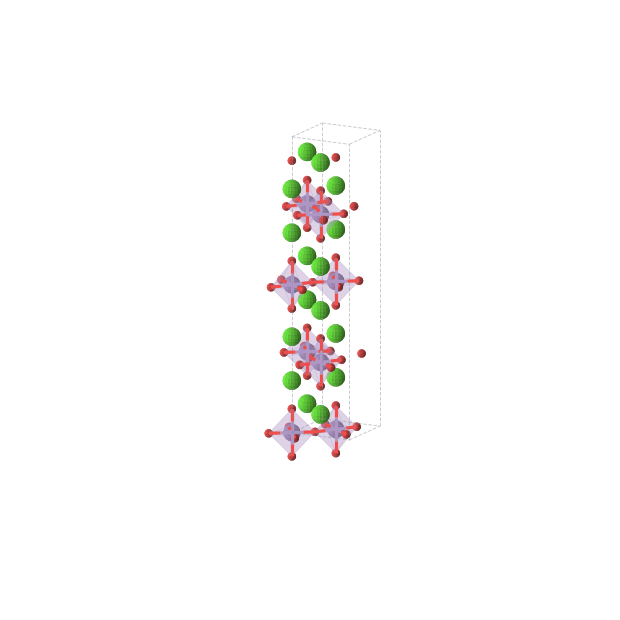
About Ca2MnO4
Ca2MnO4 is a metallic oxide that belongs to the class of oxygen-evolution catalysts. Its electronic structure is characterized by a lack of a band gap, which facilitates the charge transfer processes necessary for efficient electrochemical performance in catalytic applications. The material is considered near-hull, indicating it is a promising candidate for experimental synthesis and further structural investigation. Because of its structural versatility, it remains a subject of interest for researchers looking to optimize transition metal oxides for energy conversion. Its ability to maintain structural integrity while providing metallic conductivity makes it a valuable addition to the study of complex oxide systems.
Key Properties
Cross-validated computational properties for Ca2MnO4, aggregated across 3 databases.
Band GapEnergy needed to move an electron from the valence band to the conduction band. Lower or zero values tend to behave more metallic; larger gaps are more insulating or semiconducting.
Energy Above HullThermodynamic distance from the most stable set of competing phases. 0 eV/atom is on the convex hull; small positive values may still be experimentally accessible.
StabilityA plain-language summary of the best reported energy-above-hull result. It reflects whether the lowest-energy structure is on, near, or far from the stability hull.
StructuresCount of reported calculated crystal structures for this formula, including alternate polymorphs, source databases, and observed space groups.
Cross-Source DFT Agreement
How well independent DFT databases agree on the thermodynamics of Ca2MnO4. Tight agreement means computed properties can be trusted without re-running calculations.
Agreement ScoreA normalized confidence score summarizing how closely independent DFT databases agree. Higher scores mean tighter cross-source agreement.
Hull SpreadDifference between the highest and lowest energy-above-hull values reported by comparable sources. Smaller spread means less thermodynamic disagreement.
Sources ComparedNumber and names of computational sources with comparable entries for this formula.
Space Group ConsensusWhether independent sources predict the same crystal symmetry for the lowest-energy structure.
Reported Structures
Lowest-energy structures reported for Ca2MnO4, ranked by energy above hull.
| Space GroupSymmetry classification of the crystal arrangement. The number is the international space-group index. | Crystal SystemBroad lattice family, such as cubic, tetragonal, monoclinic, or triclinic, derived from unit-cell symmetry. | Band Gap (eV)Electronic gap calculated for this specific reported structure, measured in electronvolts. | E above hull (eV/atom)Thermodynamic distance from the convex hull for this structure, normalized per atom. Lower is generally more stable. | E/atom (eV)Computed total energy normalized per atom. Use energy above hull, not this value alone, when comparing stability. | Density (g/cm³)Mass per relaxed crystal volume, reported in grams per cubic centimeter. |
|---|---|---|---|---|---|
| I41/acd (No. 142) | tetragonal | 0.00 | 0.0073 | -7.458 | 4.10 |
| — | — | 1.18 | 0.0135 | -2.646 | — |
| — | — | 0.00 | 0.0200 | -2.640 | — |
| I4/mmm (No. 139) | tetragonal | 0.00 | 0.0210 | -7.444 | 3.95 |
| I4/mmm (No. 139) | tetragonal | — | — | — | 3.95 |
| I41/acd (No. 142) | tetragonal | — | — | — | 3.93 |
| I4/mmm (No. 139) | tetragonal | — | — | — | 4.09 |
| I41/acd (No. 142) | tetragonal | — | — | — | 4.20 |
| I41/acd (No. 142) | tetragonal | — | — | — | 4.08 |
| I4/mmm (No. 139) | tetragonal | — | — | — | 4.20 |
Synthesis Routes
Literature-extracted synthesis procedures targeting Ca2MnO4.
Applications
Where Ca2MnO4 is used.
Frequently Asked Questions
Common questions about Ca2MnO4, answered from cross-validated data.
What is Ca2MnO4?
Ca2MnO4 is a metallic oxide catalyst with a layered structure that is potentially synthesizable for use in electrochemical energy conversion.
What is Ca2MnO4 used for?
What is the band gap of Ca2MnO4?
Is Ca2MnO4 a metal, semiconductor, or insulator?
Is Ca2MnO4 thermodynamically stable?
What is the crystal structure of Ca2MnO4?
What is the density of Ca2MnO4?
How many polymorphs of Ca2MnO4 are known?
How is Ca2MnO4 synthesized?
What elements does Ca2MnO4 contain?
Where does the data for Ca2MnO4 come from?
How It Compares
Within the oxide oxygen-evolution catalysts class.
Within the diverse landscape of oxide oxygen-evolution catalysts, Ca2MnO4 occupies a distinct position compared to more conventional materials like NiO or LiCoO2. While many of its class members, such as LaMnO3 or La2NiO4, are studied for their perovskite or layered-perovskite architectures, Ca2MnO4 provides a unique structural framework that balances metallic character with thermodynamic accessibility, distinguishing it from the highly studied lithium-based intercalation compounds like LiMn2O4.
Related Compounds
Other Oxide Oxygen-Evolution Catalysts in the database.
Data sources & attribution
- materials_project — Data from the Materials Project (materialsproject.org). Cite: Jain et al., APL Materials 1, 011002 (2013). (CC-BY-4.0)
- oqmd — Data from the OQMD (oqmd.org). Cite: Saal et al., JOM 65, 1501 (2013); Kirklin et al., npj Comp. Mater. 1, 15010 (2015). (CC-BY-4.0)
- mpaloe — Data from MP-ALOE. Cite: Kuner et al., npj Comput. Mater. (2025), doi:10.1038/s41524-025-01834-9.
Analyze Ca2MnO4 in the Lattice Graph platform
Polymorph comparison, confidence scoring, supply-chain risk, and patent monitoring — across 85 source databases.
Explore the Platform →