ZrSiO4
Zircon · zirconium silicate, zirconium orthosilicate
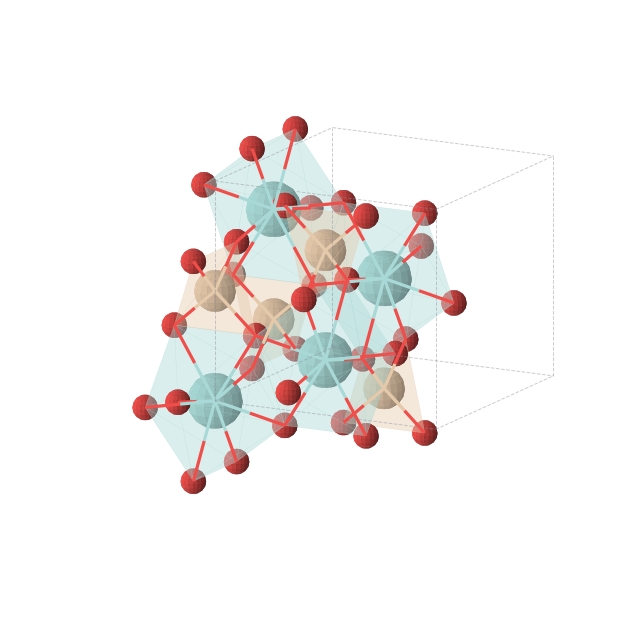
ZrSiO4 is zirconium silicate, best known as the mineral zircon. Its dense tetragonal nesosilicate structure is built from isolated SiO4 tetrahedra alternating with eight-coordinated ZrO8 dodecahedra. It resists chemical attack, is thermodynamically stable at ambient pressure, and is an electrical insulator with a wide band gap.
About Zircon
What is ZrSiO4 and what structure does it adopt?
ZrSiO4 is zirconium silicate, which occurs naturally as the mineral zircon. It is the type example of the tetragonal zircon structure family. In this structure, isolated SiO4 tetrahedra and ZrO8 dodecahedra share corners and edges to form a rigid three-dimensional framework. The SiO4 tetrahedra stay isolated rather than linking into chains, sheets or networks, so zircon is classed as an orthosilicate (nesosilicate). This arrangement gives zircon its high hardness and strong chemical inertness.
What is ZrSiO4 used for?
ZrSiO4 copes well with high temperatures and is chemically stable, so it has many commercial and scientific uses. In industry, finely ground zircon and zircon sand are widely used as opacifiers in ceramic glazes, as foundry sand and moulds for metal casting, and in high-temperature refractory linings. Zircon is also the main commercial source of zirconium metal and zirconium chemicals, and hafnium is recovered as a byproduct. Transparent natural crystals are cut as gemstones. In geology, zircon crystals are widely analysed for uranium–lead dating because they can keep their isotopic record for billions of years.
How stable and synthesizable is ZrSiO4?
At ambient pressure, ZrSiO4 is the thermodynamically stable compound in the ZrO2–SiO2 system. At very high pressure it changes to the scheelite-type polymorph reidite. Natural zircon is very durable over geological time. Synthetic zirconium silicate can be made by reacting zirconia (ZrO2) and silica (SiO2) in the solid state at high temperature. It can also be made by sol-gel routes from zirconium alkoxide or oxychloride precursors and silica sources, followed by calcination.
What is the electronic character of ZrSiO4 and what does it imply?
ZrSiO4 is an electrical insulator with a wide band gap, so it does not conduct electricity under ordinary conditions. When pure, it is transparent across the visible spectrum and colourless, with a vitreous to adamantine lustre. The many colours of natural zircon come from trace impurities, radiation damage and defect-related colour centres, not from the pure compound's own electronic structure.
How does ZrSiO4 compare to other materials in its class?
ZrSiO4 defines the zircon structure type, which several other orthosilicates and orthophosphates share. Hafnon (HfSiO4) is its direct hafnium analogue. Because zirconium and hafnium ions are almost the same size, hafnon forms an essentially complete solid solution with zircon. Other compounds with this tetragonal structure include the actinide silicates thorite (ThSiO4) and coffinite (USiO4), and the rare-earth phosphate xenotime (YPO4). Zircon is the most economically important member of this family.
Key Properties
Cross-validated computational properties for Zircon, aggregated across 3 databases.
Band GapEnergy needed to move an electron from the valence band to the conduction band. Lower or zero values tend to behave more metallic; larger gaps are more insulating or semiconducting.
Energy Above HullThermodynamic distance from the most stable set of competing phases. 0 eV/atom is on the convex hull; small positive values may still be experimentally accessible.
StabilityA plain-language summary of the best reported energy-above-hull result. It reflects whether the lowest-energy structure is on, near, or far from the stability hull.
StructuresCount of reported calculated crystal structures for this formula, including alternate polymorphs, source databases, and observed space groups.
Cross-Source DFT Agreement
How well independent DFT databases agree on the thermodynamics of ZrSiO4. Tight agreement means computed properties can be trusted without re-running calculations.
Agreement ScoreA normalized confidence score summarizing how closely independent DFT databases agree. Higher scores mean tighter cross-source agreement.
Hull SpreadDifference between the highest and lowest energy-above-hull values reported by comparable sources. Smaller spread means less thermodynamic disagreement.
Sources ComparedNumber and names of computational sources with comparable entries for this formula.
Space Group ConsensusWhether independent sources predict the same crystal symmetry for the lowest-energy structure.
Reported Structures
Lowest-energy structures reported for ZrSiO4, ranked by energy above hull.
| Space GroupSymmetry classification of the crystal arrangement. The number is the international space-group index. | Crystal SystemBroad lattice family, such as cubic, tetragonal, monoclinic, or triclinic, derived from unit-cell symmetry. | Band Gap (eV)Electronic gap calculated for this specific reported structure, measured in electronvolts. | E above hull (eV/atom)Thermodynamic distance from the convex hull for this structure, normalized per atom. Lower is generally more stable. | E/atom (eV)Computed total energy normalized per atom. Use energy above hull, not this value alone, when comparing stability. | Density (g/cm³)Mass per relaxed crystal volume, reported in grams per cubic centimeter. |
|---|---|---|---|---|---|
| — | — | 4.82 | 0.0000 | -3.376 | — |
| I41/amd (No. 141) | tetragonal | 4.70 | 0.0000 | -3.347 | — |
| I41/amd (No. 141) | tetragonal | 4.46 | 0.0000 | -9.186 | 4.63 |
| I41/a (No. 88) | tetragonal | 4.21 | 0.0552 | -3.291 | — |
| I41/a (No. 88) | tetragonal | 4.00 | 0.0796 | -9.107 | 4.99 |
| — | — | 4.40 | 0.0797 | -3.297 | — |
| — | — | 0.00 | 0.1506 | -3.226 | — |
| P2/c (No. 13) | monoclinic | 4.08 | 0.1639 | -3.183 | — |
| P2/c (No. 13) | monoclinic | 3.86 | 0.1819 | -9.004 | 5.10 |
| I41/amd (No. 141) | tetragonal | — | — | — | 4.67 |
| I41/amd (No. 141) | tetragonal | — | — | — | 4.63 |
| P2/c (No. 13) | monoclinic | — | — | — | 5.26 |
Synthesis Routes
Literature-extracted synthesis procedures targeting ZrSiO4.
Applications
Where Zircon is used.
Patent Landscape
2 patents reference ZrSiO4 or close compositional variants.
| Patent | Title | Assignee | Granted |
|---|---|---|---|
| 11217968 | Spark plug resistance element with increased ZrSiO4 phase fraction | — | — |
| 5476696 | White thermal control surfaces containing ZrSiO.sub.4 | — | — |
Frequently Asked Questions
Common questions about Zircon, answered from cross-validated data and the published literature.
Is zircon the same as cubic zirconia?
No. Zircon is a natural silicate mineral with the formula ZrSiO4. Cubic zirconia is a synthetic, stabilised cubic form of zirconium dioxide (ZrO2).
Why is zircon widely used for geological dating?
Can ZrSiO4 conduct electricity?
What elements compose ZrSiO4?
How is synthetic ZrSiO4 prepared?
What is ZrSiO4?
What is ZrSiO4 used for?
What is the band gap of ZrSiO4?
Is ZrSiO4 a metal, semiconductor, or insulator?
Is ZrSiO4 thermodynamically stable?
What is the crystal structure of ZrSiO4?
How many polymorphs of ZrSiO4 are known?
How is ZrSiO4 synthesized?
What elements does ZrSiO4 contain?
Where does the data for ZrSiO4 come from?
Data sources & attribution
- oqmd — Data from the OQMD (oqmd.org). Cite: Saal et al., JOM 65, 1501 (2013); Kirklin et al., npj Comp. Mater. 1, 15010 (2015). (CC-BY-4.0)
- jarvis — Data from JARVIS (jarvis.nist.gov), NIST. Cite: Choudhary et al., npj Comp. Mater. 6, 173 (2020). (LicenseRef-US-Gov-PD)
- materials_project — Data from the Materials Project (materialsproject.org). Cite: Jain et al., APL Materials 1, 011002 (2013). (CC-BY-4.0)
- cod — Data from the Crystallography Open Database (crystallography.net/cod/). Cite: Grazulis et al., J. Appl. Cryst. 42, 726 (2009). (CC0-1.0)
- mpaloe — Data from MP-ALOE. Cite: Kuner et al., npj Comput. Mater. (2025), doi:10.1038/s41524-025-01834-9.
Analyze ZrSiO4 in the Lattice Graph platform
Polymorph comparison, confidence scoring, supply-chain risk, and patent monitoring — across 85 source databases.
Explore the Platform →