ZrO2
Zirconia · zirconium dioxide, zirconium(IV) oxide, baddeleyite
ZrO2, commonly known as zirconia or zirconium dioxide, is an insulating binary transition-metal oxide known for its high thermodynamic stability and rich polymorphism. Under ambient conditions it occurs naturally as the monoclinic mineral baddeleyite, transforming at higher temperatures into tetragonal and cubic fluorite-related phases that can be stabilized at room temperature for engineering and electronic applications.
About Zirconia
What is ZrO2 and what structure does it adopt?
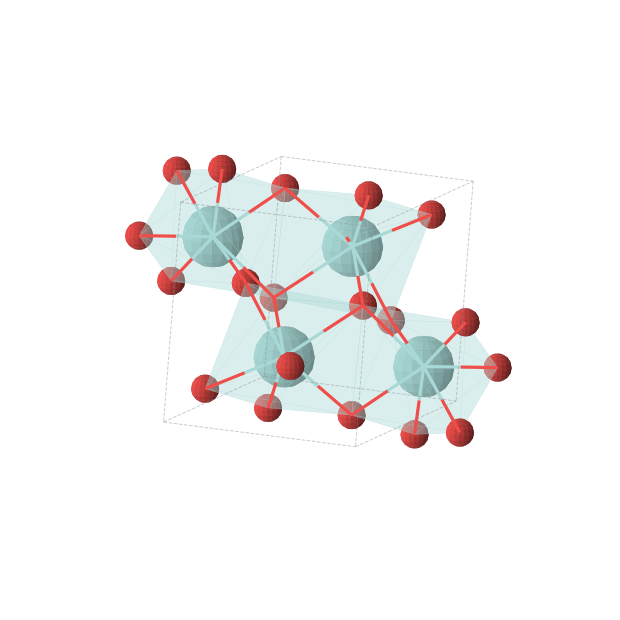
ZrO2 is zirconium dioxide, an oxide of tetravalent zirconium. At room temperature and atmospheric pressure, the thermodynamically stable form is monoclinic with the baddeleyite structure, where zirconium adopts sevenfold coordination. As temperature increases, it transitions to a tetragonal phase and subsequently to a cubic fluorite-type lattice. The tetragonal-to-monoclinic transformation is accompanied by a volume expansion; in pure zirconia this causes cracking on cooling, but in partially stabilized or tetragonal zirconia ceramics a stress-induced tetragonal-to-monoclinic transformation near crack tips is harnessed for transformation toughening.
What is ZrO2 used for?
Zirconia is widely utilized in structural, biological, and electrochemical technologies. Its high mechanical toughness, chemical stability, and biocompatibility make it a standard choice for dental restorations, orthopedic implants, and wear-resistant components such as ceramic blades. When stabilized with dopants such as yttria, it conducts oxide ions at elevated temperatures, serving as the solid electrolyte in oxygen sensors and solid oxide fuel cells. Due to low thermal conductivity and refractoriness, yttria-stabilized zirconia is applied as thermal barrier coatings on turbine components, while cubic single crystals serve as diamond simulants in jewelry. Thin ZrO2 films are also used as high-index layers in optical coatings and as high-k dielectrics in microelectronics.
How stable is ZrO2 and how is it synthesized?
ZrO2 is a highly stable oxide; its monoclinic form is the thermodynamically stable phase at ambient conditions. Naturally occurring zirconia is mined as the mineral baddeleyite, but industrial grades are derived primarily from zircon sand through high-temperature chlorination or chemical decomposition. Common synthetic routes include precipitation of hydrous zirconium hydroxides followed by calcination, sol-gel processing, and hydrothermal synthesis, often incorporating stabilizing dopants such as yttrium, calcium, or magnesium to preserve high-symmetry phases at room temperature.
What is the electronic character of ZrO2?
Pure stoichiometric ZrO2 is an electrically insulating material with a wide band gap, exhibiting optical transparency across the visible spectrum and minimal electronic conductivity at ordinary temperatures. Its relatively high dielectric permittivity led to extensive research on it as an alternative gate dielectric to silicon dioxide, and ZrO2-based stacks such as ZrO2/Al2O3/ZrO2 are used as capacitor dielectrics in DRAM. When aliovalent dopants are incorporated to create mobile oxygen vacancies, the resulting ionic conductivity allows it to behave as an effective solid electrolyte at high temperatures, with electronic conduction remaining minor over a wide range of conditions.
How does ZrO2 compare to related materials?
Within group-4 transition metal dioxides, ZrO2 exhibits physical and chemical properties closely matching those of hafnia (HfO2), sharing analogous monoclinic, tetragonal, and cubic polymorph sequences and high-dielectric-constant behavior. In contrast to titania (TiO2), which is a lower-band-gap semiconductor widely utilized in photocatalytic applications, ZrO2 is an insulator with a much wider band gap. Compared with other common engineering ceramics like alumina, partially stabilized and tetragonal zirconia ceramics provide significantly enhanced fracture toughness via transformation toughening.
Key Properties
Cross-validated computational properties for Zirconia, aggregated across 3 databases.
Band GapEnergy needed to move an electron from the valence band to the conduction band. Lower or zero values tend to behave more metallic; larger gaps are more insulating or semiconducting.
Energy Above HullThermodynamic distance from the most stable set of competing phases. 0 eV/atom is on the convex hull; small positive values may still be experimentally accessible.
StabilityA plain-language summary of the best reported energy-above-hull result. It reflects whether the lowest-energy structure is on, near, or far from the stability hull.
StructuresCount of reported calculated crystal structures for this formula, including alternate polymorphs, source databases, and observed space groups.
Cross-Source DFT Agreement
How well independent DFT databases agree on the thermodynamics of ZrO2. Tight agreement means computed properties can be trusted without re-running calculations.
Agreement ScoreA normalized confidence score summarizing how closely independent DFT databases agree. Higher scores mean tighter cross-source agreement.
Hull SpreadDifference between the highest and lowest energy-above-hull values reported by comparable sources. Smaller spread means less thermodynamic disagreement.
Sources ComparedNumber and names of computational sources with comparable entries for this formula.
Space Group ConsensusWhether independent sources predict the same crystal symmetry for the lowest-energy structure.
Reported Structures
Lowest-energy structures reported for ZrO2, ranked by energy above hull.
| Space GroupSymmetry classification of the crystal arrangement. The number is the international space-group index. | Crystal SystemBroad lattice family, such as cubic, tetragonal, monoclinic, or triclinic, derived from unit-cell symmetry. | Band Gap (eV)Electronic gap calculated for this specific reported structure, measured in electronvolts. | E above hull (eV/atom)Thermodynamic distance from the convex hull for this structure, normalized per atom. Lower is generally more stable. | E/atom (eV)Computed total energy normalized per atom. Use energy above hull, not this value alone, when comparing stability. | Density (g/cm³)Mass per relaxed crystal volume, reported in grams per cubic centimeter. |
|---|---|---|---|---|---|
| — | — | 3.84 | 0.0000 | -3.633 | — |
| Pbca (No. 61) | orthorhombic | 3.76 | 0.0000 | -3.704 | — |
| P21/c (No. 14) | monoclinic | 3.53 | 0.0000 | -9.961 | 5.78 |
| P21/c (No. 14) | monoclinic | 3.62 | 0.0031 | -3.701 | — |
| Pbca (No. 61) | orthorhombic | 3.46 | 0.0095 | -9.952 | 5.78 |
| Pbca (No. 61) | orthorhombic | 3.58 | 0.0133 | -9.948 | 6.03 |
| Pca21 (No. 29) | orthorhombic | 3.70 | 0.0167 | -9.945 | 5.98 |
| — | — | 3.81 | 0.0183 | -3.615 | — |
| — | — | 4.09 | 0.0221 | -3.611 | — |
| P42/nmc (No. 137) | tetragonal | 3.88 | 0.0271 | -9.934 | 6.04 |
| Pnma (No. 62) | orthorhombic | 3.96 | 0.0280 | -9.934 | 5.71 |
| Pnma (No. 62) | orthorhombic | 3.21 | 0.0288 | -9.933 | 5.99 |
Synthesis Routes
Literature-extracted synthesis procedures targeting ZrO2.
Applications
Where Zirconia is used.
Patent Landscape
53 patents reference ZrO2 or close compositional variants.
| Patent | Title | Assignee | Granted |
|---|---|---|---|
| 7169673 | Atomic layer deposited nanolaminates of HfO2/ZrO2 films as gate dielectrics | — | — |
| 4910174 | Thin ceramic articles obtained by fusing and casting in a mold a composition of the system Al.sub.2 O-ZrO.sub. | — | — |
| 4758542 | Low thermal expansion ZrTiO.sub.4 --Al.sub.2 TiO.sub.5 --ZrO.sub.2 compositions | — | — |
| 4316964 | Al.sub.2 O.sub.3 /ZrO.sub.2 ceramic | — | — |
| 9902654 | ZrO2-Al2O3-based ceramic sintered compact and production method thereof | — | — |
| 7491654 | Method of forming a ZrO2 thin film using plasma enhanced atomic layer deposition and method of fabricating a c | — | — |
| 11667577 | Y2O3—ZrO2 erosion resistant material for chamber components in plasma environments | — | — |
| 7141523 | Ceramics comprising Al2O3, REO, ZrO2 and/or HfO2, and Nb2O5 and/or Ta2O5 and methods of making the same | — | — |
| 7122064 | AI2O3 and ZrO2 based abrasive grain, method for the production and use thereof | — | — |
| 7507268 | Al2O3-Y2O3-ZrO2/HfO2 materials, and methods of making and using the same | — | — |
Frequently Asked Questions
Common questions about Zirconia, answered from cross-validated data and the published literature.
Is cubic zirconia the same as ZrO2?
Cubic zirconia is the cubic crystalline form of ZrO2, typically stabilized down to ambient temperature using dopant oxides such as yttria or calcia.
Why is yttria added to zirconia?
Does ZrO2 conduct electricity?
What are the crystal phases of zirconia?
Is ZrO2 biocompatible?
What is ZrO2?
What is ZrO2 used for?
What is the band gap of ZrO2?
Is ZrO2 a metal, semiconductor, or insulator?
Is ZrO2 thermodynamically stable?
What is the crystal structure of ZrO2?
What is the density of ZrO2?
How many polymorphs of ZrO2 are known?
How is ZrO2 synthesized?
What elements does ZrO2 contain?
Where does the data for ZrO2 come from?
Data sources & attribution
- oqmd — Data from the OQMD (oqmd.org). Cite: Saal et al., JOM 65, 1501 (2013); Kirklin et al., npj Comp. Mater. 1, 15010 (2015). (CC-BY-4.0)
- jarvis — Data from JARVIS (jarvis.nist.gov), NIST. Cite: Choudhary et al., npj Comp. Mater. 6, 173 (2020). (LicenseRef-US-Gov-PD)
- materials_project — Data from the Materials Project (materialsproject.org). Cite: Jain et al., APL Materials 1, 011002 (2013). (CC-BY-4.0)
Analyze ZrO2 in the Lattice Graph platform
Polymorph comparison, confidence scoring, supply-chain risk, and patent monitoring — across 85 source databases.
Explore the Platform →