TiO2
Titanium dioxide · titania, titanium(IV) oxide
TiO2 is titanium dioxide, an oxide of titanium that occurs in several crystal forms (polymorphs). The best known are rutile and anatase. It is a wide-band-gap semiconductor, used widely as a bright white pigment and as a photocatalyst.
About Titanium dioxide
What is TiO2 and what structure family does it belong to?
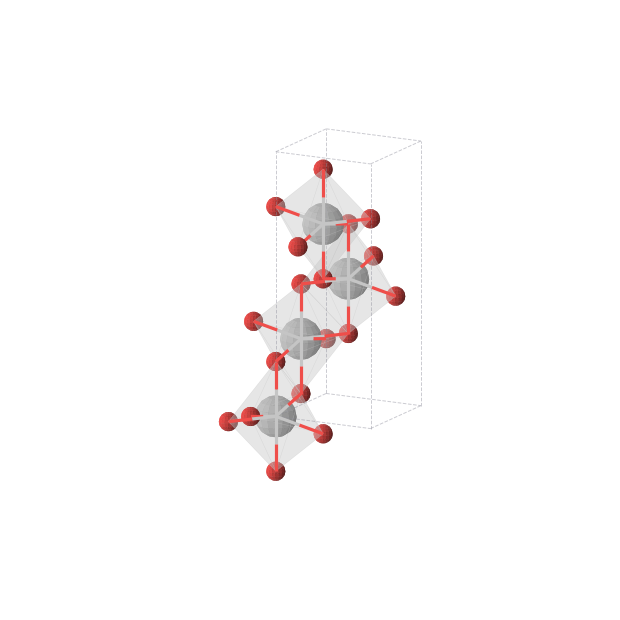
TiO2 is titanium dioxide, a binary oxide of titanium and oxygen. It does not exist in just one form. Rutile, anatase and brookite are the well-known crystal phases found in nature, and there are also several high-pressure forms. Rutile is built from TiO6 octahedra: they share edges to form chains, and the chains are linked through shared corners. Coarse-grained (bulk) rutile is the thermodynamically stable form. Anatase and brookite are metastable in bulk and only slowly transform to rutile. In very small nanoparticles, anatase can be more stable than rutile because its surface energy is lower. This is why anatase is common in nanoscale natural and synthetic samples. TiO2 is one of the most thoroughly studied transition-metal oxides.
What is TiO2 used for?
Titanium dioxide is a major industrial material. Its main use is as a white pigment in paints, coatings, plastics, paper and cosmetics, where its high refractive index and chemical durability give strong opacity. TiO2 is also a key photocatalyst. Under ultraviolet light it generates charge carriers that can break down organic contaminants, which makes it useful for air and water purification and for self-cleaning coatings. It is also used as an ultraviolet filter in sunscreens, as an electron-transport layer in solar cells such as dye-sensitized cells, and as a catalyst support.
How stable is TiO2 and how easy is it to synthesize?
TiO2 is a very stable, chemically inert oxide. In nature it occurs as the minerals rutile, anatase and brookite. Of these, only bulk rutile is the thermodynamically stable phase. Anatase and brookite survive because their conversion to rutile is kinetically slow. Bulk anatase typically converts to rutile irreversibly only when heated in air. TiO2 is easy to make by established routes. These include the industrial sulfate and chloride processes (the chloride process oxidizes titanium tetrachloride), hydrothermal crystallization, and sol-gel hydrolysis of titanium alkoxides or titanium tetrachloride. To get a particular polymorph, such as anatase or rutile, the pH, precursor chemistry, temperature and particle size must be controlled.
What is the electronic character of TiO2 and what does it imply?
TiO2 is a wide-band-gap semiconductor. Stoichiometric bulk TiO2 is transparent to visible light and conducts electricity very poorly. Its absorption lies mainly in the ultraviolet, so pristine TiO2 uses only a small fraction of sunlight for photoactivation. To extend light absorption into the visible range, research focuses on chemical doping, defect engineering (for example oxygen vacancies) and surface sensitization.
How does TiO2 compare to other members of its class?
Among simple metal oxides, TiO2 stands out for combining chemical inertness, a high refractive index and useful photochemistry. Silica and alumina have much wider band gaps. TiO2's gap is narrow enough for ultraviolet light to drive photo-assisted redox reactions. Many transition-metal oxides with narrower gaps absorb visible light. Pristine TiO2 absorbs very little visible light, which makes it a good non-absorbing white scattering agent, but it must be modified to use the full solar spectrum.
Key Properties
Cross-validated computational properties for Titanium dioxide, aggregated across 3 databases.
Band GapEnergy needed to move an electron from the valence band to the conduction band. Lower or zero values tend to behave more metallic; larger gaps are more insulating or semiconducting.
Energy Above HullThermodynamic distance from the most stable set of competing phases. 0 eV/atom is on the convex hull; small positive values may still be experimentally accessible.
StabilityA plain-language summary of the best reported energy-above-hull result. It reflects whether the lowest-energy structure is on, near, or far from the stability hull.
StructuresCount of reported calculated crystal structures for this formula, including alternate polymorphs, source databases, and observed space groups.
Cross-Source DFT Agreement
How well independent DFT databases agree on the thermodynamics of TiO2. Tight agreement means computed properties can be trusted without re-running calculations.
Agreement ScoreA normalized confidence score summarizing how closely independent DFT databases agree. Higher scores mean tighter cross-source agreement.
Hull SpreadDifference between the highest and lowest energy-above-hull values reported by comparable sources. Smaller spread means less thermodynamic disagreement.
Sources ComparedNumber and names of computational sources with comparable entries for this formula.
Space Group ConsensusWhether independent sources predict the same crystal symmetry for the lowest-energy structure.
Reported Structures
Lowest-energy structures reported for TiO2, ranked by energy above hull.
| Space GroupSymmetry classification of the crystal arrangement. The number is the international space-group index. | Crystal SystemBroad lattice family, such as cubic, tetragonal, monoclinic, or triclinic, derived from unit-cell symmetry. | Band Gap (eV)Electronic gap calculated for this specific reported structure, measured in electronvolts. | E above hull (eV/atom)Thermodynamic distance from the convex hull for this structure, normalized per atom. Lower is generally more stable. | E/atom (eV)Computed total energy normalized per atom. Use energy above hull, not this value alone, when comparing stability. | Density (g/cm³)Mass per relaxed crystal volume, reported in grams per cubic centimeter. |
|---|---|---|---|---|---|
| I41/amd (No. 141) | tetragonal | 2.06 | 0.0000 | -9.439 | 3.86 |
| I41/amd (No. 141) | tetragonal | 2.05 | 0.0000 | -3.263 | — |
| — | — | 1.97 | 0.0000 | -3.243 | — |
| — | — | 2.68 | 0.0013 | -3.241 | — |
| Pbca (No. 61) | orthorhombic | 2.29 | 0.0030 | -9.435 | 4.11 |
| Pbcn (No. 60) | orthorhombic | 2.53 | 0.0045 | -9.434 | 4.31 |
| C2/m (No. 12) | monoclinic | 2.68 | 0.0064 | -9.432 | 3.62 |
| Pbcn (No. 60) | orthorhombic | 2.08 | 0.0122 | -9.426 | 4.26 |
| Pbcn (No. 60) | orthorhombic | 2.57 | 0.0135 | -3.250 | — |
| — | — | 2.18 | 0.0139 | -3.229 | — |
| C2/c (No. 15) | monoclinic | 1.97 | 0.0145 | -9.424 | 3.77 |
| P42/mnm (No. 136) | tetragonal | 1.76 | 0.0146 | -3.249 | — |
Synthesis Routes
Literature-extracted synthesis procedures targeting TiO2.
Applications
Where Titanium dioxide is used.
Patent Landscape
139 patents reference TiO2 or close compositional variants.
| Patent | Title | Assignee | Granted |
|---|---|---|---|
| 7842131 | High opacity TiO2 pigment and production method | — | — |
| 11712681 | Near infrared photocatalyst based on TiO2-coated gold nanoparticles | — | — |
| 6517804 | TiO2 ultrafine powder, and process for preparing thereof | — | — |
| 9108862 | Method of making rutile titanium dioxide microspheres containing elongated TiO2-nanocrystallites | — | — |
| 9408791 | Oral care and oral hygiene products having photocatalytic activity comprising inorganic particles superficiall | — | — |
| 4356272 | Sintered bodies Al.sub.2 O.sub.3 -TiC-TiO.sub.2 continuing yttrium (y) | — | — |
| 9908100 | TiO2 material that is absorbent in the visible spectrum and method for producing same | — | — |
| 4462979 | Process for preparing soft TiO.sub.2 agglomerates | — | — |
| 5262142 | Composite oxide of formula R.sub.2 O.Al.sub.2 O.sub.3.TiO.sub.2.SiO.sub.2.H.sub.2 O, where R is an alkali meta | — | — |
| 5110772 | Fabrication of dense SI.sub.3 N.sub.4 ceramics using CaO-TiO.sub.2 SiO.sub. 2 | — | — |
Frequently Asked Questions
Common questions about Titanium dioxide, answered from cross-validated data and the published literature.
What are the three main polymorphs of TiO2?
The three main polymorphs found in nature are rutile, anatase and brookite. Bulk rutile is the thermodynamically stable form. Anatase and brookite are metastable in bulk, although anatase can be favoured in very small nanoparticles.
Why is TiO2 white?
Is TiO2 used in sunscreens?
Why does pristine TiO2 photocatalysis require UV light?
Is TiO2 an electrical conductor or an insulator?
What is TiO2?
What is TiO2 used for?
What is the band gap of TiO2?
Is TiO2 a metal, semiconductor, or insulator?
Is TiO2 thermodynamically stable?
What is the crystal structure of TiO2?
How many polymorphs of TiO2 are known?
How is TiO2 synthesized?
What elements does TiO2 contain?
Where does the data for TiO2 come from?
Related Research
Data sources & attribution
- materials_project — Data from the Materials Project (materialsproject.org). Cite: Jain et al., APL Materials 1, 011002 (2013). (CC-BY-4.0)
- jarvis — Data from JARVIS (jarvis.nist.gov), NIST. Cite: Choudhary et al., npj Comp. Mater. 6, 173 (2020). (LicenseRef-US-Gov-PD)
- oqmd — Data from the OQMD (oqmd.org). Cite: Saal et al., JOM 65, 1501 (2013); Kirklin et al., npj Comp. Mater. 1, 15010 (2015). (CC-BY-4.0)
Analyze TiO2 in the Lattice Graph platform
Polymorph comparison, confidence scoring, supply-chain risk, and patent monitoring — across 85 source databases.
Explore the Platform →