SiO2
Silicon dioxide · Silica, Silicic oxide, Silicon(IV) oxide
Silicon dioxide (SiO2), commonly called silica, is an oxide of silicon. It occurs naturally as quartz and as several other crystalline polymorphs, and it also forms glassy amorphous solids. It is a thermodynamically stable, wide-band-gap insulator, and it is one of the most abundant and technologically important compounds on Earth.
About Silicon dioxide
What is SiO2 and what structure does it have?
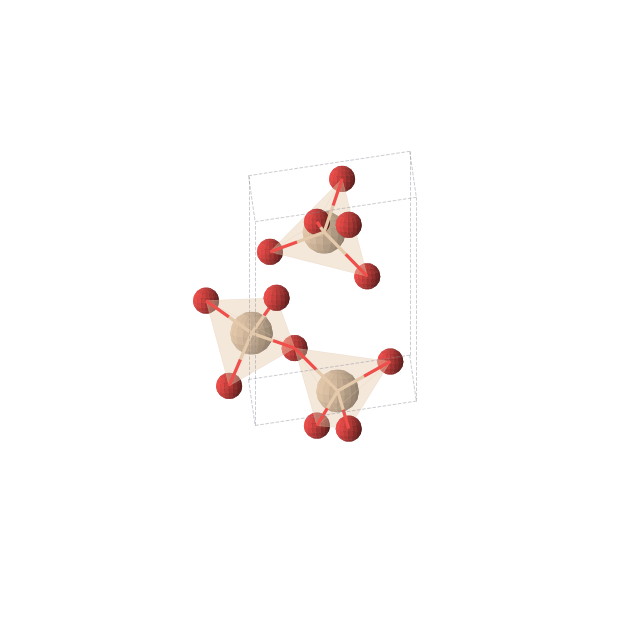
SiO2 is silicon dioxide. Silicon and oxygen bond into an extended three-dimensional network rather than forming separate molecules. At ambient conditions the stable crystalline form is alpha-quartz, which is built from corner-sharing SiO4 tetrahedra. At high temperature silica takes other tetrahedral forms, such as tridymite and cristobalite. At high pressure it forms coesite and then stishovite. In stishovite, each silicon atom is surrounded by six oxygens (octahedral coordination) in a rutile-type framework. Silica also readily forms an amorphous glass (fused silica). The glass keeps the local tetrahedral bonding but has no long-range periodic order. Strong silicon–oxygen bonding gives these forms high rigidity and chemical resistance.
What is silicon dioxide used for?
Silica is a foundational industrial material. It is the main ingredient of commercial glass and a component of ceramics, concrete, paints and polymer fillers. Quartz is also the raw material for producing elemental silicon. In microelectronics, thin films of amorphous SiO2 serve as isolation and passivation layers. SiO2 was long the standard gate dielectric. At advanced technology nodes it has largely been replaced by high-k dielectrics, but it remains as a thin interfacial layer. Fused silica is used in lenses, windows and telecommunication optical fibers because it is highly transparent and has low optical loss. Porous and particulate forms, such as silica gel and precipitated silica, are used as desiccants, catalyst supports, chromatography media and anti-caking agents. Because crystalline quartz is piezoelectric, it is used in resonators and timing crystals.
How stable is SiO2 and how easy is it to synthesize?
SiO2 is thermodynamically stable, which is consistent with its huge geological abundance as quartz and silica sand. The phase relations of its crystalline polymorphs are well mapped. Large synthetic quartz crystals are grown hydrothermally. The dense phases coesite and stishovite require high-pressure synthesis and are metastable at ambient pressure. Amorphous silica is routinely made in several ways: thermal oxidation of silicon wafers, flame hydrolysis, and sol-gel processing from alkoxide or silicate precursors.
Is SiO2 a conductor, semiconductor, or insulator?
Silicon dioxide is an electrical insulator with a very wide band gap, so almost no carriers are thermally excited at ordinary temperatures. This makes silica an excellent dielectric for insulating interconnects and separating transistor gates from their channels. The wide gap also means there is no interband absorption in the visible and near-ultraviolet. That is why fused silica waveguides and lenses are so transparent.
How does SiO2 compare to related materials in its class?
Among the group-14 dioxides, SiO2 stands apart from the heavier congeners GeO2, SnO2 and PbO2. At ambient conditions, silica favors four-coordinate tetrahedral networks such as quartz. The heavier dioxides more readily adopt six-coordinate structures: SnO2 (cassiterite) has the rutile structure, and GeO2 and PbO2 both have rutile-type polymorphs. Silica reaches this geometry only under high pressure, as stishovite. SiO2 also has a considerably wider band gap than GeO2 or SnO2, so it insulates better and transmits further into the ultraviolet.
Key Properties
Cross-validated computational properties for Silicon dioxide, aggregated across 3 databases.
Band GapEnergy needed to move an electron from the valence band to the conduction band. Lower or zero values tend to behave more metallic; larger gaps are more insulating or semiconducting.
Energy Above HullThermodynamic distance from the most stable set of competing phases. 0 eV/atom is on the convex hull; small positive values may still be experimentally accessible.
StabilityA plain-language summary of the best reported energy-above-hull result. It reflects whether the lowest-energy structure is on, near, or far from the stability hull.
StructuresCount of reported calculated crystal structures for this formula, including alternate polymorphs, source databases, and observed space groups.
Cross-Source DFT Agreement
How well independent DFT databases agree on the thermodynamics of SiO2. Tight agreement means computed properties can be trusted without re-running calculations.
Agreement ScoreA normalized confidence score summarizing how closely independent DFT databases agree. Higher scores mean tighter cross-source agreement.
Hull SpreadDifference between the highest and lowest energy-above-hull values reported by comparable sources. Smaller spread means less thermodynamic disagreement.
Sources ComparedNumber and names of computational sources with comparable entries for this formula.
Space Group ConsensusWhether independent sources predict the same crystal symmetry for the lowest-energy structure.
Reported Structures
Lowest-energy structures reported for SiO2, ranked by energy above hull.
| Space GroupSymmetry classification of the crystal arrangement. The number is the international space-group index. | Crystal SystemBroad lattice family, such as cubic, tetragonal, monoclinic, or triclinic, derived from unit-cell symmetry. | Band Gap (eV)Electronic gap calculated for this specific reported structure, measured in electronvolts. | E above hull (eV/atom)Thermodynamic distance from the convex hull for this structure, normalized per atom. Lower is generally more stable. | E/atom (eV)Computed total energy normalized per atom. Use energy above hull, not this value alone, when comparing stability. | Density (g/cm³)Mass per relaxed crystal volume, reported in grams per cubic centimeter. |
|---|---|---|---|---|---|
| — | — | 6.26 | 0.0000 | -3.074 | — |
| P3221 (No. 154) | trigonal | 5.99 | 0.0000 | -2.901 | — |
| P3121 (No. 152) | trigonal | 5.99 | 0.0000 | -2.901 | — |
| P3121 (No. 152) | trigonal | 5.68 | 0.0000 | -8.380 | 2.63 |
| P3221 (No. 154) | trigonal | 5.99 | 0.0001 | -2.901 | — |
| — | — | 5.58 | 0.0002 | -3.073 | — |
| P3221 (No. 154) | trigonal | 5.67 | 0.0006 | -8.379 | 2.63 |
| — | — | 5.60 | 0.0008 | -3.073 | — |
| C2/c (No. 15) | monoclinic | 6.01 | 0.0016 | -2.900 | — |
| — | — | 5.99 | 0.0017 | -3.072 | — |
| — | — | 5.75 | 0.0019 | -3.072 | — |
| — | — | 5.51 | 0.0019 | -3.072 | — |
Synthesis Routes
Literature-extracted synthesis procedures targeting SiO2.
Applications
Where Silicon dioxide is used.
Patent Landscape
120 patents reference SiO2 or close compositional variants.
| Patent | Title | Assignee | Granted |
|---|---|---|---|
| 7763110 | Titanium dioxide pigment particles with doped, dense SiO2 skin and methods for their manufacture | — | — |
| 9090475 | In situ oxide removal, dispersal and drying for silicon SiO2 | — | — |
| 5378666 | Production of whisker-free Si.sub.3 N.sub.4 particulates by carbonitriding SiO.sub.2 | — | — |
| 6077574 | Plasma CVD process for forming a fluorine-doped SiO.sub.2 dielectric film | — | — |
| 4341663 | Process for the production of spherical shaped bodies based on Al.sub.2 O.sub.3 and optionally SiO.sub.2 | — | — |
| 5536857 | Single source volatile precursor for SiO.sub.2.TiO.sub.2 powders and films | — | — |
| 8163260 | Process for the production of monodisperse SiO2 particles | — | — |
| 5587107 | SiO.sub.2 aerogels containing carbon particles and their preparation | — | — |
| 4508538 | Recovery of fumed SiO.sub.2 | — | — |
| 4916091 | Plasma and plasma UV deposition of SiO.sub.2 | — | — |
Frequently Asked Questions
Common questions about Silicon dioxide, answered from cross-validated data and the published literature.
Is SiO2 the same thing as quartz?
No. Quartz is one specific crystalline polymorph of SiO2, the stable form at ambient conditions. Silica also includes other crystalline phases, such as cristobalite, tridymite, coesite and stishovite, and non-crystalline forms such as fused silica.
Is silicon dioxide safe or toxic?
Why is SiO2 used as a gate dielectric in chips?
Does SiO2 dissolve in water?
What is the difference between crystalline and amorphous silica?
What is SiO2?
What is SiO2 used for?
What is the band gap of SiO2?
Is SiO2 a metal, semiconductor, or insulator?
Is SiO2 thermodynamically stable?
How many polymorphs of SiO2 are known?
How is SiO2 synthesized?
What elements does SiO2 contain?
Where does the data for SiO2 come from?
Related Research
Data sources & attribution
- oqmd — Data from the OQMD (oqmd.org). Cite: Saal et al., JOM 65, 1501 (2013); Kirklin et al., npj Comp. Mater. 1, 15010 (2015). (CC-BY-4.0)
- jarvis — Data from JARVIS (jarvis.nist.gov), NIST. Cite: Choudhary et al., npj Comp. Mater. 6, 173 (2020). (LicenseRef-US-Gov-PD)
- materials_project — Data from the Materials Project (materialsproject.org). Cite: Jain et al., APL Materials 1, 011002 (2013). (CC-BY-4.0)
Analyze SiO2 in the Lattice Graph platform
Polymorph comparison, confidence scoring, supply-chain risk, and patent monitoring — across 85 source databases.
Explore the Platform →