PO4
PO4 is a semiconducting phosphorus oxide species that is typically found in a metastable state.
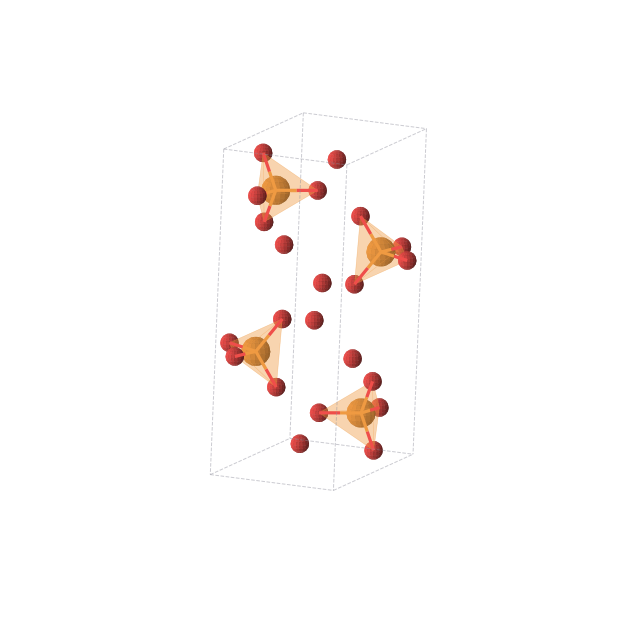
About PO4
PO4 is a phosphorus-oxygen species characterized by its semiconducting electronic nature. While it appears in various structural configurations within computational databases, it is generally found to be thermodynamically unstable relative to more common phosphorus oxide phases. Its existence is primarily of interest in theoretical studies of phosphorus-based materials and high-energy chemical environments. Because it sits above the thermodynamic hull, it is rarely encountered as a stable bulk material in ambient conditions. Instead, it serves as a critical building block or transient intermediate in the broader landscape of phosphorus chemistry and materials science.
Key Properties
Cross-validated computational properties for PO4, aggregated across 2 databases.
Band GapEnergy needed to move an electron from the valence band to the conduction band. Lower or zero values tend to behave more metallic; larger gaps are more insulating or semiconducting.
Energy Above HullThermodynamic distance from the most stable set of competing phases. 0 eV/atom is on the convex hull; small positive values may still be experimentally accessible.
StabilityA plain-language summary of the best reported energy-above-hull result. It reflects whether the lowest-energy structure is on, near, or far from the stability hull.
StructuresCount of reported calculated crystal structures for this formula, including alternate polymorphs, source databases, and observed space groups.
Synthesis Routes
Literature-extracted synthesis procedures targeting PO4.
Applications
Where PO4 is used.
Patent Landscape
15 patents reference PO4 or close compositional variants.
| Patent | Title | Assignee | Granted |
|---|---|---|---|
| 10749199 | Li1+xAlxTi2-x(PO4)3 solid-state thin film electrolyte for 3D microbattery and method of fabrication | — | — |
| 4482436 | Use of H.sub.2 SO.sub.4 H.sub.3 PO.sub.4 to remove electrolytic deposits from silver cathode surfaces | — | — |
| 11658336 | Lithium-ion solid state conductor containing a compound of Li1+(4-a)αHf2-αMaα(PO4-δ)3, Electrode and battery i | — | — |
| 4083933 | Process for preparing AlH.sub.3 (PO.sub.4).sub.2 .multidot.3H.sub.2 O | — | — |
| 4021528 | Process for preparing AlH.sub.3 (PO.sub.4).sub.2.3 H.sub.2 O | — | — |
| 4153465 | CaZn.sub.2 (PO.sub.4).sub.2 .2H.sub.2 O anticorrosion pigment | — | — |
| 11040881 | Method for preparing a NA3V2(PO4)2F3 particulate material | — | — |
| 4466944 | Process for recovery of uranium from wet process H.sub.3 PO.sub.4 | — | — |
| 5227148 | Vitreous compositions based on Li.sub.3 PO.sub.4 and LiPO.sub.3 as network formers and network modifiers | — | — |
| 12148916 | Metal-doped sodium vanadium fluorophosphate/sodium vanadium phosphate (Na3V2(PO4)2F3/Na3V2(PO4)3) composite fo | — | — |
Frequently Asked Questions
Common questions about PO4, answered from cross-validated data.
What is PO4?
PO4 is a semiconducting phosphorus oxide species that is typically found in a metastable state.
What is PO4 used for?
What is the band gap of PO4?
Is PO4 a metal, semiconductor, or insulator?
Is PO4 thermodynamically stable?
How many polymorphs of PO4 are known?
How is PO4 synthesized?
What elements does PO4 contain?
Where does the data for PO4 come from?
How It Compares
As a unique phosphorus-oxygen species, PO4 represents a specialized case within the broader family of phosphorus oxides. Unlike more stable, naturally occurring oxides of phosphorus, this compound is distinguished by its high-energy state and theoretical structural diversity, making it a subject of interest for understanding metastable phases in inorganic chemistry.
Data sources & attribution
- latticegraph — Lattice Graph Materials Intelligence Platform
Analyze PO4 in the Lattice Graph platform
Polymorph comparison, confidence scoring, supply-chain risk, and patent monitoring — across 53 integrated data sources.
Explore the Platform →