NaCl
Sodium chloride · halite, rock salt, table salt, common salt
Sodium chloride (NaCl) is an ionic compound of sodium and chlorine, widely known as table salt and the mineral halite. It crystallizes in the archetypal rock-salt structure, where sodium and chloride ions alternate in an interpenetrating face-centered cubic lattice.
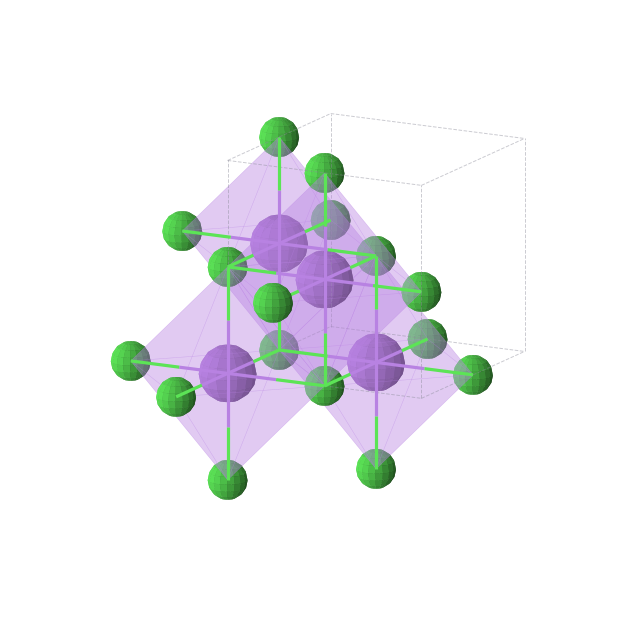
About Sodium chloride
What is NaCl and what structure does it adopt?
NaCl is a binary ionic compound formed by the transfer of an electron from sodium to chlorine, resulting in Na+ and Cl- ions held together by electrostatic attraction. Its crystal structure defines an entire structural family: the rock-salt (halite) structure (space group Fm-3m), in which each ion is octahedrally coordinated by six counterions. This highly symmetric cubic arrangement serves as the standard prototype for many alkali halides and alkaline-earth oxides. First solved by X-ray diffraction in the early days of crystallography, NaCl remains a foundational model in solid-state chemistry.
What is sodium chloride used for?
NaCl is most familiar as table salt for culinary seasoning and food preservation, and it serves as the essential feedstock in the industrial chlor-alkali process, where electrolysis of brine produces chlorine gas, sodium hydroxide, and hydrogen. It is also used in massive quantities for highway de-icing and in the regeneration of ion-exchange water softening resins. In specialized optical applications, high-purity single crystals of NaCl are fabricated into infrared-transmitting windows and lenses for spectroscopy due to their wide transparency window. Furthermore, dissolved NaCl forms physiological saline solutions vital in clinical medicine.
How stable is NaCl and how is it made?
NaCl is thermodynamically stable, situated on the convex hull of the sodium-chlorine system, indicating it is the energetically preferred phase under standard conditions. Naturally occurring halite deposits have endured over geological timescales in evaporite basins. While it can be formed directly by the vigorous reaction of elemental sodium with chlorine gas or by acid-base neutralization of hydrochloric acid with sodium hydroxide, commercial production relies on conventional underground mining of rock salt, solution mining of salt deposits to produce brine, and the solar evaporation of seawater and natural brines.
Is NaCl a conductor, semiconductor, or insulator?
NaCl is a wide-band-gap electrical insulator. In the solid state, electrons are firmly localized within closed-shell ionic configurations, and the large energy gap between the occupied valence band and the empty conduction band leaves virtually no mobile electronic charge carriers under ambient conditions. Consequently, crystalline NaCl is essentially non-conducting at room temperature and is optically transparent across the visible spectrum and far into the infrared. Appreciable conductivity arises when the ions become mobile: weakly in the hot solid through lattice vacancies, and much more strongly when NaCl is melted or dissolved in polar solvents like water.
How does NaCl compare to related compounds?
NaCl represents the quintessential prototype for the rock-salt crystal structure, shared by closely related alkali halides such as LiF, KCl, and KBr, as well as binary oxides such as MgO. Across the alkali halide group, ionic radii and lattice dimensions increase systematically as cations and anions progress down the periodic table. Caesium chloride, bromide and iodide instead adopt the eight-coordinated CsCl-type structure, whereas NaCl maintains octahedral coordination, making it a standard benchmark for understanding ionic crystal physics.
Key Properties
Cross-validated computational properties for Sodium chloride, aggregated across 3 databases.
Band GapEnergy needed to move an electron from the valence band to the conduction band. Lower or zero values tend to behave more metallic; larger gaps are more insulating or semiconducting.
Energy Above HullThermodynamic distance from the most stable set of competing phases. 0 eV/atom is on the convex hull; small positive values may still be experimentally accessible.
StabilityA plain-language summary of the best reported energy-above-hull result. It reflects whether the lowest-energy structure is on, near, or far from the stability hull.
StructuresCount of reported calculated crystal structures for this formula, including alternate polymorphs, source databases, and observed space groups.
Cross-Source DFT Agreement
How well independent DFT databases agree on the thermodynamics of NaCl. Tight agreement means computed properties can be trusted without re-running calculations.
Agreement ScoreA normalized confidence score summarizing how closely independent DFT databases agree. Higher scores mean tighter cross-source agreement.
Hull SpreadDifference between the highest and lowest energy-above-hull values reported by comparable sources. Smaller spread means less thermodynamic disagreement.
Sources ComparedNumber and names of computational sources with comparable entries for this formula.
Space Group ConsensusWhether independent sources predict the same crystal symmetry for the lowest-energy structure.
Reported Structures
Lowest-energy structures reported for NaCl, ranked by energy above hull.
| Space GroupSymmetry classification of the crystal arrangement. The number is the international space-group index. | Crystal SystemBroad lattice family, such as cubic, tetragonal, monoclinic, or triclinic, derived from unit-cell symmetry. | Band Gap (eV)Electronic gap calculated for this specific reported structure, measured in electronvolts. | E above hull (eV/atom)Thermodynamic distance from the convex hull for this structure, normalized per atom. Lower is generally more stable. | E/atom (eV)Computed total energy normalized per atom. Use energy above hull, not this value alone, when comparing stability. | Density (g/cm³)Mass per relaxed crystal volume, reported in grams per cubic centimeter. |
|---|---|---|---|---|---|
| Fm-3m (No. 225) | cubic | 5.32 | 0.0000 | -1.937 | — |
| Fm-3m (No. 225) | cubic | 5.00 | 0.0000 | -3.695 | 2.22 |
| — | — | 5.25 | 0.0005 | -2.050 | — |
| — | — | 5.20 | 0.0019 | -2.049 | — |
| — | — | 5.31 | 0.0059 | -2.045 | — |
| — | — | 5.20 | 0.0247 | -2.026 | — |
| P63/mmc (No. 194) | hexagonal | 4.38 | 0.0588 | -3.636 | 2.05 |
| — | — | 5.03 | 0.0621 | -1.989 | — |
| P-6m2 (No. 187) | hexagonal | 4.58 | 0.0635 | -1.873 | — |
| — | — | 5.16 | 0.0652 | -1.985 | — |
| — | — | 4.69 | 0.0663 | -1.984 | — |
| — | — | 5.00 | 0.0681 | -1.982 | — |
Synthesis Routes
Literature-extracted synthesis procedures targeting NaCl.
Applications
Where Sodium chloride is used.
Patent Landscape
11 patents reference NaCl or close compositional variants.
| Patent | Title | Assignee | Granted |
|---|---|---|---|
| 6063345 | Method of separating NaCl from a LiCl solution | — | — |
| 4522951 | Removal of Mg.sup.++ and Ca.sup.++ ions from NaCl brine | — | — |
| 4067751 | Aqueous NaCl test solution for aluminum and its alloys | — | — |
| 4472361 | Method of recovering alumina values from a starting solid mixture comprising AlCl.sub.3 and NaCl | — | — |
| 6547948 | Method of increasing the concentration of dilute brine in NaCl electrolysis plants using the membrane process | — | — |
| 7988763 | Use of a binary salt flux of NaCl and MgCl2 for the purification of aluminium or aluminium alloys, and method | — | — |
| 4125586 | Removal of AlCl.sub.3 from crude TiCl.sub.4 by addition of H.sub.2 O and NaCl | — | — |
| 11040903 | Purification of NaCl brine containing iodine | — | — |
| 4405574 | Removal of Mg.sup.++ and Ca.sup.++ ions from NaCl brine | — | — |
| 4519806 | Enhanced recovery of soda ash from aqueous sodium carbonate solutions containing Na.sub.2 SO.sub.4 - and NaCl | — | — |
Frequently Asked Questions
Common questions about Sodium chloride, answered from cross-validated data and the published literature.
Is NaCl the same thing as table salt?
Purified NaCl is the primary constituent of table salt, and its naturally occurring mineral form is called halite. Commercial food-grade salt often includes minor additives such as anti-caking agents or iodine compounds like potassium iodate.
Why does NaCl dissolve in water?
Does NaCl conduct electricity?
What is the rock-salt structure?
Are there other sodium chloride phases?
What is NaCl?
What is NaCl used for?
What is the band gap of NaCl?
Is NaCl a metal, semiconductor, or insulator?
Is NaCl thermodynamically stable?
What is the crystal structure of NaCl?
How many polymorphs of NaCl are known?
How is NaCl synthesized?
What elements does NaCl contain?
Where does the data for NaCl come from?
Data sources & attribution
- jarvis — Data from JARVIS (jarvis.nist.gov), NIST. Cite: Choudhary et al., npj Comp. Mater. 6, 173 (2020). (LicenseRef-US-Gov-PD)
- materials_project — Data from the Materials Project (materialsproject.org). Cite: Jain et al., APL Materials 1, 011002 (2013). (CC-BY-4.0)
- oqmd — Data from the OQMD (oqmd.org). Cite: Saal et al., JOM 65, 1501 (2013); Kirklin et al., npj Comp. Mater. 1, 15010 (2015). (CC-BY-4.0)
- mpaloe — Data from MP-ALOE. Cite: Kuner et al., npj Comput. Mater. (2025), doi:10.1038/s41524-025-01834-9.
Analyze NaCl in the Lattice Graph platform
Polymorph comparison, confidence scoring, supply-chain risk, and patent monitoring — across 85 source databases.
Explore the Platform →