Na2CO3
Sodium carbonate · soda ash, disodium carbonate
Na2CO3 is sodium carbonate, an ionic salt made of sodium cations and carbonate anions. Its anhydrous form is commonly called soda ash. It is a thermodynamically stable, wide-band-gap insulating solid. The anhydrous compound has several temperature-dependent polymorphs, and sodium carbonate also forms several hydrates.
About Sodium carbonate
What is Na2CO3 and what structure does it have?
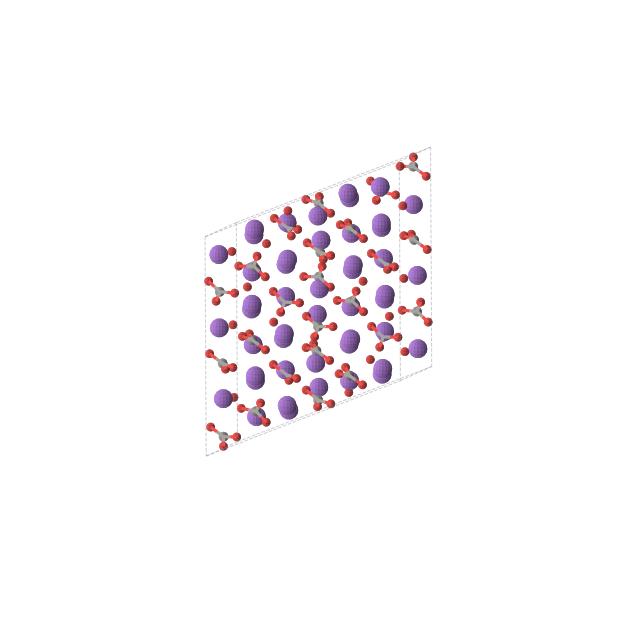
Na2CO3 is sodium carbonate, an ionic compound made of Na+ cations and planar carbonate (CO3 2-) anions. At room temperature, anhydrous sodium carbonate takes a monoclinic, incommensurately modulated structure called the gamma phase. On heating it changes first to the monoclinic beta phase and then to the hexagonal alpha phase. On cooling below room temperature it locks into a commensurate monoclinic delta phase. Sodium carbonate also forms separate hydrate compounds, including the monohydrate, heptahydrate and decahydrate.
What is Na2CO3 used for?
Sodium carbonate is a high-volume commodity chemical. Its biggest use is in glassmaking, where it acts as a flux that lowers the melting temperature of silica sand. It is also widely used in detergents as a water-softening and alkaline builder, and in chemical manufacturing, pulp and paper production, pH control and water treatment. In the home, its hydrated form is sold as washing soda. It is also used as a food acidity regulator.
How stable and synthesizable is Na2CO3?
Na2CO3 is thermodynamically stable. In nature, the anhydrous form occurs as the rare mineral natrite, found mainly in pegmatites of alkaline igneous massifs. Most natural sodium carbonate, however, is obtained by processing trona, a mineral that contains both sodium carbonate and sodium bicarbonate. Industrially, it is made in very large volumes either by the Solvay process, from sodium chloride and limestone using ammonia, or by calcining mined trona. In the laboratory it can be made by heating sodium bicarbonate until it decomposes. The anhydrous salt is hygroscopic: it absorbs moisture from the air and forms hydrates.
Is Na2CO3 a conductor, semiconductor, or insulator?
Na2CO3 is an electrical insulator with a wide band gap. At room temperature it has no free electronic charge carriers. Because of its large band gap, the pure material is transparent to visible light, and the bulk powder looks white. Solid sodium carbonate does not conduct electricity through electrons. Molten sodium carbonate and molten carbonate mixtures conduct electricity through moving ions.
How does Na2CO3 compare to other carbonates?
As an alkali metal carbonate, Na2CO3 is strongly ionic and very stable against heat. It melts with little loss of carbon dioxide, whereas many transition metal carbonates break down into oxides and carbon dioxide at relatively low temperatures. It is also highly soluble in water and gives basic solutions, unlike poorly soluble alkaline earth carbonates such as calcium carbonate.
Key Properties
Cross-validated computational properties for Sodium carbonate, aggregated across 3 databases.
Band GapEnergy needed to move an electron from the valence band to the conduction band. Lower or zero values tend to behave more metallic; larger gaps are more insulating or semiconducting.
Energy Above HullThermodynamic distance from the most stable set of competing phases. 0 eV/atom is on the convex hull; small positive values may still be experimentally accessible.
StabilityA plain-language summary of the best reported energy-above-hull result. It reflects whether the lowest-energy structure is on, near, or far from the stability hull.
StructuresCount of reported calculated crystal structures for this formula, including alternate polymorphs, source databases, and observed space groups.
Cross-Source DFT Agreement
How well independent DFT databases agree on the thermodynamics of Na2CO3. Tight agreement means computed properties can be trusted without re-running calculations.
Agreement ScoreA normalized confidence score summarizing how closely independent DFT databases agree. Higher scores mean tighter cross-source agreement.
Hull SpreadDifference between the highest and lowest energy-above-hull values reported by comparable sources. Smaller spread means less thermodynamic disagreement.
Sources ComparedNumber and names of computational sources with comparable entries for this formula.
Space Group ConsensusWhether independent sources predict the same crystal symmetry for the lowest-energy structure.
Reported Structures
Lowest-energy structures reported for Na2CO3, ranked by energy above hull.
| Space GroupSymmetry classification of the crystal arrangement. The number is the international space-group index. | Crystal SystemBroad lattice family, such as cubic, tetragonal, monoclinic, or triclinic, derived from unit-cell symmetry. | Band Gap (eV)Electronic gap calculated for this specific reported structure, measured in electronvolts. | E above hull (eV/atom)Thermodynamic distance from the convex hull for this structure, normalized per atom. Lower is generally more stable. | E/atom (eV)Computed total energy normalized per atom. Use energy above hull, not this value alone, when comparing stability. | Density (g/cm³)Mass per relaxed crystal volume, reported in grams per cubic centimeter. |
|---|---|---|---|---|---|
| P21/c (No. 14) | monoclinic | 5.24 | 0.0000 | -6.529 | 2.65 |
| C2/m (No. 12) | monoclinic | 4.36 | 0.0000 | -1.854 | — |
| — | — | 4.33 | 0.0000 | -1.974 | — |
| C2/m (No. 12) | monoclinic | 3.82 | 0.0051 | -6.524 | 2.63 |
| — | — | 3.59 | 0.0131 | -1.961 | — |
| C2/m (No. 12) | monoclinic | 3.35 | 0.0134 | -6.516 | 2.32 |
| — | — | 0.00 | 0.0222 | -1.952 | — |
| — | — | 5.03 | 0.0235 | -1.951 | — |
| P63/mmc (No. 194) | hexagonal | 3.51 | 0.0269 | -1.827 | — |
| P63/mmc (No. 194) | hexagonal | 3.15 | 0.0305 | -6.499 | 2.47 |
| — | — | 4.22 | 0.0405 | -1.934 | — |
| C2/m (No. 12) | monoclinic | — | — | — | 2.57 |
Applications
Where Sodium carbonate is used.
Frequently Asked Questions
Common questions about Sodium carbonate, answered from cross-validated data and the published literature.
What is the difference between soda ash and washing soda?
Both are sodium carbonate. Soda ash usually means the anhydrous commercial salt, Na2CO3. Washing soda usually means the hydrated crystals, mainly the decahydrate, used for household cleaning and laundry.
Is Na2CO3 the same as baking soda?
Does sodium carbonate occur naturally?
Is Na2CO3 soluble in water?
How many crystal structures of Na2CO3 are known?
What is Na2CO3?
What is Na2CO3 used for?
What is the band gap of Na2CO3?
Is Na2CO3 a metal, semiconductor, or insulator?
Is Na2CO3 thermodynamically stable?
What is the crystal structure of Na2CO3?
How many polymorphs of Na2CO3 are known?
What elements does Na2CO3 contain?
Where does the data for Na2CO3 come from?
Data sources & attribution
- materials_project — Data from the Materials Project (materialsproject.org). Cite: Jain et al., APL Materials 1, 011002 (2013). (CC-BY-4.0)
- jarvis — Data from JARVIS (jarvis.nist.gov), NIST. Cite: Choudhary et al., npj Comp. Mater. 6, 173 (2020). (LicenseRef-US-Gov-PD)
- oqmd — Data from the OQMD (oqmd.org). Cite: Saal et al., JOM 65, 1501 (2013); Kirklin et al., npj Comp. Mater. 1, 15010 (2015). (CC-BY-4.0)
- cod — Data from the Crystallography Open Database (crystallography.net/cod/). Cite: Grazulis et al., J. Appl. Cryst. 42, 726 (2009). (CC0-1.0)
- mpaloe — Data from MP-ALOE. Cite: Kuner et al., npj Comput. Mater. (2025), doi:10.1038/s41524-025-01834-9.
Analyze Na2CO3 in the Lattice Graph platform
Polymorph comparison, confidence scoring, supply-chain risk, and patent monitoring — across 85 source databases.
Explore the Platform →