HgS
Mercury sulfide · Mercury(II) sulfide, Mercuric sulfide, Cinnabar, Metacinnabar, Vermilion
HgS (mercury(II) sulfide) is a binary semiconducting chalcogenide of mercury and sulfur. Its thermodynamically stable form at ambient conditions is the scarlet trigonal mineral cinnabar (alpha-HgS). Cinnabar is the most common natural form and has long been the main ore of mercury and the source of the red pigment vermilion. A black cubic polymorph, metacinnabar (beta-HgS), is less common in nature.
About Mercury sulfide
What is HgS and what structure family does it belong to?
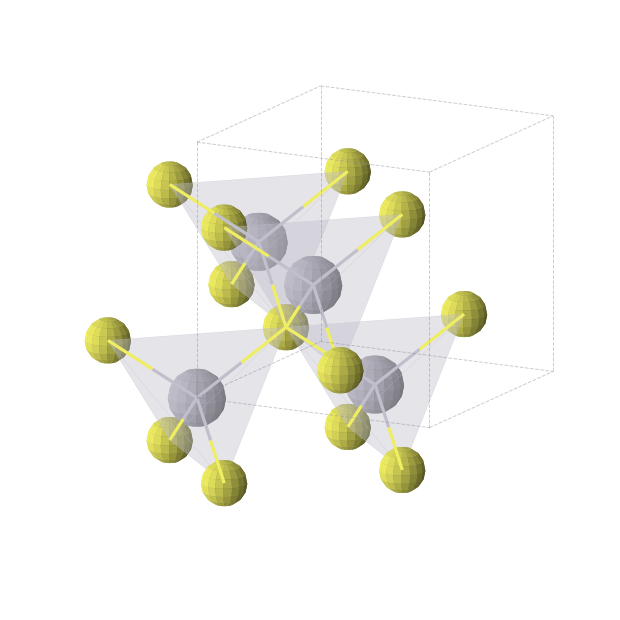
HgS is a binary chalcogenide of mercury and sulfur with three known polymorphs. Alpha-HgS (cinnabar), the form stable at low temperature and ambient conditions, has a trigonal crystal structure built from helical Hg–S chains. Beta-HgS (metacinnabar), the higher-temperature polymorph that also forms readily by precipitation, has the cubic zinc-blende (sphalerite) structure. A third, hexagonal high-temperature form called hypercinnabar is also known. The chain-based cinnabar and the tetrahedral zinc-blende metacinnabar differ markedly in color, crystal habit and electronic properties.
What is HgS used for?
Historically, HgS has been used both as a pigment and as an industrial raw material. Red alpha-HgS in powdered form, called vermilion, was a leading red pigment in ancient Roman wall paintings, illuminated manuscripts, Chinese lacquerware and many other artworks. Cinnabar has also been the chief ore of mercury, which is extracted by roasting. In modern research, red HgS is studied as a photoconductor and in photoelectrochemistry, metacinnabar nanocrystals are studied for infrared optoelectronics, and cultural heritage science studies how vermilion degrades and how to conserve it.
How stable and synthesizable is HgS?
Cinnabar (alpha-HgS) is the thermodynamically stable form at ambient conditions. Metacinnabar is stable only at higher temperatures and is metastable at room temperature. HgS can be made by both dry and wet chemical routes. In the dry route, mercury reacts directly with sulfur to give a black sulfide, which turns into red cinnabar when sublimed or heat-treated. Adding hydrogen sulfide or sulfide salts to solutions of mercury(II) salts usually precipitates black metacinnabar. This product can be converted to cinnabar by heating or by treatment with, for example, warm polysulfide solutions.
Is HgS a semiconductor, and what does that imply?
Yes, HgS is a semiconductor, and spin-orbit coupling from the heavy mercury atom strongly affects its band structure. Red cinnabar has a band gap in the visible range: it absorbs blue and green light and transmits red. Cubic metacinnabar has a much smaller gap. Researchers still disagree about whether its band ordering is inverted. Some calculations predict that metacinnabar is a topological insulator, while others predict an ordinary small-gap semiconductor. This has made the zinc-blende mercury chalcogenides model systems for studying narrow-gap and topological band physics.
How do the polymorphs of HgS compare with each other?
Cinnabar (alpha-HgS) is trigonal and red. Its helical chain structure makes it optically active, and it is the stable form at ambient conditions. Metacinnabar (beta-HgS) has the cubic zinc-blende structure, is grayish-black and opaque, and is stable at higher temperatures; at room temperature it is metastable, including when freshly precipitated. Hypercinnabar is a hexagonal high-temperature form. All three have the same composition, but their different structures give them different optical absorption, cleavage and electronic band structures.
Key Properties
Cross-validated computational properties for Mercury sulfide, aggregated across 5 databases.
Band GapEnergy needed to move an electron from the valence band to the conduction band. Lower or zero values tend to behave more metallic; larger gaps are more insulating or semiconducting.
Energy Above HullThermodynamic distance from the most stable set of competing phases. 0 eV/atom is on the convex hull; small positive values may still be experimentally accessible.
StabilityA plain-language summary of the best reported energy-above-hull result. It reflects whether the lowest-energy structure is on, near, or far from the stability hull.
StructuresCount of reported calculated crystal structures for this formula, including alternate polymorphs, source databases, and observed space groups.
Cross-Source DFT Agreement
How well independent DFT databases agree on the thermodynamics of HgS. Tight agreement means computed properties can be trusted without re-running calculations.
Agreement ScoreA normalized confidence score summarizing how closely independent DFT databases agree. Higher scores mean tighter cross-source agreement.
Hull SpreadDifference between the highest and lowest energy-above-hull values reported by comparable sources. Smaller spread means less thermodynamic disagreement.
Sources ComparedNumber and names of computational sources with comparable entries for this formula.
Space Group ConsensusWhether independent sources predict the same crystal symmetry for the lowest-energy structure.
Reported Structures
Lowest-energy structures reported for HgS, ranked by energy above hull.
| Space GroupSymmetry classification of the crystal arrangement. The number is the international space-group index. | Crystal SystemBroad lattice family, such as cubic, tetragonal, monoclinic, or triclinic, derived from unit-cell symmetry. | Band Gap (eV)Electronic gap calculated for this specific reported structure, measured in electronvolts. | E above hull (eV/atom)Thermodynamic distance from the convex hull for this structure, normalized per atom. Lower is generally more stable. | E/atom (eV)Computed total energy normalized per atom. Use energy above hull, not this value alone, when comparing stability. | Density (g/cm³)Mass per relaxed crystal volume, reported in grams per cubic centimeter. |
|---|---|---|---|---|---|
| P3121 (No. 152) | trigonal | 1.40 | 0.0000 | -0.016 | — |
| P3221 (No. 154) | trigonal | 1.40 | 0.0000 | -0.016 | — |
| — | — | 0.18 | 0.0000 | -0.249 | — |
| F-43m (No. 216) | cubic | 0.00 | 0.0000 | -2.599 | 7.38 |
| — | — | 0.00 | 0.0012 | -0.248 | — |
| P63mc (No. 186) | hexagonal | 0.00 | 0.0016 | -2.597 | 7.37 |
| — | — | 0.00 | 0.0025 | -0.246 | — |
| P3221 (No. 154) | trigonal | 1.70 | 0.0039 | -2.595 | 7.00 |
| — | — | 1.44 | 0.0128 | -0.236 | — |
| F-43m (No. 216) | cubic | 0.00 | 0.0324 | 0.016 | — |
| P63mc (No. 186) | hexagonal | 0.00 | 0.0362 | 0.020 | — |
| P3121 (No. 152) | trigonal | 0.00 | 0.1190 | 0.103 | — |
Applications
Where Mercury sulfide is used.
Frequently Asked Questions
Common questions about Mercury sulfide, answered from cross-validated data and the published literature.
Is HgS toxic?
Yes. Like other mercury compounds, HgS is hazardous. However, cinnabar is very poorly soluble in water and is generally less bioavailable than mercury vapor or organomercury compounds.
Why is cinnabar red while metacinnabar is black?
What is vermilion?
Is HgS an ore of mercury?
Does HgS have other crystal phases besides cinnabar and metacinnabar?
What is HgS?
What is HgS used for?
What is the band gap of HgS?
Is HgS a metal, semiconductor, or insulator?
Is HgS thermodynamically stable?
What is the crystal structure of HgS?
How many polymorphs of HgS are known?
What elements does HgS contain?
Where does the data for HgS come from?
Data sources & attribution
- jarvis — Data from JARVIS (jarvis.nist.gov), NIST. Cite: Choudhary et al., npj Comp. Mater. 6, 173 (2020). (LicenseRef-US-Gov-PD)
- oqmd — Data from the OQMD (oqmd.org). Cite: Saal et al., JOM 65, 1501 (2013); Kirklin et al., npj Comp. Mater. 1, 15010 (2015). (CC-BY-4.0)
- materials_project — Data from the Materials Project (materialsproject.org). Cite: Jain et al., APL Materials 1, 011002 (2013). (CC-BY-4.0)
Analyze HgS in the Lattice Graph platform
Polymorph comparison, confidence scoring, supply-chain risk, and patent monitoring — across 85 source databases.
Explore the Platform →