FeSO4
Iron(II) sulfate · ferrous sulfate, iron(II) sulphate
FeSO4 is iron(II) sulfate (ferrous sulfate), an inorganic salt of Fe2+ cations and sulfate anions. Calculations place anhydrous FeSO4 on the thermodynamic convex hull. It is an electrical insulator with high-spin Fe2+ and orders antiferromagnetically at low temperature. Besides the anhydrous α and β polymorphs, it forms a well-known series of hydrates, the most familiar being the green heptahydrate.
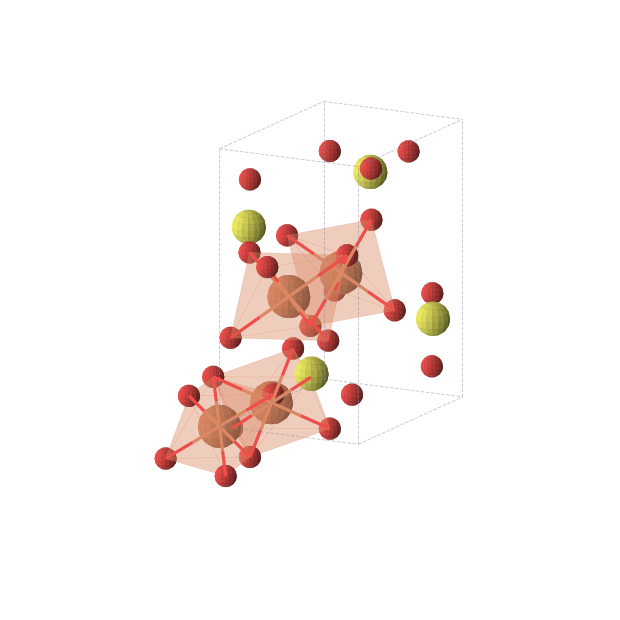
About Iron(II) sulfate
What is FeSO4 and what structure family does it belong to?
FeSO4 is iron(II) sulfate, built from divalent iron (Fe2+) cations and tetrahedral sulfate (SO4 2-) anions. The common anhydrous form, α-FeSO4, has the orthorhombic CrVO4-type structure: chains of edge-sharing FeO6 octahedra linked by SO4 tetrahedra. A high-temperature polymorph, β-FeSO4, has also been made. The compound is best known in its hydrated forms. The heptahydrate is called green vitriol or copperas and occurs as the mineral melanterite. The monohydrate occurs as szomolnokite and the tetrahydrate as rozenite. In all these phases iron is octahedrally coordinated by oxygen, which comes from sulfate groups, water molecules, or both.
What is FeSO4 used for?
Iron(II) sulfate is used widely in industry and agriculture. In farming it serves as a soil amendment and foliar spray to treat iron chlorosis. It is also a dietary iron supplement and an animal-feed additive. In water and wastewater treatment it acts as a coagulant/flocculant and helps remove phosphate. It is used to reduce chromate in cement and serves as a precursor for iron oxide pigments and other iron compounds. Historically, it was a key ingredient in iron gall inks.
How stable and synthesizable is FeSO4?
Calculated phase diagrams place anhydrous FeSO4 on the thermodynamic convex hull, meaning it is stable against decomposition into competing phases. Iron(II) sulfate has been made for centuries. The hydrates crystallize from solutions of iron in dilute sulfuric acid, and the compound is also a large-scale by-product of steel pickling and of the sulfate process for titanium dioxide. Anhydrous FeSO4 is made by heating the hydrates to drive off water. Fe2+ must be protected from atmospheric oxidation during these steps, especially in moist conditions.
What is the electronic and magnetic character of FeSO4?
Anhydrous FeSO4 is an electrical insulator. It contains high-spin Fe2+ (3d6) ions, and its band gap separates filled Fe 3d/O 2p states from empty Fe 3d states. Semilocal DFT predicts a moderate gap but is known to underestimate gaps in open-shell transition-metal compounds like this one, so the real gap is probably larger. At low temperature both α- and β-FeSO4 order antiferromagnetically; neutron diffraction has determined their magnetic structures. Because the bulk conducts so poorly, FeSO4 is not used as an electronic conductor.
How does FeSO4 compare with related sulfates?
α-FeSO4 has the same structure as the anhydrous sulfates of divalent cobalt and nickel (CoSO4, NiSO4), all of the CrVO4 type, and their antiferromagnetic structures have been studied together. FeSO4 differs from iron(III) sulfate, Fe2(SO4)3, which contains ferric iron and has a different composition and crystal structures. In air and moisture, ferrous sulfate gradually oxidizes toward ferric species.
Key Properties
Cross-validated computational properties for Iron(II) sulfate, aggregated across 3 databases.
Band GapEnergy needed to move an electron from the valence band to the conduction band. Lower or zero values tend to behave more metallic; larger gaps are more insulating or semiconducting.
Energy Above HullThermodynamic distance from the most stable set of competing phases. 0 eV/atom is on the convex hull; small positive values may still be experimentally accessible.
StabilityA plain-language summary of the best reported energy-above-hull result. It reflects whether the lowest-energy structure is on, near, or far from the stability hull.
StructuresCount of reported calculated crystal structures for this formula, including alternate polymorphs, source databases, and observed space groups.
Cross-Source DFT Agreement
How well independent DFT databases agree on the thermodynamics of FeSO4. Tight agreement means computed properties can be trusted without re-running calculations.
Agreement ScoreA normalized confidence score summarizing how closely independent DFT databases agree. Higher scores mean tighter cross-source agreement.
Hull SpreadDifference between the highest and lowest energy-above-hull values reported by comparable sources. Smaller spread means less thermodynamic disagreement.
Sources ComparedNumber and names of computational sources with comparable entries for this formula.
Space Group ConsensusWhether independent sources predict the same crystal symmetry for the lowest-energy structure.
Reported Structures
Lowest-energy structures reported for FeSO4, ranked by energy above hull.
| Space GroupSymmetry classification of the crystal arrangement. The number is the international space-group index. | Crystal SystemBroad lattice family, such as cubic, tetragonal, monoclinic, or triclinic, derived from unit-cell symmetry. | Band Gap (eV)Electronic gap calculated for this specific reported structure, measured in electronvolts. | E above hull (eV/atom)Thermodynamic distance from the convex hull for this structure, normalized per atom. Lower is generally more stable. | E/atom (eV)Computed total energy normalized per atom. Use energy above hull, not this value alone, when comparing stability. | Density (g/cm³)Mass per relaxed crystal volume, reported in grams per cubic centimeter. |
|---|---|---|---|---|---|
| — | — | 3.48 | 0.0000 | -1.777 | — |
| Pnma (No. 62) | orthorhombic | 2.77 | 0.0000 | -7.258 | 3.59 |
| Cmcm (No. 63) | orthorhombic | 0.00 | 0.0000 | -1.286 | — |
| Pnma (No. 62) | orthorhombic | 0.00 | 0.0012 | -1.285 | — |
| Cmcm (No. 63) | orthorhombic | 2.29 | 0.0013 | -7.257 | 3.69 |
| — | — | 3.19 | 0.0058 | -1.772 | — |
| — | — | 0.00 | 0.0327 | -1.745 | — |
| — | — | 3.68 | 0.0345 | -1.743 | — |
| — | — | 3.34 | 0.0766 | -1.701 | — |
| — | — | 3.65 | 0.0988 | -1.679 | — |
| — | — | 0.00 | 0.1147 | -1.663 | — |
| — | — | 0.00 | 0.1955 | -1.582 | — |
Synthesis Routes
Literature-extracted synthesis procedures targeting FeSO4.
Applications
Where Iron(II) sulfate is used.
Frequently Asked Questions
Common questions about Iron(II) sulfate, answered from cross-validated data and the published literature.
What is the common name for FeSO4?
FeSO4 is commonly called iron(II) sulfate or ferrous sulfate. The names green vitriol and copperas refer specifically to the heptahydrate, FeSO4·7H2O.
Is FeSO4 stable in air?
What elements make up FeSO4?
Does FeSO4 conduct electricity?
How is FeSO4 typically synthesized?
What is FeSO4?
What is FeSO4 used for?
What is the band gap of FeSO4?
Is FeSO4 a metal, semiconductor, or insulator?
Is FeSO4 thermodynamically stable?
What is the crystal structure of FeSO4?
What is the density of FeSO4?
How many polymorphs of FeSO4 are known?
How is FeSO4 synthesized?
What elements does FeSO4 contain?
Where does the data for FeSO4 come from?
Related Compounds
Other Oxide Oxygen-Evolution Catalysts in the database.
Data sources & attribution
- oqmd — Data from the OQMD (oqmd.org). Cite: Saal et al., JOM 65, 1501 (2013); Kirklin et al., npj Comp. Mater. 1, 15010 (2015). (CC-BY-4.0)
- materials_project — Data from the Materials Project (materialsproject.org). Cite: Jain et al., APL Materials 1, 011002 (2013). (CC-BY-4.0)
- jarvis — Data from JARVIS (jarvis.nist.gov), NIST. Cite: Choudhary et al., npj Comp. Mater. 6, 173 (2020). (LicenseRef-US-Gov-PD)
- cod — Data from the Crystallography Open Database (crystallography.net/cod/). Cite: Grazulis et al., J. Appl. Cryst. 42, 726 (2009). (CC0-1.0)
- mpaloe — Data from MP-ALOE. Cite: Kuner et al., npj Comput. Mater. (2025), doi:10.1038/s41524-025-01834-9.
Analyze FeSO4 in the Lattice Graph platform
Polymorph comparison, confidence scoring, supply-chain risk, and patent monitoring — across 85 source databases.
Explore the Platform →