FeS2
Pyrite · iron disulfide, iron pyrite, fool's gold
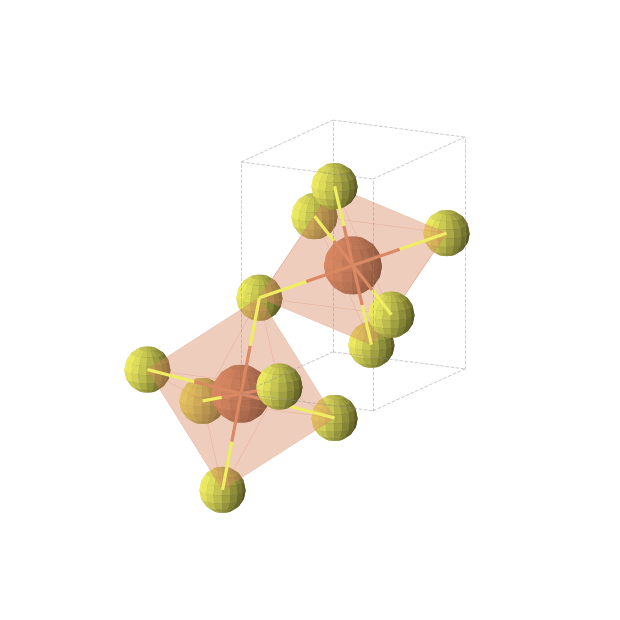
FeS2 is iron disulfide. In nature it is best known as the mineral pyrite, or "fool's gold". Pyrite is a thermodynamically stable semiconductor with a cubic crystal structure. Each iron(II) ion sits inside an octahedron of sulfur atoms, and the sulfur atoms are paired into covalently bonded disulfide (S2) units.
About Pyrite
What is FeS2 and what structure does it adopt?
FeS2 is iron disulfide, an inorganic compound of iron and sulfur. Its stable and most common form is pyrite, which has a cubic structure (space group Pa-3). Each iron atom is surrounded by an octahedron of sulfur atoms, and the sulfur atoms are paired into covalently bonded disulfide (persulfide, S2) units. FeS2 also occurs naturally in a second form, marcasite, which has an orthorhombic structure (space group Pnnm). Both forms are built from FeS6 octahedra, but they are linked differently: by corners only in pyrite, and by edges into chains in marcasite. This gives the two forms different structures and properties.
What is FeS2 used for?
Pyrite was historically roasted as a source of sulfur dioxide for making sulfuric acid. Today FeS2 is the cathode material in commercial lithium–iron disulfide primary (non-rechargeable) batteries and in thermal batteries. It is also being researched as a cathode for rechargeable lithium and sodium batteries. Because it absorbs light very strongly and is made of abundant elements, pyrite has long been studied as a light absorber for thin-film solar cells. It has also been used as a catalytic counter electrode (a platinum replacement) in dye-sensitized solar cells, and as an electrocatalyst, for example for hydrogen evolution.
How stable and synthesizable is FeS2?
Cubic pyrite is the thermodynamically stable form of FeS2 under ambient conditions. It lies on the convex hull of the iron–sulfur system. It can be made by several routes, including sulfidation of iron precursors, chemical vapor transport (which gives single crystals), and hydrothermal reactions in aqueous solution. In hydrothermal synthesis, solution acidity affects which form crystallizes: more acidic conditions favor the metastable marcasite form.
Is FeS2 a metal, semiconductor, or insulator?
Pyrite is a semiconductor with a narrow band gap. The filled valence-band top consists mainly of low-spin iron(II) 3d states, and the empty conduction band is made of iron 3d and sulfur states. This band structure makes pyrite absorb light very strongly. In practice, however, its electronic behavior depends heavily on defects and impurities. Sulfur deficiency, surface states and secondary phases can create states inside the band gap and lower the photovoltage of pyrite solar cells. This is a major reason pyrite photovoltaics have not met expectations.
How does FeS2 compare to other iron sulfides?
FeS2 is the most sulfur-rich common phase in the iron–sulfur system, and the only one in which the sulfur atoms are paired into disulfide units. In iron-rich sulfides such as troilite (FeS) and pyrrhotite (Fe1-xS), iron is bonded to isolated sulfide ions instead. Pyrrhotite is magnetic, while pyrite is not. Compared with its orthorhombic polymorph marcasite, pyrite is the thermodynamically stable phase. Marcasite is metastable and converts irreversibly to pyrite when heated.
Key Properties
Cross-validated computational properties for Pyrite, aggregated across 5 databases.
Band GapEnergy needed to move an electron from the valence band to the conduction band. Lower or zero values tend to behave more metallic; larger gaps are more insulating or semiconducting.
Energy Above HullThermodynamic distance from the most stable set of competing phases. 0 eV/atom is on the convex hull; small positive values may still be experimentally accessible.
StabilityA plain-language summary of the best reported energy-above-hull result. It reflects whether the lowest-energy structure is on, near, or far from the stability hull.
StructuresCount of reported calculated crystal structures for this formula, including alternate polymorphs, source databases, and observed space groups.
Cross-Source DFT Agreement
How well independent DFT databases agree on the thermodynamics of FeS2. Tight agreement means computed properties can be trusted without re-running calculations.
Agreement ScoreA normalized confidence score summarizing how closely independent DFT databases agree. Higher scores mean tighter cross-source agreement.
Hull SpreadDifference between the highest and lowest energy-above-hull values reported by comparable sources. Smaller spread means less thermodynamic disagreement.
Sources ComparedNumber and names of computational sources with comparable entries for this formula.
Space Group ConsensusWhether independent sources predict the same crystal symmetry for the lowest-energy structure.
Reported Structures
Lowest-energy structures reported for FeS2, ranked by energy above hull.
| Space GroupSymmetry classification of the crystal arrangement. The number is the international space-group index. | Crystal SystemBroad lattice family, such as cubic, tetragonal, monoclinic, or triclinic, derived from unit-cell symmetry. | Band Gap (eV)Electronic gap calculated for this specific reported structure, measured in electronvolts. | E above hull (eV/atom)Thermodynamic distance from the convex hull for this structure, normalized per atom. Lower is generally more stable. | E/atom (eV)Computed total energy normalized per atom. Use energy above hull, not this value alone, when comparing stability. | Density (g/cm³)Mass per relaxed crystal volume, reported in grams per cubic centimeter. |
|---|---|---|---|---|---|
| — | — | 0.90 | 0.0000 | -0.702 | — |
| Pnnm (No. 58) | orthorhombic | 0.88 | 0.0000 | -6.429 | 4.94 |
| Pnnm (No. 58) | orthorhombic | 0.87 | 0.0000 | -0.635 | — |
| — | — | 1.00 | 0.0001 | -0.702 | — |
| — | — | 0.50 | 0.0071 | -0.694 | — |
| — | — | 0.50 | 0.0071 | -0.694 | — |
| — | — | 0.50 | 0.0071 | -0.694 | — |
| Pa-3 (No. 205) | cubic | 0.43 | 0.0080 | -0.627 | — |
| Pa-3 (No. 205) | cubic | 0.46 | 0.0101 | -6.419 | 5.07 |
| R-3m (No. 166) | trigonal | 0.00 | 0.2047 | -6.224 | 3.11 |
| — | — | 0.00 | 0.2107 | -0.491 | — |
| — | — | 0.00 | 0.2110 | -0.491 | — |
Applications
Where Pyrite is used.
Patent Landscape
7 patents reference FeS2 or close compositional variants.
| Patent | Title | Assignee | Granted |
|---|---|---|---|
| 7510808 | Low temperature Li/FeS2 battery | — | — |
| 4731307 | Methods for achieving the equilibrium number of phases in mixtures suitable for use in battery electrodes, e.g | — | — |
| 10457566 | Low-dimensional hyperthin FeS2 nanostructures for electrocatalysis | — | — |
| 5432030 | Li/FeS.sub.2 cell employing a solvent mixture of diox, DME and 3ME20X with a lithium-based solute | — | — |
| 4761487 | Method for improving voltage regulation of batteries, particularly Li/FeS.sub.2 thermal batteries | — | — |
| 9862617 | Method to synthesize colloidal iron pyrite (FeS2) nanocrystals and fabricate iron pyrite thin film solar cells | — | — |
| 8460403 | Method of storing iron disulfide (FeS2) particles | — | — |
Frequently Asked Questions
Common questions about Pyrite, answered from cross-validated data and the published literature.
Why is pyrite called fool's gold?
Pyrite is pale brass-yellow with a metallic shine that looks like gold, so prospectors sometimes mistook it for the precious metal.
Does FeS2 contain gold?
Is FeS2 magnetic?
Is FeS2 toxic?
What polymorphs exist for FeS2?
What is FeS2?
What is FeS2 used for?
What is the band gap of FeS2?
Is FeS2 a metal, semiconductor, or insulator?
Is FeS2 thermodynamically stable?
What is the crystal structure of FeS2?
How many polymorphs of FeS2 are known?
What elements does FeS2 contain?
Where does the data for FeS2 come from?
Data sources & attribution
- oqmd — Data from the OQMD (oqmd.org). Cite: Saal et al., JOM 65, 1501 (2013); Kirklin et al., npj Comp. Mater. 1, 15010 (2015). (CC-BY-4.0)
- materials_project — Data from the Materials Project (materialsproject.org). Cite: Jain et al., APL Materials 1, 011002 (2013). (CC-BY-4.0)
- jarvis — Data from JARVIS (jarvis.nist.gov), NIST. Cite: Choudhary et al., npj Comp. Mater. 6, 173 (2020). (LicenseRef-US-Gov-PD)
Analyze FeS2 in the Lattice Graph platform
Polymorph comparison, confidence scoring, supply-chain risk, and patent monitoring — across 85 source databases.
Explore the Platform →