CaF2
fluorite · calcium fluoride, fluorspar, calcium difluoride
CaF2 is calcium fluoride, an ionic crystalline compound commonly known by its mineral name fluorite. Its cubic arrangement of calcium and fluorine atoms defines the archetype fluorite structure. It is a thermodynamically stable, wide-band-gap insulator known for optical transparency from the deep ultraviolet to the infrared.
About fluorite
What is CaF2 and what structure does it adopt?
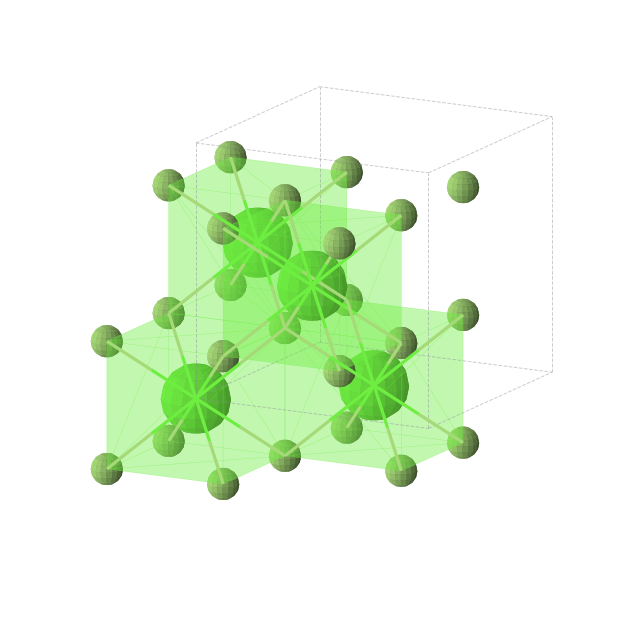
CaF2 is calcium fluoride, an ionic compound of calcium cations and fluoride anions. It occurs naturally as the mineral fluorite, also called fluorspar. Its crystal structure gives its name to the wider fluorite structure family. The calcium cations form a face-centered cubic lattice, and fluoride anions fill all the tetrahedral interstitial sites. This gives each calcium eightfold cubic coordination and each fluoride tetrahedral coordination. In the inverted arrangement, the anion and cation positions are swapped. That arrangement is the antifluorite structure, found in compounds such as lithium oxide and lithium sulfide.
What is CaF2 used for?
Calcium fluoride is widely used in precision optics. It transmits light from the vacuum and deep ultraviolet into the infrared, and it has a low refractive index and low chromatic dispersion. High-purity single crystals are made into windows, lenses, and prisms for excimer laser systems, deep-ultraviolet microlithography, and infrared spectrometers. In industry, natural fluorspar is used as a flux in metal smelting and steelmaking. It is also the main raw material for making hydrofluoric acid.
How stable and synthesizable is CaF2?
CaF2 is thermodynamically stable at ambient conditions, which fits with how common it is as a natural mineral. Synthetic calcium fluoride can be made by precipitation, mixing aqueous calcium salts with soluble fluorides. Crystals can also be grown by gel methods such as diffusion in silica gel. Bulk optical-grade single crystals are grown from the melt, for example by the Bridgman technique under controlled atmospheres.
What is the electronic character of CaF2 and what does it imply?
CaF2 is a wide-band-gap insulator. Its bonding is strongly ionic, so valence electrons stay tightly bound to the fluoride anions. As a result, its intrinsic electronic conductivity is negligible at ambient conditions. The very large band gap means the crystal does not absorb in the visible, the near infrared, or much of the ultraviolet. This is the source of its excellent optical clarity.
How does CaF2 compare to other compounds in its class?
CaF2 is the crystallographic prototype for the cubic fluorite structure. The same structure is adopted by the alkaline-earth fluorides SrF2 and BaF2, and by tetravalent metal oxides such as stabilized zirconia and ceria. Compared with strontium fluoride and barium fluoride, calcium fluoride has a smaller lattice parameter and lighter ions. It offers excellent short-wavelength ultraviolet transmission and good mechanical robustness. The heavier fluorides tend to transmit further into the infrared.
Key Properties
Cross-validated computational properties for fluorite, aggregated across 6 databases.
Band GapEnergy needed to move an electron from the valence band to the conduction band. Lower or zero values tend to behave more metallic; larger gaps are more insulating or semiconducting.
Energy Above HullThermodynamic distance from the most stable set of competing phases. 0 eV/atom is on the convex hull; small positive values may still be experimentally accessible.
StabilityA plain-language summary of the best reported energy-above-hull result. It reflects whether the lowest-energy structure is on, near, or far from the stability hull.
StructuresCount of reported calculated crystal structures for this formula, including alternate polymorphs, source databases, and observed space groups.
Cross-Source DFT Agreement
How well independent DFT databases agree on the thermodynamics of CaF2. Tight agreement means computed properties can be trusted without re-running calculations.
Agreement ScoreA normalized confidence score summarizing how closely independent DFT databases agree. Higher scores mean tighter cross-source agreement.
Hull SpreadDifference between the highest and lowest energy-above-hull values reported by comparable sources. Smaller spread means less thermodynamic disagreement.
Sources ComparedNumber and names of computational sources with comparable entries for this formula.
Space Group ConsensusWhether independent sources predict the same crystal symmetry for the lowest-energy structure.
Reported Structures
Lowest-energy structures reported for CaF2, ranked by energy above hull.
| Space GroupSymmetry classification of the crystal arrangement. The number is the international space-group index. | Crystal SystemBroad lattice family, such as cubic, tetragonal, monoclinic, or triclinic, derived from unit-cell symmetry. | Band Gap (eV)Electronic gap calculated for this specific reported structure, measured in electronvolts. | E above hull (eV/atom)Thermodynamic distance from the convex hull for this structure, normalized per atom. Lower is generally more stable. | E/atom (eV)Computed total energy normalized per atom. Use energy above hull, not this value alone, when comparing stability. | Density (g/cm³)Mass per relaxed crystal volume, reported in grams per cubic centimeter. |
|---|---|---|---|---|---|
| — | — | 7.80 | 0.0000 | -4.219 | — |
| Fm-3m (No. 225) | cubic | 7.59 | 0.0000 | -4.171 | — |
| Fm-3m (No. 225) | cubic | 7.12 | 0.0000 | -6.167 | 3.09 |
| — | — | 7.60 | 0.0027 | -4.217 | — |
| — | — | 7.86 | 0.0170 | -4.202 | — |
| Pnma (No. 62) | orthorhombic | 7.99 | 0.0294 | -4.142 | — |
| — | — | 8.03 | 0.0312 | -4.188 | — |
| Pnma (No. 62) | orthorhombic | 7.47 | 0.0346 | -6.132 | 3.51 |
| — | — | 7.21 | 0.0489 | -4.171 | — |
| — | — | 7.22 | 0.0495 | -4.170 | — |
| — | — | 7.93 | 0.0499 | -4.169 | — |
| — | — | 8.32 | 0.0636 | -4.156 | — |
Synthesis Routes
Literature-extracted synthesis procedures targeting CaF2.
Applications
Where fluorite is used.
Patent Landscape
12 patents reference CaF2 or close compositional variants.
| Patent | Title | Assignee | Granted |
|---|---|---|---|
| 7534412 | Large-volume CaF2 single crystals with reduced scattering and improved laser stability, and uses thereof | — | — |
| 9586867 | CaF2 translucent ceramics and manufacturing method of CaF2 translucent ceramics | — | — |
| 7393409 | Method for making large-volume CaF2 single cystals with reduced scattering and improved laser stability, the c | — | — |
| 5545247 | Particulate CaF.sub.2 and BaF.sub.2 agent for improving the machinability of sintered iron-based powder | — | — |
| 4185139 | Filler for a glass-ceramic material comprising CaF.sub.2 granules overcoated with a silicon dioxide film | — | — |
| 5631431 | Particulate CaF.sub.2 agent for improving the machinability of sintered iron-based powder | — | — |
| 5026575 | Growth of polycrystalline CaF.sub.2 via low temperature OMCVD | — | — |
| 10074523 | Polycrystalline CaF2 member, member for plasma treatment device, plasma treatment device, and method for produ | — | — |
| 4965244 | CaF.sub.2 passivation layers for high temperature superconductors | — | — |
| 9789335 | MgF2—CaF2 binary system sintered body for radiation moderator and method for producing the same | — | — |
Frequently Asked Questions
Common questions about fluorite, answered from cross-validated data and the published literature.
Is CaF2 the same thing as fluorite?
Yes. Fluorite is the naturally occurring mineral form of calcium fluoride. Fluorspar is the usual industrial term in mining and bulk trade.
Is CaF2 soluble in water?
Why is CaF2 widely used in ultraviolet lithography?
Does CaF2 conduct electricity?
What is the antifluorite structure?
What is CaF2?
What is CaF2 used for?
What is the band gap of CaF2?
Is CaF2 a metal, semiconductor, or insulator?
Is CaF2 thermodynamically stable?
What is the crystal structure of CaF2?
How many polymorphs of CaF2 are known?
How is CaF2 synthesized?
What elements does CaF2 contain?
Where does the data for CaF2 come from?
Data sources & attribution
- oqmd — Data from the OQMD (oqmd.org). Cite: Saal et al., JOM 65, 1501 (2013); Kirklin et al., npj Comp. Mater. 1, 15010 (2015). (CC-BY-4.0)
- jarvis — Data from JARVIS (jarvis.nist.gov), NIST. Cite: Choudhary et al., npj Comp. Mater. 6, 173 (2020). (LicenseRef-US-Gov-PD)
- materials_project — Data from the Materials Project (materialsproject.org). Cite: Jain et al., APL Materials 1, 011002 (2013). (CC-BY-4.0)
Analyze CaF2 in the Lattice Graph platform
Polymorph comparison, confidence scoring, supply-chain risk, and patent monitoring — across 85 source databases.
Explore the Platform →