Ba10Br4O18Ru4
Ba10Br4O18Ru4 is a thermodynamically stable, semiconducting quaternary inorganic compound composed of barium, bromine, oxygen, and ruthenium.
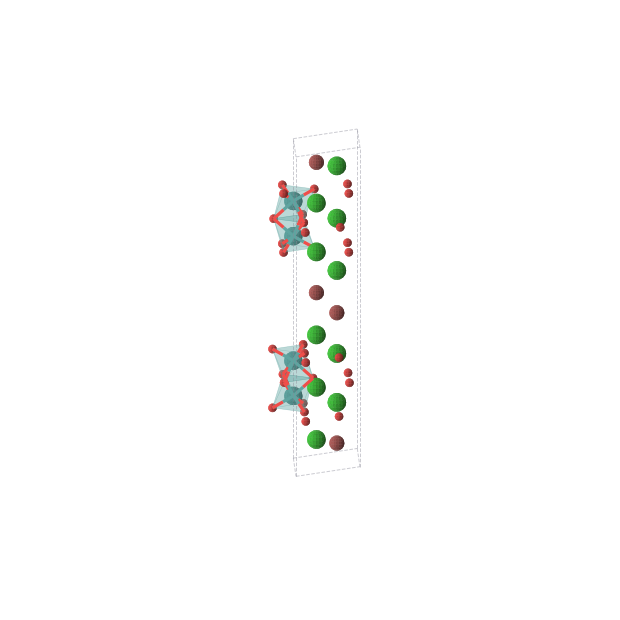
About Ba10Br4O18Ru4
Ba10Br4O18Ru4 is a complex quaternary inorganic compound characterized by its semiconducting electronic nature. Its position on the convex hull indicates that it is a thermodynamically stable phase, making it a significant subject for structural analysis and materials characterization.
As a material with multiple reported structures, it serves as a key example of how heavy alkaline earth metals and transition metal oxides can integrate with halides to form stable, ordered crystalline frameworks. Its specific composition allows for unique electronic environments that are of interest for fundamental solid-state chemistry studies.
Key Properties
Cross-validated computational properties for Ba10Br4O18Ru4, aggregated across 3 databases.
Band GapEnergy needed to move an electron from the valence band to the conduction band. Lower or zero values tend to behave more metallic; larger gaps are more insulating or semiconducting.
Energy Above HullThermodynamic distance from the most stable set of competing phases. 0 eV/atom is on the convex hull; small positive values may still be experimentally accessible.
StabilityA plain-language summary of the best reported energy-above-hull result. It reflects whether the lowest-energy structure is on, near, or far from the stability hull.
StructuresCount of reported calculated crystal structures for this formula, including alternate polymorphs, source databases, and observed space groups.
Applications
Where Ba10Br4O18Ru4 is used.
Frequently Asked Questions
Common questions about Ba10Br4O18Ru4, answered from cross-validated data.
What is Ba10Br4O18Ru4?
Ba10Br4O18Ru4 is a thermodynamically stable, semiconducting quaternary inorganic compound composed of barium, bromine, oxygen, and ruthenium.
What is Ba10Br4O18Ru4 used for?
What is the band gap of Ba10Br4O18Ru4?
Is Ba10Br4O18Ru4 a metal, semiconductor, or insulator?
Is Ba10Br4O18Ru4 thermodynamically stable?
How many polymorphs of Ba10Br4O18Ru4 are known?
What elements does Ba10Br4O18Ru4 contain?
Where does the data for Ba10Br4O18Ru4 come from?
How It Compares
As a unique quaternary phase, Ba10Br4O18Ru4 represents a distinct structural arrangement within the broader landscape of complex barium-ruthenium-based oxides and halides. It stands out for its inherent thermodynamic stability, which provides a reliable baseline for investigating the interplay between its semiconducting properties and its complex anionic framework.
Data sources & attribution
- latticegraph — Lattice Graph Materials Intelligence Platform
Analyze Ba10Br4O18Ru4 in the Lattice Graph platform
Polymorph comparison, confidence scoring, supply-chain risk, and patent monitoring — across 53 integrated data sources.
Explore the Platform →