Al2SiO5
Aluminium silicate · aluminum silicate
Al2SiO5 is aluminium silicate, an inorganic compound of aluminium, silicon and oxygen. It has three classic mineral polymorphs: kyanite, andalusite and sillimanite. Each one is the stable form in its own range of pressure and temperature. It is a wide-band-gap electrical insulator.
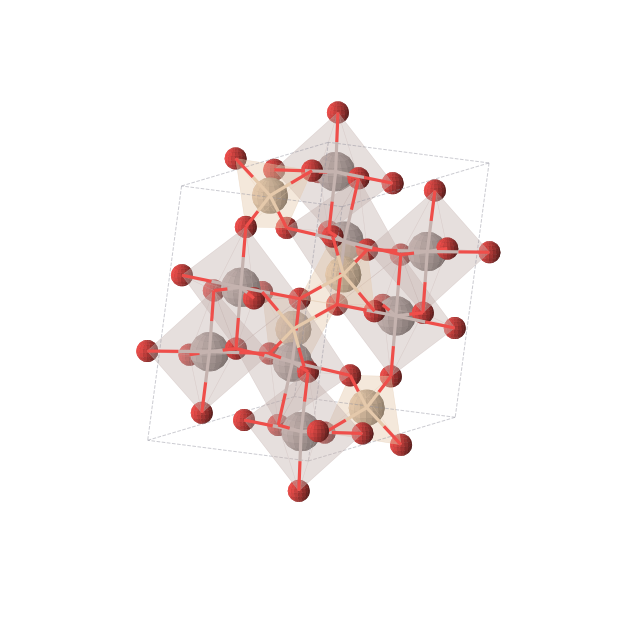
About Aluminium silicate
What is Al2SiO5 and what structure family does it belong to?
Al2SiO5 is an orthosilicate (nesosilicate): its SiO4 tetrahedra are isolated from one another. It is not a framework aluminosilicate. It has three forms (it is trimorphous): sillimanite (orthorhombic), andalusite (orthorhombic) and kyanite (triclinic). All three contain chains of edge-sharing AlO6 octahedra running parallel to the crystallographic c-axis, linked by isolated SiO4 tetrahedra. They differ in how the second aluminium atom is coordinated: fourfold in sillimanite, fivefold in andalusite and sixfold in kyanite.
What is Al2SiO5 used for?
Most of the kyanite, andalusite and sillimanite that is mined goes into refractories, such as furnace and kiln linings, bricks, mortars and kiln furniture. When fired at high temperature they turn into mullite and silica. Mullite gives strength at high temperature and resistance to thermal shock. Kyanite also goes into porcelain products, including spark-plug insulators. In geology, kyanite, andalusite and sillimanite are classic index minerals. The boundaries between their stability fields are used to estimate the pressures and temperatures at which metamorphic rocks formed.
How stable and synthesizable is Al2SiO5?
Al2SiO5 is a thermodynamically stable composition. However, no single polymorph is stable under all conditions. Kyanite, the densest form, is stable at high pressure. Sillimanite is stable at high temperature. Andalusite is stable at relatively low pressure. The three stability fields meet at a triple point. The free-energy differences between the polymorphs are small and the transformations between them are sluggish. As a result, polymorphs often survive metastably outside their own stability fields. Laboratory studies of the phase boundaries have mostly used high-pressure, high-temperature experiments, often in the presence of water, with natural or synthetic crystals as starting materials. Most of the material used in industry is mined from natural deposits.
What is the electronic character of Al2SiO5 and what does it imply?
Al2SiO5 is a wide-band-gap electrical insulator. Its filled valence band comes mainly from oxygen 2p states, and its conduction band is empty. The band gap is large, so electrons do not conduct under ordinary conditions. Pure Al2SiO5 has no partly filled d or f shells, so it should not absorb visible light. The colours seen in natural crystals, such as the blue of many kyanites, come from impurities.
How does Al2SiO5 compare to other aluminosilicates in its class?
Al2SiO5 contains no alkali or alkaline-earth cations, unlike framework aluminosilicates and zeolites. In albite (NaAlSi3O8), kalsilite (KAlSiO4) and eucryptite (LiAlSiO4), tetrahedra link into continuous three-dimensional frameworks, and alkali ions balance the charge left by aluminium substituting for silicon. Gehlenite (Ca2Al2SiO7) is a melilite-group sorosilicate with paired tetrahedra and calcium between them. Cordierite (Mg2Al4Si5O18) is a ring-based aluminosilicate known for its low thermal expansion. Al2SiO5, by contrast, is a compact structure with isolated silicate tetrahedra, no extra cations, and aluminium in more than one coordination.
Key Properties
Cross-validated computational properties for Aluminium silicate, aggregated across 3 databases.
Band GapEnergy needed to move an electron from the valence band to the conduction band. Lower or zero values tend to behave more metallic; larger gaps are more insulating or semiconducting.
Energy Above HullThermodynamic distance from the most stable set of competing phases. 0 eV/atom is on the convex hull; small positive values may still be experimentally accessible.
StabilityA plain-language summary of the best reported energy-above-hull result. It reflects whether the lowest-energy structure is on, near, or far from the stability hull.
StructuresCount of reported calculated crystal structures for this formula, including alternate polymorphs, source databases, and observed space groups.
Cross-Source DFT Agreement
How well independent DFT databases agree on the thermodynamics of Al2SiO5. Tight agreement means computed properties can be trusted without re-running calculations.
Agreement ScoreA normalized confidence score summarizing how closely independent DFT databases agree. Higher scores mean tighter cross-source agreement.
Hull SpreadDifference between the highest and lowest energy-above-hull values reported by comparable sources. Smaller spread means less thermodynamic disagreement.
Sources ComparedNumber and names of computational sources with comparable entries for this formula.
Space Group ConsensusWhether independent sources predict the same crystal symmetry for the lowest-energy structure.
Reported Structures
Lowest-energy structures reported for Al2SiO5, ranked by energy above hull.
| Space GroupSymmetry classification of the crystal arrangement. The number is the international space-group index. | Crystal SystemBroad lattice family, such as cubic, tetragonal, monoclinic, or triclinic, derived from unit-cell symmetry. | Band Gap (eV)Electronic gap calculated for this specific reported structure, measured in electronvolts. | E above hull (eV/atom)Thermodynamic distance from the convex hull for this structure, normalized per atom. Lower is generally more stable. | E/atom (eV)Computed total energy normalized per atom. Use energy above hull, not this value alone, when comparing stability. | Density (g/cm³)Mass per relaxed crystal volume, reported in grams per cubic centimeter. |
|---|---|---|---|---|---|
| P-1 (No. 2) | triclinic | 5.92 | 0.0000 | -3.170 | — |
| P-1 (No. 2) | triclinic | 5.45 | 0.0000 | -8.084 | 3.68 |
| — | — | 5.05 | 0.0000 | -3.204 | — |
| Pnnm (No. 58) | orthorhombic | 4.84 | 0.0020 | -8.082 | 3.16 |
| Pnma (No. 62) | orthorhombic | 4.96 | 0.0047 | -8.079 | 3.25 |
| Pnma (No. 62) | orthorhombic | 5.33 | 0.0064 | -3.164 | — |
| — | — | 5.31 | 0.0076 | -3.196 | — |
| — | — | 5.29 | 0.0094 | -3.194 | — |
| — | — | 5.27 | 0.0102 | -3.193 | — |
| Pnnm (No. 58) | orthorhombic | 4.98 | 0.0104 | -3.160 | — |
| — | — | 5.87 | 0.0199 | -3.184 | — |
| — | — | 6.00 | 0.0214 | -3.182 | — |
Synthesis Routes
Literature-extracted synthesis procedures targeting Al2SiO5.
Applications
Where Aluminium silicate is used.
Frequently Asked Questions
Common questions about Aluminium silicate, answered from cross-validated data and the published literature.
Is Al2SiO5 the same as sillimanite?
Sillimanite is one of three natural polymorphs with the formula Al2SiO5. The other two are kyanite and andalusite.
Does Al2SiO5 conduct electricity?
Is Al2SiO5 naturally occurring?
How do the Al2SiO5 polymorphs differ structurally?
Is Al2SiO5 thermodynamically stable?
What is Al2SiO5?
What is Al2SiO5 used for?
What is the band gap of Al2SiO5?
Is Al2SiO5 a metal, semiconductor, or insulator?
What is the crystal structure of Al2SiO5?
What is the density of Al2SiO5?
How many polymorphs of Al2SiO5 are known?
How is Al2SiO5 synthesized?
What elements does Al2SiO5 contain?
Where does the data for Al2SiO5 come from?
Related Compounds
Other Aluminosilicates and Zeolite Frameworks in the database.
Data sources & attribution
- jarvis — Data from JARVIS (jarvis.nist.gov), NIST. Cite: Choudhary et al., npj Comp. Mater. 6, 173 (2020). (LicenseRef-US-Gov-PD)
- materials_project — Data from the Materials Project (materialsproject.org). Cite: Jain et al., APL Materials 1, 011002 (2013). (CC-BY-4.0)
- oqmd — Data from the OQMD (oqmd.org). Cite: Saal et al., JOM 65, 1501 (2013); Kirklin et al., npj Comp. Mater. 1, 15010 (2015). (CC-BY-4.0)
- cod — Data from the Crystallography Open Database (crystallography.net/cod/). Cite: Grazulis et al., J. Appl. Cryst. 42, 726 (2009). (CC0-1.0)
- mpaloe — Data from MP-ALOE. Cite: Kuner et al., npj Comput. Mater. (2025), doi:10.1038/s41524-025-01834-9.
Analyze Al2SiO5 in the Lattice Graph platform
Polymorph comparison, confidence scoring, supply-chain risk, and patent monitoring — across 85 source databases.
Explore the Platform →